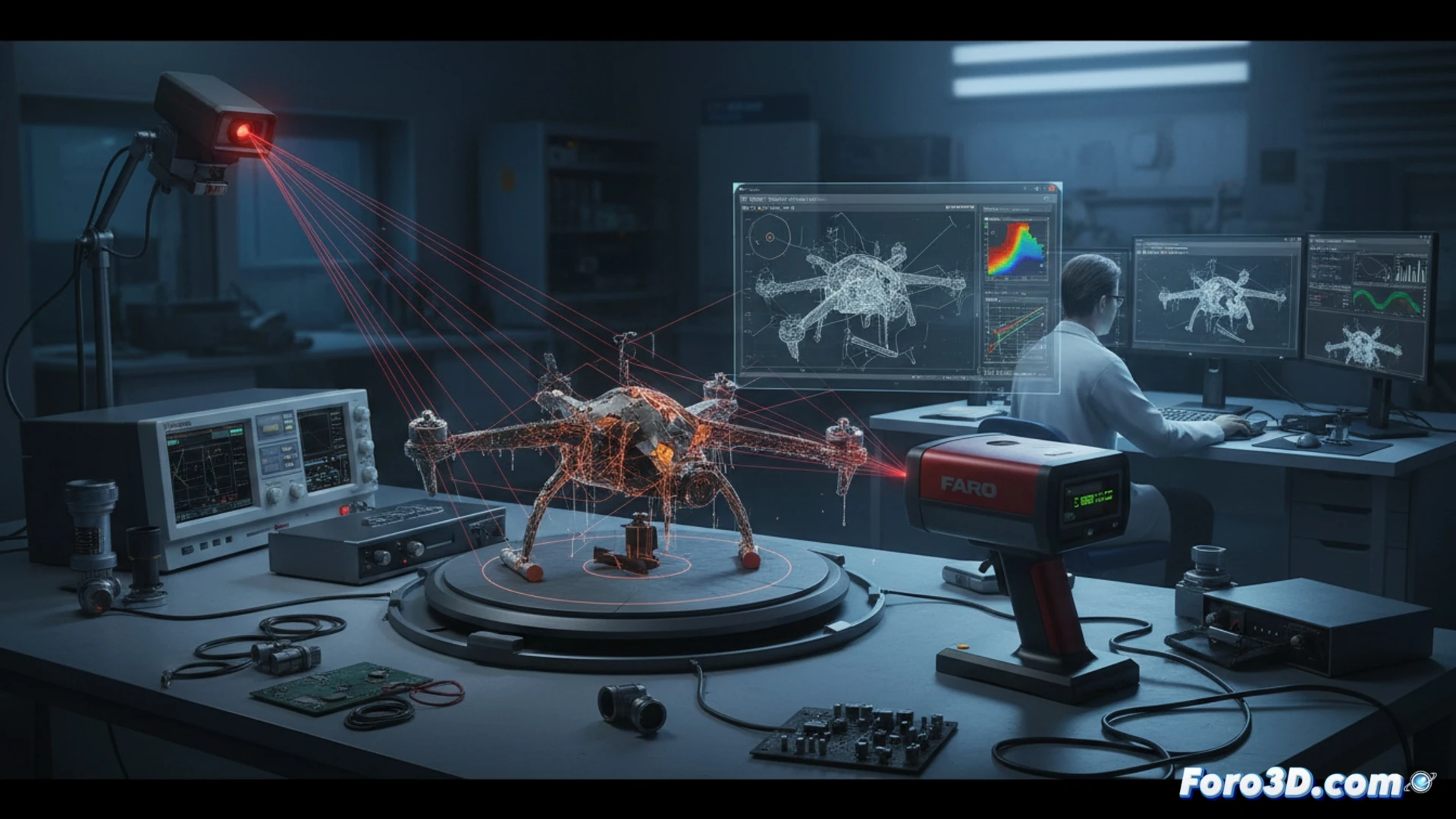
A drone is illegally shot down using a laser weapon. The crime scene includes not only physical debris but also thermal evidence recorded in the material. To determine the laser's power, the attack distance, and the angle of incidence, a forensic workflow integrating 3D scanning, mesh cleaning, and physical simulation is required. Here we break down the complete pipeline, from capture with Faro Scene to validation in COMSOL. 🚁
Capture, cleaning, and thermal simulation 🔥
The process begins with scanning the damaged drone using Faro Scene. This software captures the impact geometry with high precision, recording the morphology of the ablation. The resulting point cloud is exported to MeshMixer to remove noise and repair the topology of the burned surface. Once cleaned, the mesh is imported into Blender, where it is reoriented and prepared for simulation. Finally, COMSOL runs a heat transfer analysis on the real geometry. By adjusting the laser parameters (power, distance, angle) in the model, the observed ablation pattern is replicated, thus obtaining the key forensic data of the attack.
From simulation to legal evidence ⚖️
The precision of this pipeline turns physical damage into quantifiable evidence. By isolating the angle of incidence, the shooter's position relative to the drone can be determined, while power and distance help classify the weapon as illegal or restricted-use. This approach demonstrates that 3D analysis not only reconstructs the scene but establishes technical culpability. For the digital forensic expert, integrating modeling tools with physical simulators is the necessary standard to validate thermal evidence in a court of law.
How residual thermal evidence from a laser attack is integrated into the forensic pipeline to differentiate it from other causes of structural failure in a drone
(PS: In the forensic pipeline, the most important thing is not to mix the evidence with the reference models... or you'll end up with a ghost at the scene.)