The development of Venba, a narrative video game about Tamil cooking and culture, represents a fascinating case study for independent developers. The title stands out not only for its emotional story but also for a precise technical pipeline that merges vector art from Adobe Illustrator with the power of Unity. We analyze how Visai Games managed to make every curry leaf and every dosa shine in real-time, respecting the vibrant aesthetic of South India. 🎮
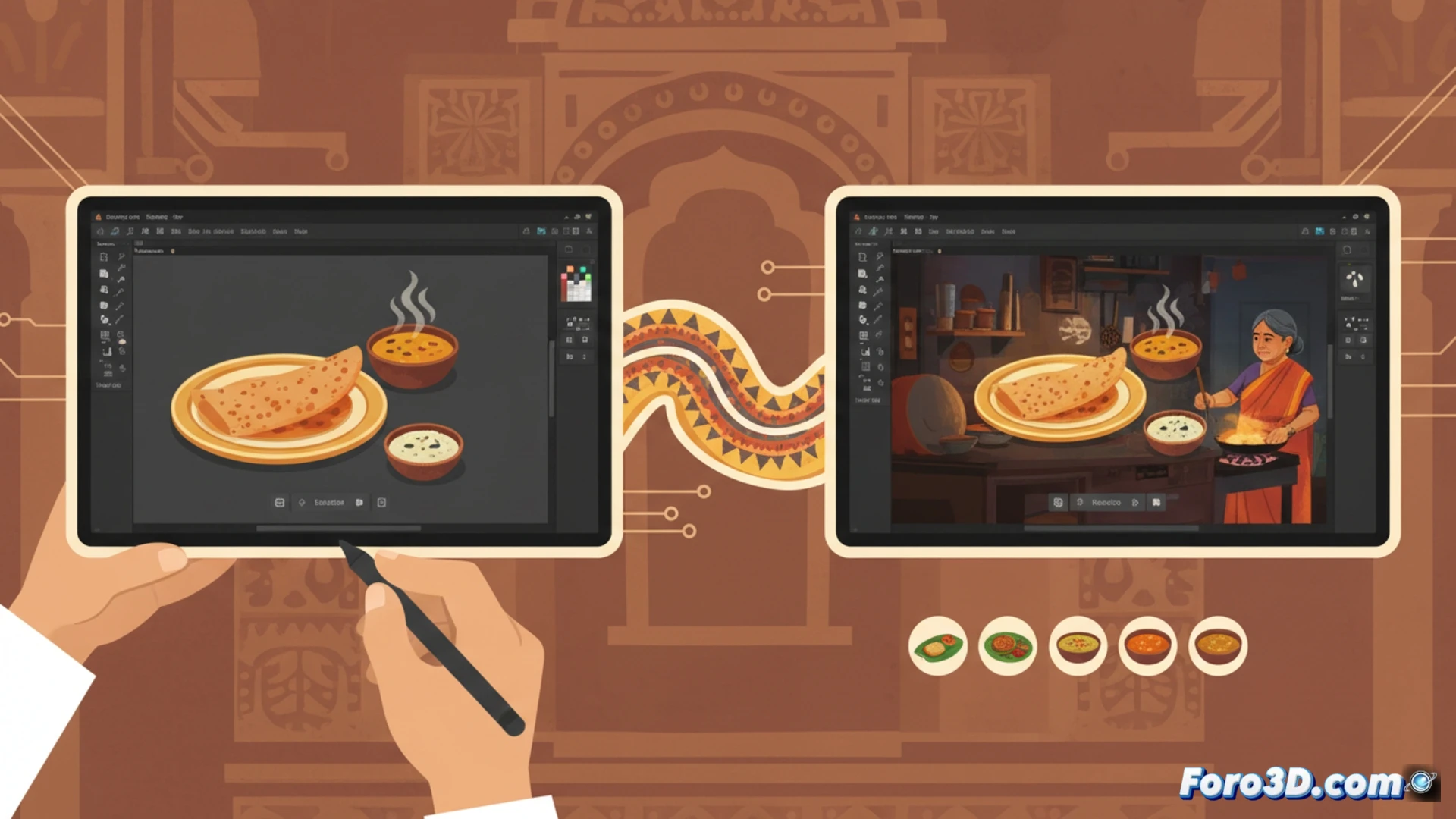
Production Pipeline: Vectorization and Multi-Layer Composition 🍛
The workflow begins in Adobe Illustrator, where artists create stylized 2D vector assets. Each ingredient, utensil, and background is designed with clean geometric shapes and vibrant color palettes, avoiding complex rasterized textures. Subsequently, these vectors are exported as high-resolution PNGs and brought into Adobe Photoshop. In this software, the team composes the kitchen layers: smoke, steam, oil splatters, and oven lights are added as separate layers with specific blending modes (Screen, Multiply, Overlay). Finally, the flat sprites are imported into Unity, where they are organized into a frame-by-frame animation system and optimized using texture atlases to reduce Draw Calls. The key is that the engine's particle effects (such as steam) are synchronized with the 2D character animations to achieve visual cohesion without sacrificing performance on modest hardware.
Lessons for Indie Developers: Aesthetic Cohesion vs. Performance 🔧
The case of Venba demonstrates that a complex 3D engine is not needed to convey a strong cultural identity. The decision to maintain pure 2D art, supported by a pipeline from Illustrator to Photoshop and then to Unity, allowed the team to focus on the frame-by-frame animation of culinary processes. For any indie developer, the lesson is clear: investing time in a coherent color palette and layer separation from the vector design phase saves hours of work during engine integration. Optimization is not at odds with beauty; on the contrary, a good sprite atlas and judicious use of 2D particles can turn a simple kitchen interface into an interactive visual feast.
As an indie developer looking to optimize a 2D pipeline with cultural identity, what specific texturing and animation techniques in Unity were applied in Venba to preserve the authenticity of Tamil illustration without losing performance on consoles?
(PS: 90% of development time is polishing, the other 90% is fixing bugs)