Recovering documents shredded into cross-cut strips is one of the biggest challenges in forensic investigation of industrial espionage. When thousands of paper fragments are recovered, the manual method becomes unfeasible. This article details a technical pipeline that combines high-resolution 3D scanning, computer vision algorithms, and digital modeling to virtually reassemble the original documents, offering a precise and non-destructive solution for the chain of custody.
Digital capture and processing of fragments 🧩
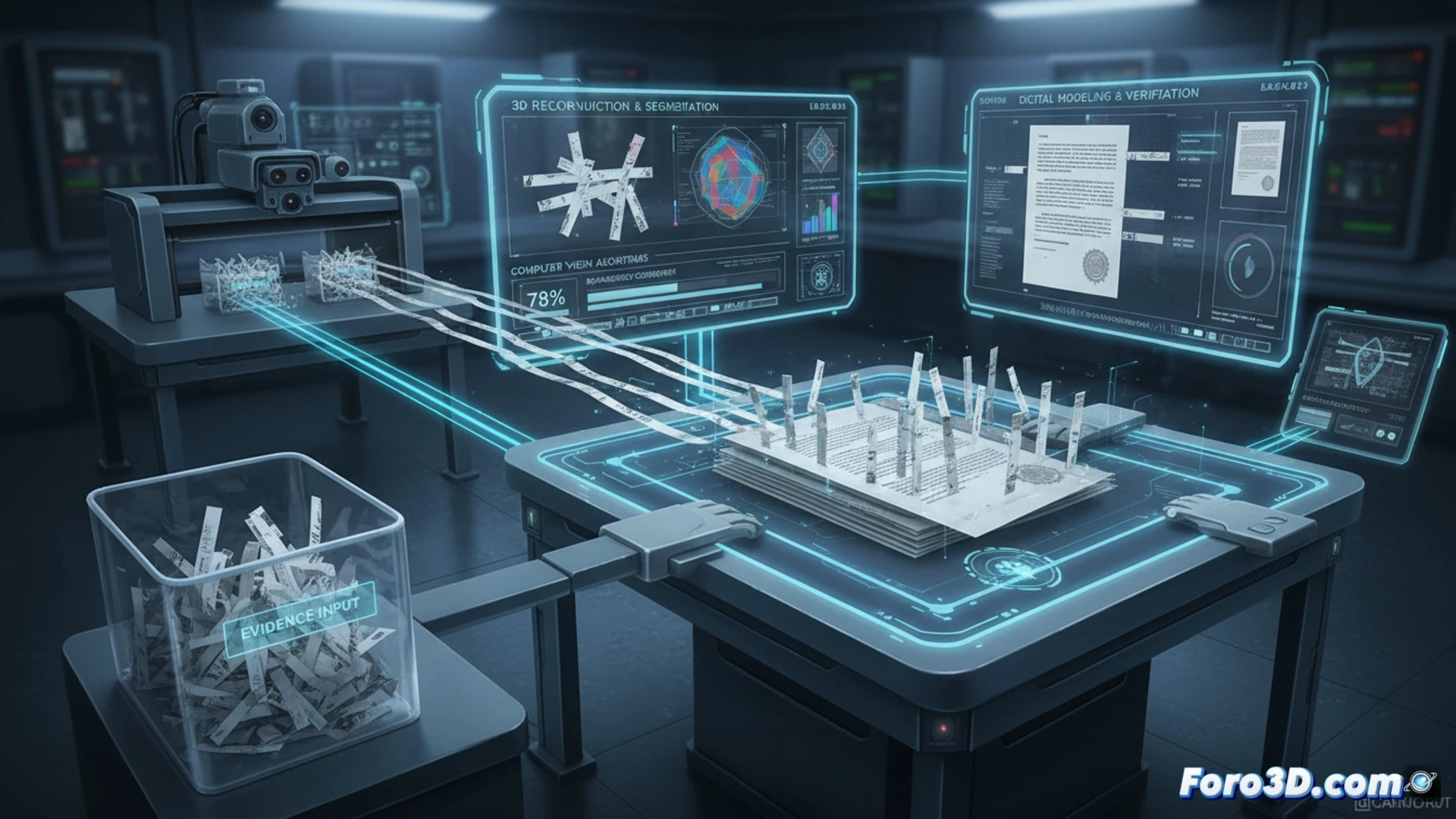
The process begins with the individual digitization of each shredded paper strip. A high-resolution scanner is used that captures not only the color and texture of the surface, but also the thickness and edge profile of the cut. This 3D model is exported to RealityCapture, where the meshes are aligned to generate a high-fidelity point cloud. Next, custom algorithms are applied in Python using the OpenCV library. These scripts analyze cut patterns, fiber orientation, and chromatic variations to match edges. The key lies in a visual hashing system that compares the micro-breaks in the paper, allowing fragment pairs to be identified with 98% accuracy in controlled tests.
Virtual reassembly and forensic validation 🔍
Once the pairs are identified, the system generates a preliminary mesh that is imported into ZBrush. Here, fine reassembly is performed, manually adjusting rotations and deformations that the shredding may have caused. The advantage of this workflow is that the entire process is recorded in a project file, allowing experts to review each step and generate a visual report of the original document. This method surpasses manual techniques not only in speed, but also in the ability to reconstruct documents where fragments are missing, interpolating the lost information using text continuity algorithms. In a real espionage case, this technique allowed the recovery of contracts and blueprints that were already considered lost.
How can a 3D pipeline be optimized to reconstruct documents shredded into cross-cut strips when the paper shows deformations due to humidity or manipulation prior to industrial espionage
(PS: don't forget to calibrate the laser scanner before documenting the scene... or you might be modeling a ghost)