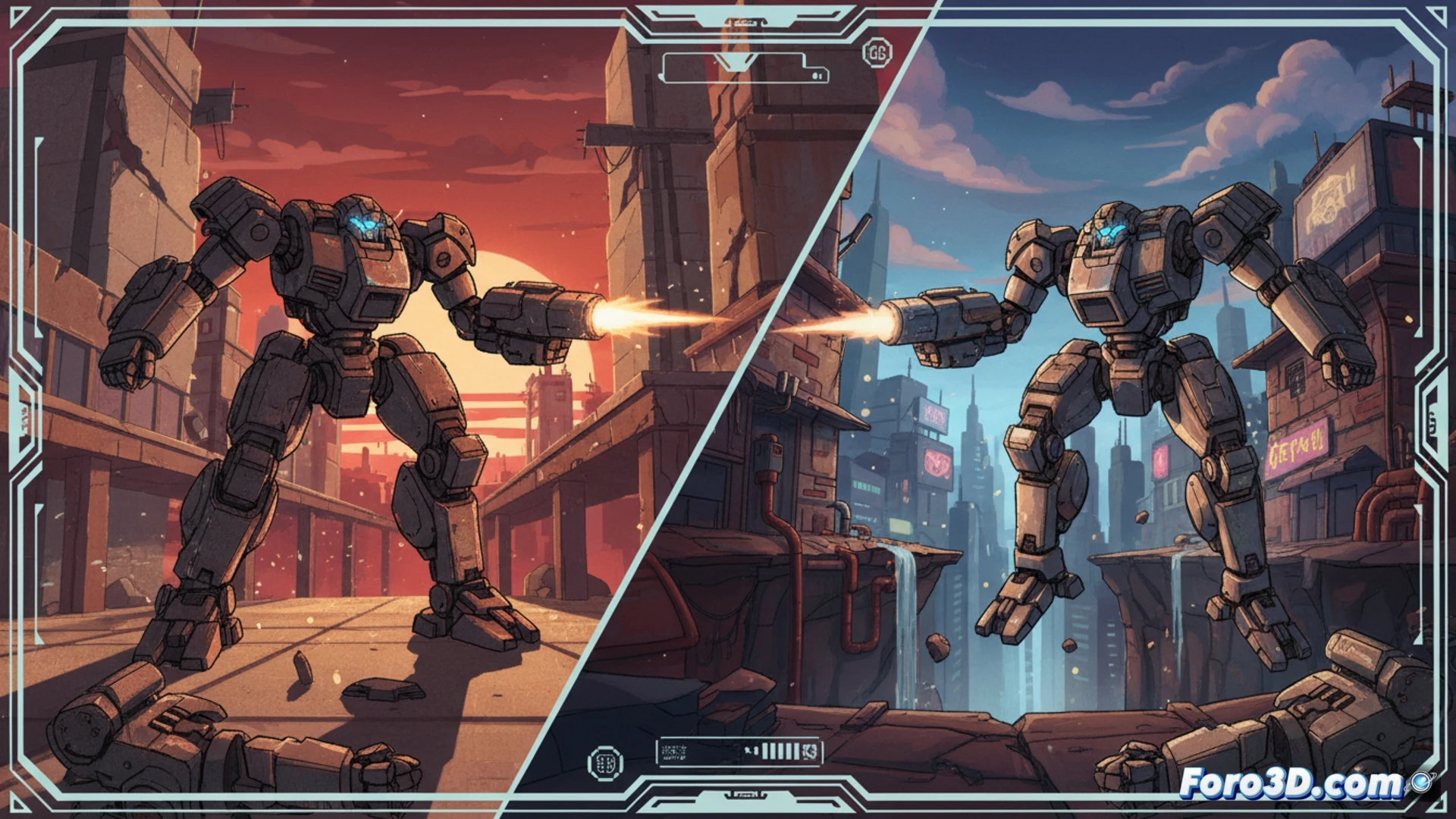
The return of the 2.5D visual style in titles like Slave Zero X demonstrates that nostalgia for the 32-bit era is not just a fad, but a powerful design tool. This game, developed in Unity, achieves a perfect balance between the fluidity of hand-drawn sprite animation and the spatial depth of three-dimensional environments. For indie developers, understanding this pipeline is key to creating a unique visual identity without needing an AAA budget. 🎮
The Technical Pipeline between Unity, Aseprite, and Blender 🔧
The creative process of Slave Zero X is divided into two parallel workflows that converge in Unity. On one hand, the 2D art is generated in Aseprite, where characters are drawn frame by frame with a limited color palette and high contrast, mimicking the limited animation of classic fighting games. These sprites are exported as texture sheets. On the other hand, the stages are modeled in Blender using low-poly geometry, textured with simple color maps and no complex lighting. In Unity, the camera is set to orthographic perspective or with a very narrow field of view, and sprites are rendered as objects always facing the camera (Billboarding). The technical trick lies in the lighting: flat directional lighting is used on the 3D models so that shadows do not visually clash with the implicit lighting of the 2D sprites.
Tips for Indie Developers: Embracing Limitations as Style 💡
The most valuable lesson from Slave Zero X is that visual consistency is more important than realism. If you want to emulate this technique, avoid the temptation to use high-resolution 3D models for the characters; the magic lies in the contrast between the sprite's detail and the stage's rawness. Additionally, unify the resolution of your textures. Sprites should look sharp, while low-poly environments should maintain a low polygon density so the scene feels like a 90s diorama. Finally, adjust the animation speed in Unity to match the frame rate of your sprites, achieving that characteristic choppy movement that defines the genre.
As an indie developer, what key technical aspects should I prioritize when integrating 2D sprites with low-poly models in a 2.5D pipeline to avoid lighting and clipping issues between both visual styles, as achieved in Slave Zero X?
(PS: optimizing for mobile is like trying to fit an elephant into a Mini Cooper)