The Last Case of Benedict Fox is a Lovecraftian horror metroidvania that demonstrates how a small team can achieve a striking aesthetic using standard industry tools. The game uses Unity as its main engine, combining modeling in Blender and texturing in Substance Painter to create its 2.5D environments. The key to its visual success lies in volumetric lighting and a rigorous asset optimization process to maintain stable 60 fps on consoles and PC. We analyze the technical pipeline behind this visual masterpiece. 🎮
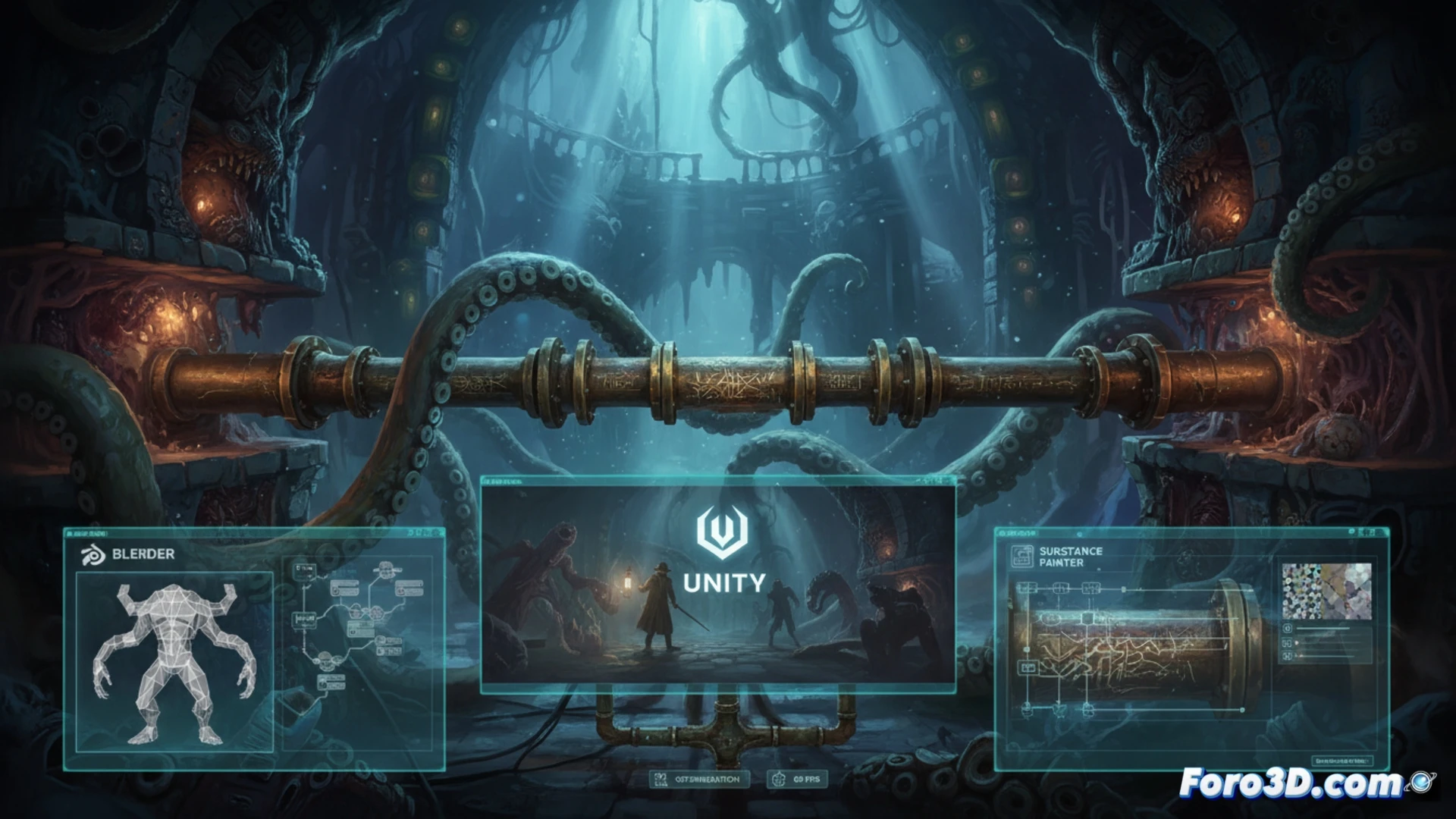
Modeling, Texturing, and Integration in Unity 🔧
The pipeline begins in Blender, where artists model environments with simple yet detailed geometry, prioritizing silhouette and volume over excessive polygonal detail. Each asset is exported with LODs (levels of detail) to maintain performance. In Substance Painter, textures with wear and dirt are applied using procedural masks that simulate the patina of time. The critical step is importing into Unity: custom shaders are configured that respond to directional volumetric lighting. Point lights and volume fogs are placed manually to create elongated shadows and oppressive atmospheres, avoiding excessive use of real-time lights to not sacrifice performance.
Lessons for Indie Developers in 2.5D 💡
To emulate this style, prioritize baked lighting in static scenes and use real-time lights only for dynamic elements. In Blender, model with overlapping planes to simulate depth without needing full 3D geometry. In Substance Painter, generate normal maps and ambient occlusion from base textures to add volume without increasing polygon count. Finally, in Unity, use the Post-Processing system to apply film grain and chromatic aberration, key elements of Lovecraftian horror. A final tip: test the scene on a low-end device from the start to avoid performance surprises at release.
What is the biggest technical challenge when integrating 2.5D assets rendered in Blender with Unity's dynamic lighting system to maintain the Lovecraftian aesthetic in a metroidvania like The Last Case of Benedict Fox?
(PS: shaders are like mayonnaise: if they break, you start all over again)