Return to Monkey Island not only marked the return of Guybrush Threepwood but also introduced a visual revolution within the graphic adventure genre. The Terrible Toybox team opted for a Unity engine to orchestrate a scrapbook aesthetic, combining flat digital paintings with three-dimensional models. This article breaks down the technical workflow between Adobe Photoshop and Blender, analyzing how angular geometric shapes and expressionism reinvent the saga's legacy without losing its classic essence.
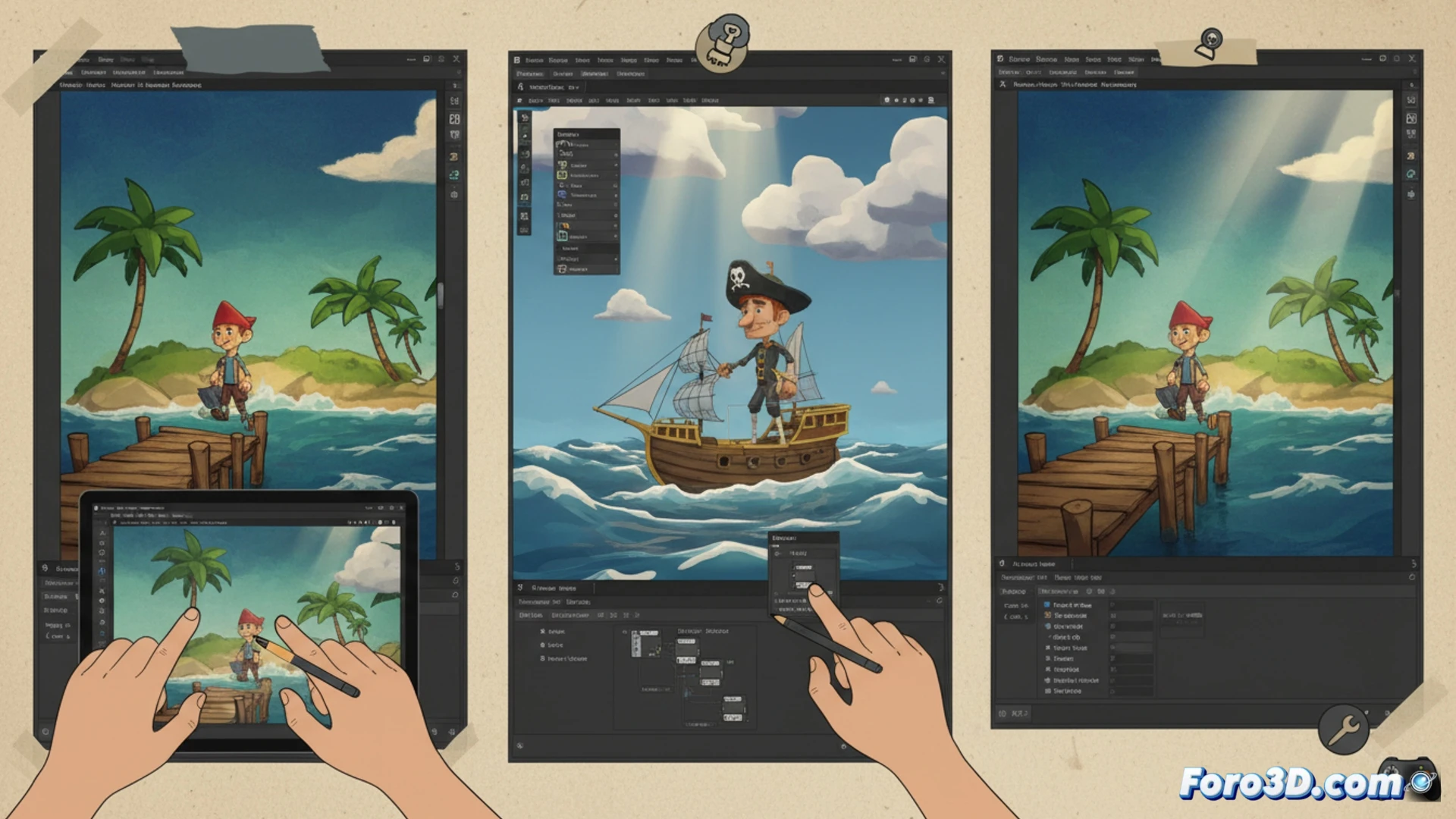
The workflow: from 2D painting to 2.5D depth 🎨
The pipeline begins in Adobe Photoshop, where artists paint each layer of the scenes as if they were independent illustrations. These layers are not simple backgrounds; they represent depth planes (foreground, midground, and background) that are later imported into Blender. In Blender, each layer is placed on a 3D plane with a small separation on the Z-axis, creating the parallax effect characteristic of 2.5D. The technical key lies in the fact that assets are not modeled with complex geometry; instead, angular geometric shapes and polygonal cutouts that mimic the texture of a collage are used. Unity interprets these planes as sprites with depth sorting, allowing the camera to move laterally without breaking the illusion of three-dimensionality. This method drastically reduces real-time rendering time, as complex dynamic lighting or depth map shadows are not needed.
Why the expressionist aesthetic works in Unity 🖌️
The decision to use an expressionist and angular style was not merely aesthetic; it responds to a technical need of Unity. Modern game engines tend to favor models with smooth normals and realistic textures, but here Unity's ability to handle sprites without aggressive mipmapping is exploited. By lacking smooth curves, characters and scenes avoid annoying aliasing at low resolutions and allow the camera to zoom in without the eye noticing texture flaws. Furthermore, expressionism disguises the transitions between 2D and 3D layers, turning what could be a technical limitation into a recognizable artistic signature. It is a case study on how limiting realism can free up a game's performance and visual identity.
How is the integration between Photoshop, Blender, and Unity achieved to maintain the 2.5D illusion in Return to Monkey Island without sacrificing gameplay fluidity?
(PS: 90% of development time is polishing, the other 90% is fixing bugs)