The indie sector constantly seeks to visually differentiate itself without skyrocketing production costs. Guilty Gear Strive offers an exceptional case study: it achieves the aesthetic of an anime in motion through a meticulous combination of Unreal Engine 4, modeling in Blender, and hand-painted shadow maps in Photoshop. This article breaks down the technical pipeline that allows a mid-sized studio to achieve a high-quality 2.5D finish, analyzing the rigging, shading, and post-production decisions that any developer can adapt to their project.
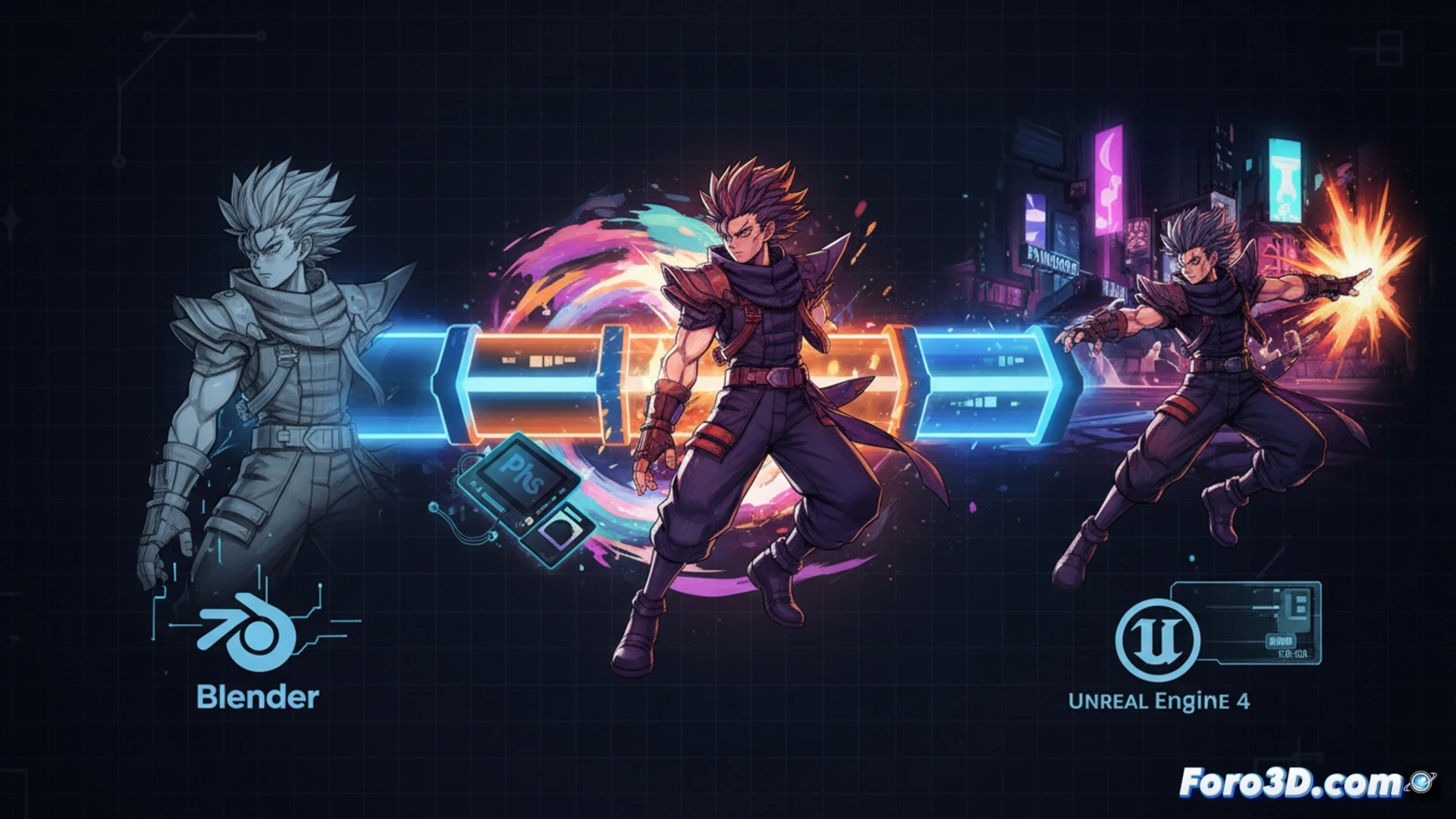
Technical breakdown of the pipeline: Maya, Blender, and Unreal Engine 4 🎨
The workflow begins in Blender, where the base modeling of the characters is done with topology designed for clean deformations. Subsequently, the asset is transferred to Autodesk Maya for rigging and animation, leveraging its skinning and bone control system to achieve fluid movements that mimic anime keyframes. The key to the visual style lies in the custom shadow maps, created in Photoshop. These maps do not rely on the engine's dynamic lighting; they are painted textures that define fixed light and shadow areas, applied via a cel-shading shader in Unreal Engine 4. The engine renders the 3D model with these static shadows, eliminating the realism of volumetric lights and forcing a flat, stylized aesthetic. To avoid the plasticine effect, black outlines are added through a post-process outline, simulating the stroke of traditional inking. The combination of 3D models with hand-painted 2D lighting is what Arc System Works calls the 2.5D technique.
Lessons for indie developers: prioritize art over technology 💡
The most valuable lesson from Guilty Gear Strive is that technical realism is not necessary to impress. For an indie studio, replicating this pipeline is feasible: Blender is free and Photoshop is accessible. The time investment is not in programming complex shaders, but in concept art and texture painting. By decoupling lighting from the engine and fixing it in shadow maps, the rendering load is drastically reduced, allowing even modest hardware to run smooth animations. The secret lies in visual consistency: each shadow must respect an imaginary and constant light source, as if it were an anime frame. If your team can draw well, you can skip light physics and achieve a visually striking result with fewer computational resources.
How can an indie studio implement a 2.5D pipeline similar to Guilty Gear Strive without the budget or team of a triple-A, and what key tools or techniques allow them to efficiently replicate its visual style?
(PS: 90% of development time is polishing, the other 90% is fixing bugs)