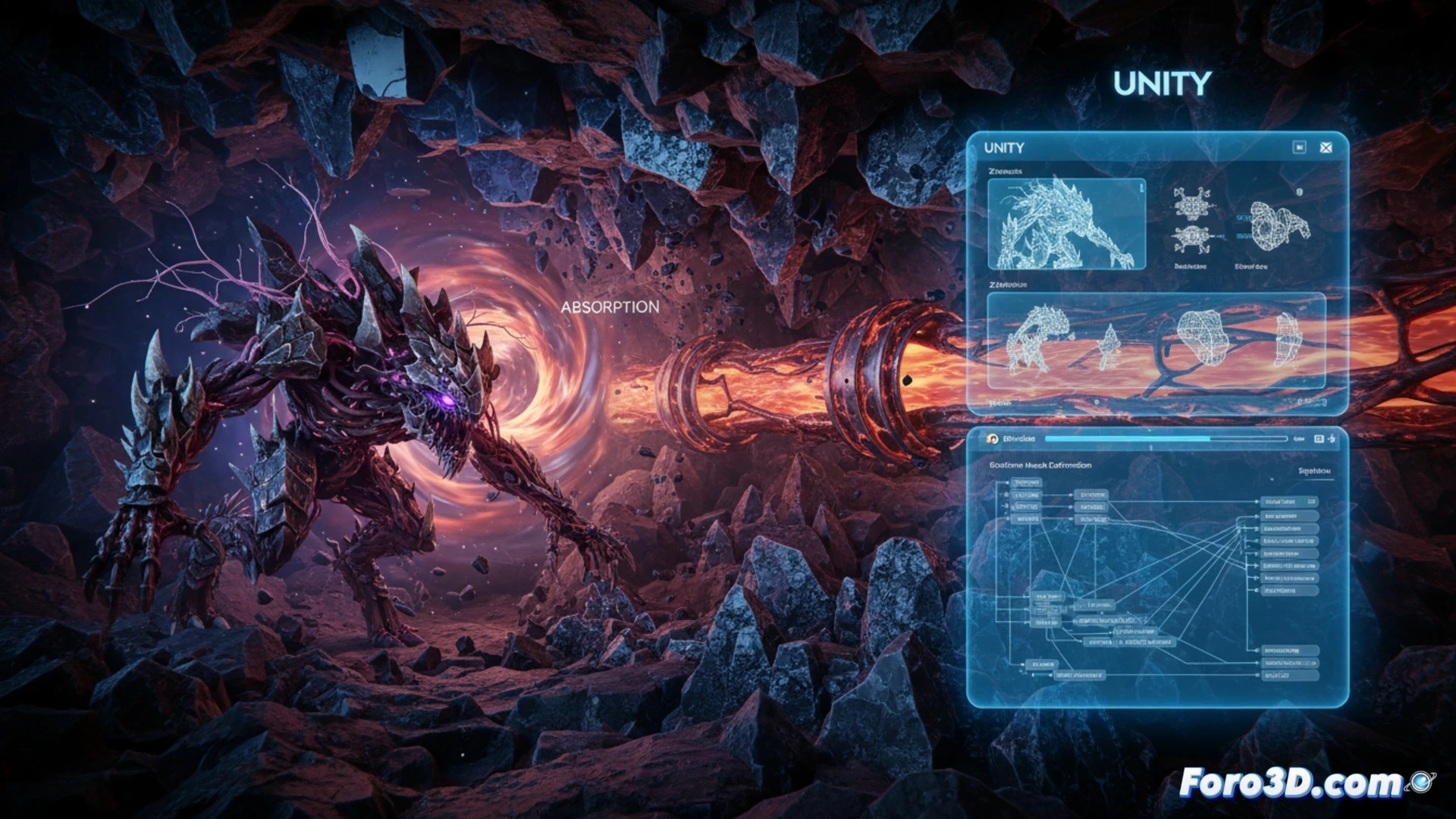
Grime is a title that redefines 2.5D action through a surrealist aesthetic where organic anatomy and abstract geology merge. Developed in Unity, the game uses 3D models sculpted in ZBrush and textured in Substance Painter, but rendered on a 2D side-scrolling plane. The technical key lies in how Blender orchestrates the transition between three-dimensional volumes and flat sprites, while the absorption effects (where the character consumes enemies) are managed through custom Unity shaders that deform the mesh in real-time without breaking the illusion of depth. 🎨
Pipeline optimization: From ZBrush to Unity in 2.5D 🛠️
The workflow begins in ZBrush, where creature assets are sculpted with a high level of anatomical detail, prioritizing shapes that work both from the front and in profile. These models are retopologized in Blender to reduce the polygon count to a range of 5,000 to 10,000 tris, ensuring real-time performance. Texturing in Substance Painter is critical: normal and occlusion maps are painted to simulate rock roughness and tissue moisture, but complex specular details are avoided to maintain visual coherence in 2.5D. In Unity, vertex cut shaders are implemented for the absorption effects: when the character absorbs an enemy, a script modifies the vertex weights in a dissolution mask, causing the model to contract towards the center of the screen. For optimization, it is recommended to use LODs (Level of Detail) generated in Blender and billboarding for distant objects, reducing draw calls by 30% without sacrificing the surrealist aesthetic.
Technical lessons for indie developers 💡
Grime demonstrates that combining 3D models with 2.5D gameplay is not only viable but advantageous for projects with limited budgets. By using Blender for retopology and Substance Painter for simplified PBR textures, a visual finish is achieved that competes with AAA titles without needing a large team. The biggest technical challenge is the absorption effect: it requires a balance between mesh deformation and the static lighting of the 2D plane. To replicate it, it is suggested to use coroutines in C# that interpolate the value of a material property block, avoiding the creation of new materials at runtime. This approach keeps memory stable and allows fluid action to be the center of the experience.
How did they manage in Grime's pipeline to synchronize the deformation of organic anatomy with the fragmentation of rock to generate the sensation of real-time absorption within Unity?
(PS: optimizing for mobile is like trying to fit an elephant into a Mini Cooper)