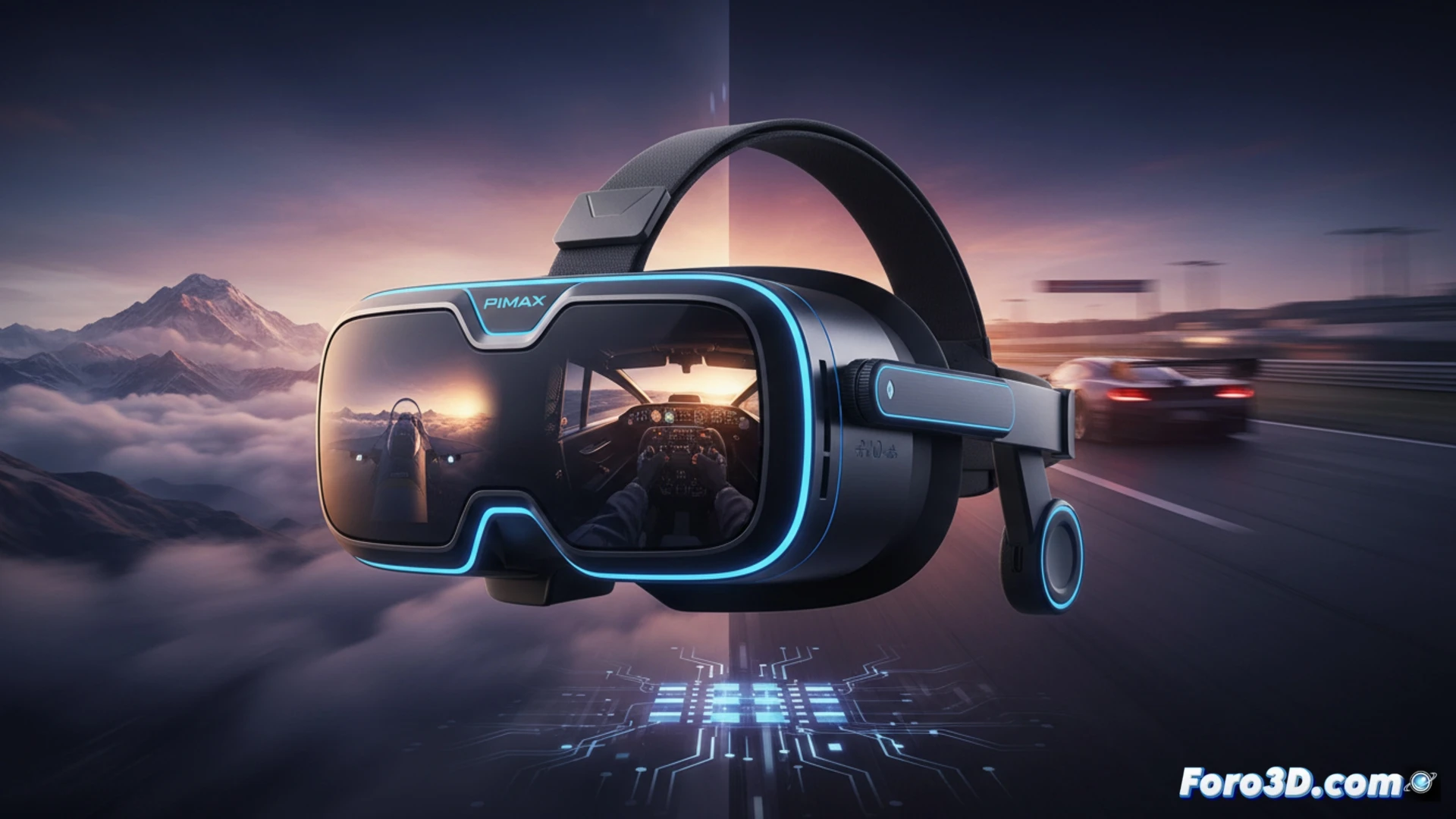
Pimax has unveiled the Crystal Light, a virtual reality headset that aims directly at the heart of simulation enthusiasts. With a native resolution of 2880 x 2880 pixels per eye, this headset promises visual clarity that surpasses most competitors on the market. The main focus of this hardware is to eliminate unnecessary weight to allow for extended gaming sessions without fatigue, a critical factor for virtual pilots and simracing drivers who spend hours immersed in their cockpits.
Technical analysis: QLED panels and aspheric optics 🖥️
The Pimax Crystal Light uses QLED panels with local dimming, allowing for superior contrast and deeper blacks compared to standard LCD screens. The glass aspheric optics reduce distortion and the screen-door effect to nearly imperceptible levels. With a 120-degree horizontal field of view, it surpasses options like the Meta Quest 3 (110 degrees) and approaches the immersive experience sought by professional simulators. The removal of the internal battery and standalone tracking modules reduces the front weight to under 500 grams, distributing the load more evenly through an adjustable head strap. This makes it a viable option for training in Microsoft Flight Simulator and titles like Assetto Corsa Competizione, where the sharpness of instrument panels and distant details are essential for performance.
Revolution or exclusive niche? 🤔
The decision to sacrifice portability and standalone tracking to focus on visual fidelity raises a key question: who is it really designed for? While a headset like the Varjo Aero offers professional precision at a high price, the Crystal Light seeks to democratize that quality for the demanding enthusiast. However, its reliance on a high-end PC and the lack of its own ecosystem limit it to a very specific audience. For the simulation professional who values every visual detail over general ease of use, this device represents a qualitative leap that justifies the investment, although for the casual user, it may be an unnecessary technical excess.
As a user of flight and racing simulators, does the higher resolution of the Pimax Crystal Light truly improve immersion and performance in demanding games, or does the added weight and cost outweigh the visual benefit?
(PS: and if you get motion sickness with VR headsets, you can always blame the coffee)