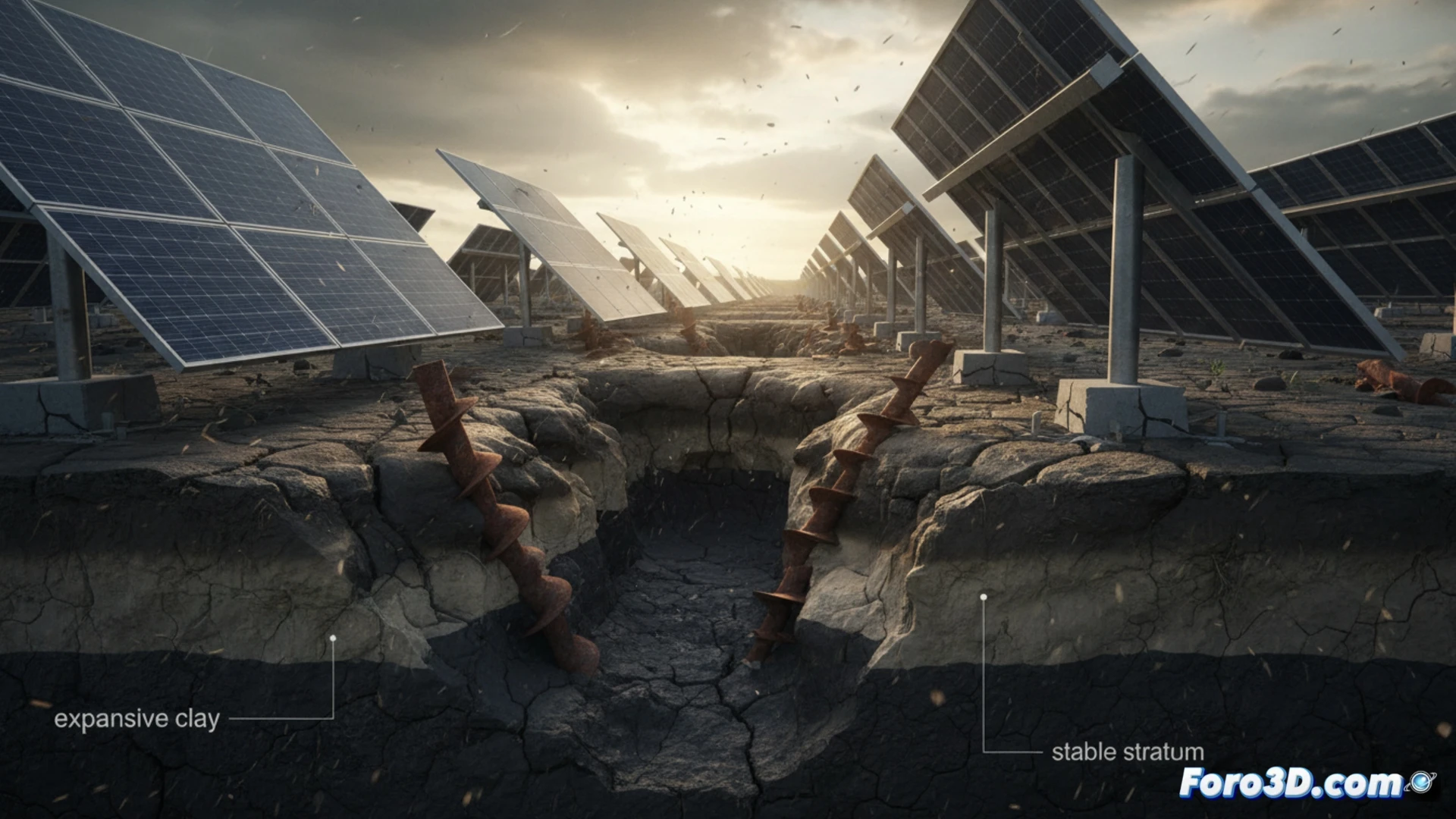
After intense rainfall in a region with expansive soil, a solar plant experienced widespread tilting of its panels. The incident, initially attributed to an extreme weather event, was analyzed using a digital twin that revealed the true cause: insufficient foundation. The helical piles did not reach the necessary depth to anchor into the stable stratum, yielding to the swelling of the clayey soil.
3D Failure Reconstruction: ReCap, OpenRoads, and Trimble Business Center 🛠️
The engineering team used Trimble Business Center to process LiDAR scan data captured with ReCap. This workflow allowed for the creation of a detailed point cloud of the deformed plant. By overlaying this model with the original design in OpenRoads, an anomalous vertical displacement was detected at the structure bases. The 3D geotechnical analysis, integrated into the model, simulated the wetting cycle of the expansive soil. The results showed that the piles, being buried below the critical depth of volume change, did not generate enough negative skin friction to counteract the uplift force. The modeling revealed that an additional depth of 1.5 meters would have prevented the collapse by reaching the stable bedrock.
Lessons for Solar Plant Engineering 📐
This case demonstrates that the digital twin is not just a visualization tool, but a critical failure simulator. To prevent future incidents, it is recommended to integrate 3D geotechnical models into the design phase, using Standard Penetration Test (SPT) data to define the exact length of helical piles. Furthermore, continuous monitoring using drones and ReCap scanners, processed in Trimble Business Center, allows for the detection of millimeter-scale deformations before they compromise production. In expansive soils, the foundation must be designed to resist not only vertical load but also cyclic swelling pressure.
What alternative geotechnical design method to the traditional static bearing capacity calculation should be used to size helical piles in expansive soils subjected to wetting and drying cycles, considering that tensile loads from expansion can exceed compressive loads from the structure's weight?
(PS: Simulating catastrophes is fun until the computer crashes and you are the catastrophe.)