Venturing into the abyssal trenches of the Pacific Ocean means encountering creatures that defy the imagination. The Nazca Dragonfish (Stomias sp.) is one of the most specialized predators of this extreme ecosystem. Its anatomy, designed for perpetual darkness and high pressure, features unique adaptations such as transparent teeth and a bioluminescent barbel that emits cold light to attract prey. This article explores how 3D scientific visualization allows us to dissect and understand these evolutionary adaptations.
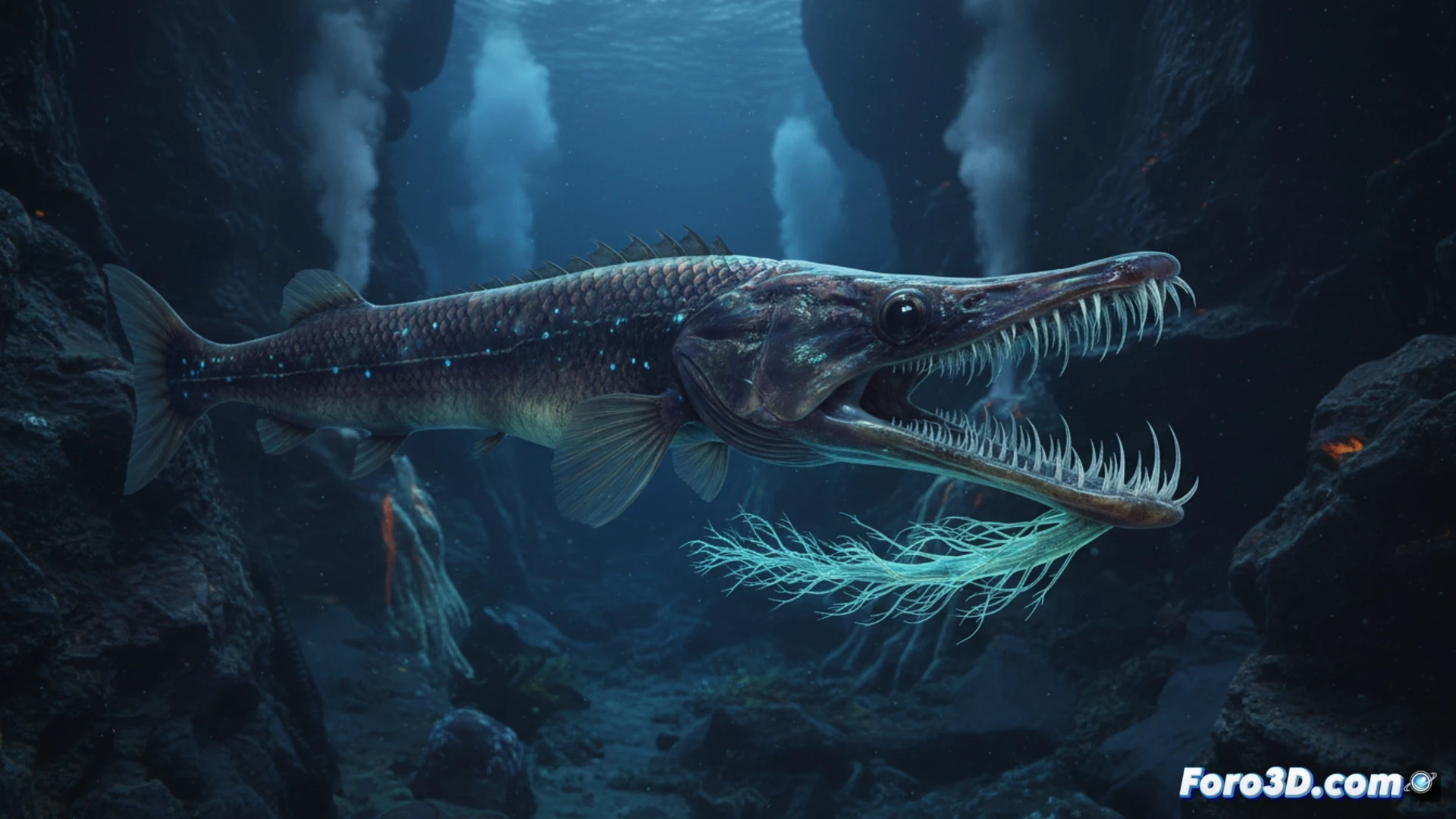
3D Anatomy of Stomias sp.: Teeth and Bioluminescence 🐉
For the anatomical modeling of Stomias sp., the main focus lies on two critical structures. The teeth, which appear invisible at first glance, require shading with a refractive index nearly identical to that of the surrounding water, achieving a transparency effect that deceives prey. The barbel, an elongated appendage on the lower jaw, is modeled with a particle emitter to simulate bioluminescence. In the photorealistic render, an emissive material with a low-intensity blue-green hue is applied, replicating the light produced by symbiotic bacteria. The fish's skeleton, elongated and with a dislocatable jaw, is articulated in the 3D engine to allow simulation of the attack. The skin, scaly and dark, absorbs ambient light, creating a perfect contrast with the luminous area of the lure.
Hunting Simulation: The Lure in Total Darkness 🎣
The 3D visualization comes to life when simulating the hunting technique. In a virtual environment of total darkness, the interactive rotatable model allows the viewer to observe how the Dragonfish remains motionless, moving only its luminous barbel. The lure blinks with a specific pattern, attracting small crustaceans or fish. In the simulation, the camera is positioned from the prey's perspective, showing how the transparent teeth are practically undetectable until the moment of jaw closure. This approach demonstrates how scientific visualization not only documents form but also explains predatory behavior and the evolutionary function of each anatomical adaptation in a hostile environment.
How can the 3D modeling of the Nazca Dragonfish be optimized to accurately reflect its bioluminescent adaptations and extreme morphology in high-pressure abyssal environments?
(PS: if your manta ray animation doesn't excite, you can always add some documentary music from channel 2)