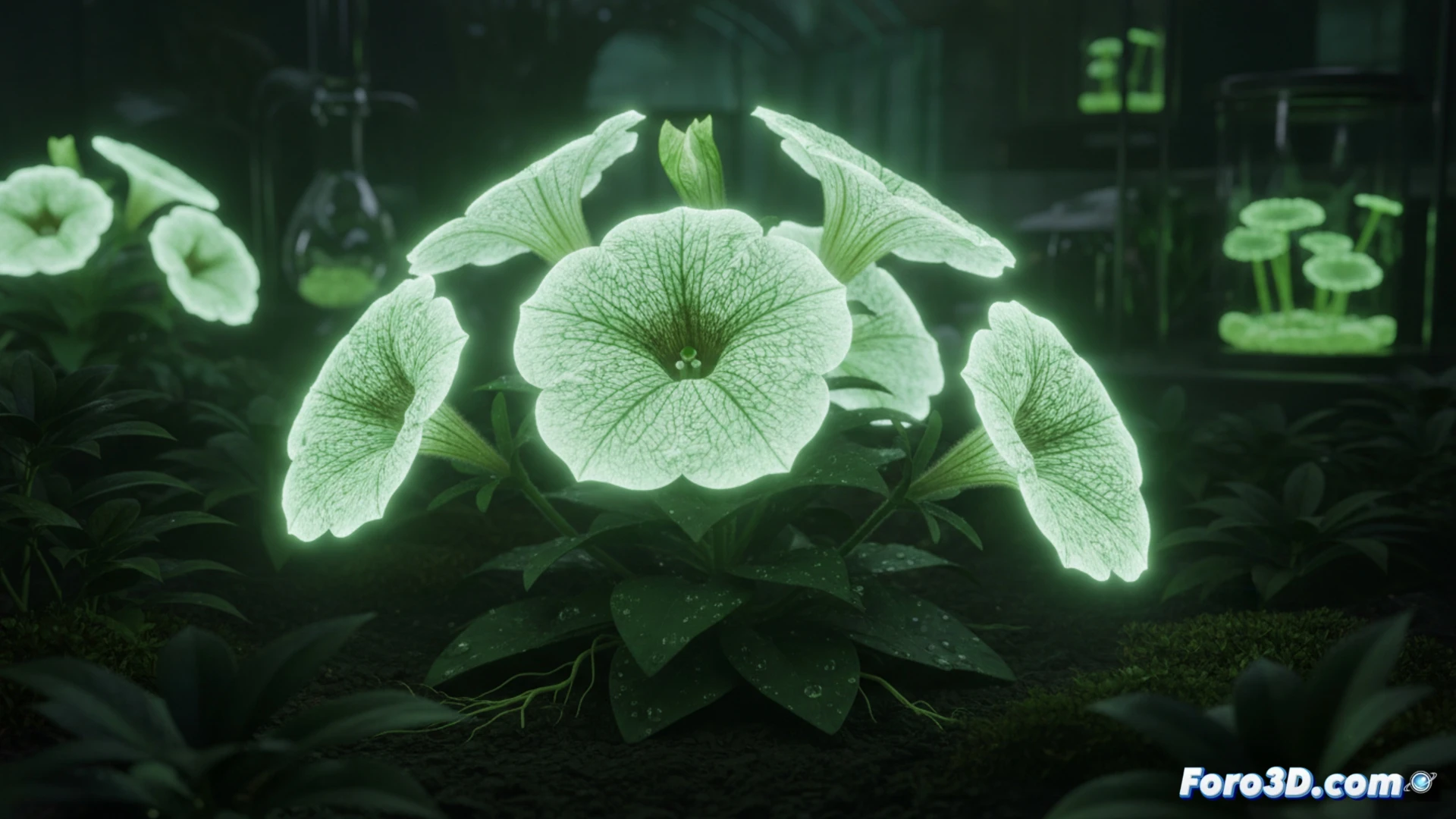
Biotechnology has taken a visual leap with the Light Bio Firefly Petunias, the first commercially available genetically modified plants that emit a visible green light in the dark. This achievement, based on genes from bioluminescent fungi, opens a fascinating door for scientific visualization. From Foro3D.com, we explore how 3D modeling can unravel the molecular mechanisms behind this phenomenon and simulate its light impact in controlled environments.
Molecular Visualization and Modeling of Bioluminescence 🌿
To understand how these petunias generate light, 3D tools allow recreating the metabolic pathway of caffeic acid, converted into luciferin by Lux enzymes from fungi such as Neonothopanus nambi. An interactive model could show, at the molecular level, the oxidation of luciferin that produces green photons. Additionally, it is possible to design digital twins of the entire plant, assigning emission properties to petals, stems, and leaves. These models facilitate the simulation of light intensity under different levels of pH, temperature, or humidity, offering researchers a virtual laboratory to optimize gene expression without the need for extensive physical cultures.
Scientific Outreach Through 3D Interactivity 🔬
The dissemination of this advancement greatly benefits from interactive 3D visualization. A real-time comparative model could pit a natural petunia against a modified one, allowing the user to adjust ambient darkness and observe the gradient of emitted green light. This representation not only educates about the difference between bioluminescence and fluorescence but also humanizes biotechnology, showcasing its aesthetic and functional potential. For the Foro3D community, this case is a perfect example of how digital art and science merge to illuminate the secrets of modified nature.
Which volumetric scattering simulation techniques in the rendering engine are most effective for replicating the homogeneous light emission without hot spots of bioluminescent petunias in a polygonal 3D model optimized for scientific visualization?
(PS: if your manta ray animation doesn't excite, you can always add documentary music from channel 2)