In the jungles of the Diquis Delta, hundreds of granite spheres lie with a geometric precision that challenges pre-Columbian technology. These petrospheres, weighing up to 15 tons, exhibit almost perfect sphericity. Today, digital archaeology uses laser scanning and photogrammetry to document every millimeter of these works, seeking clues about their manufacture, transport, and the ritual purpose they conceal.
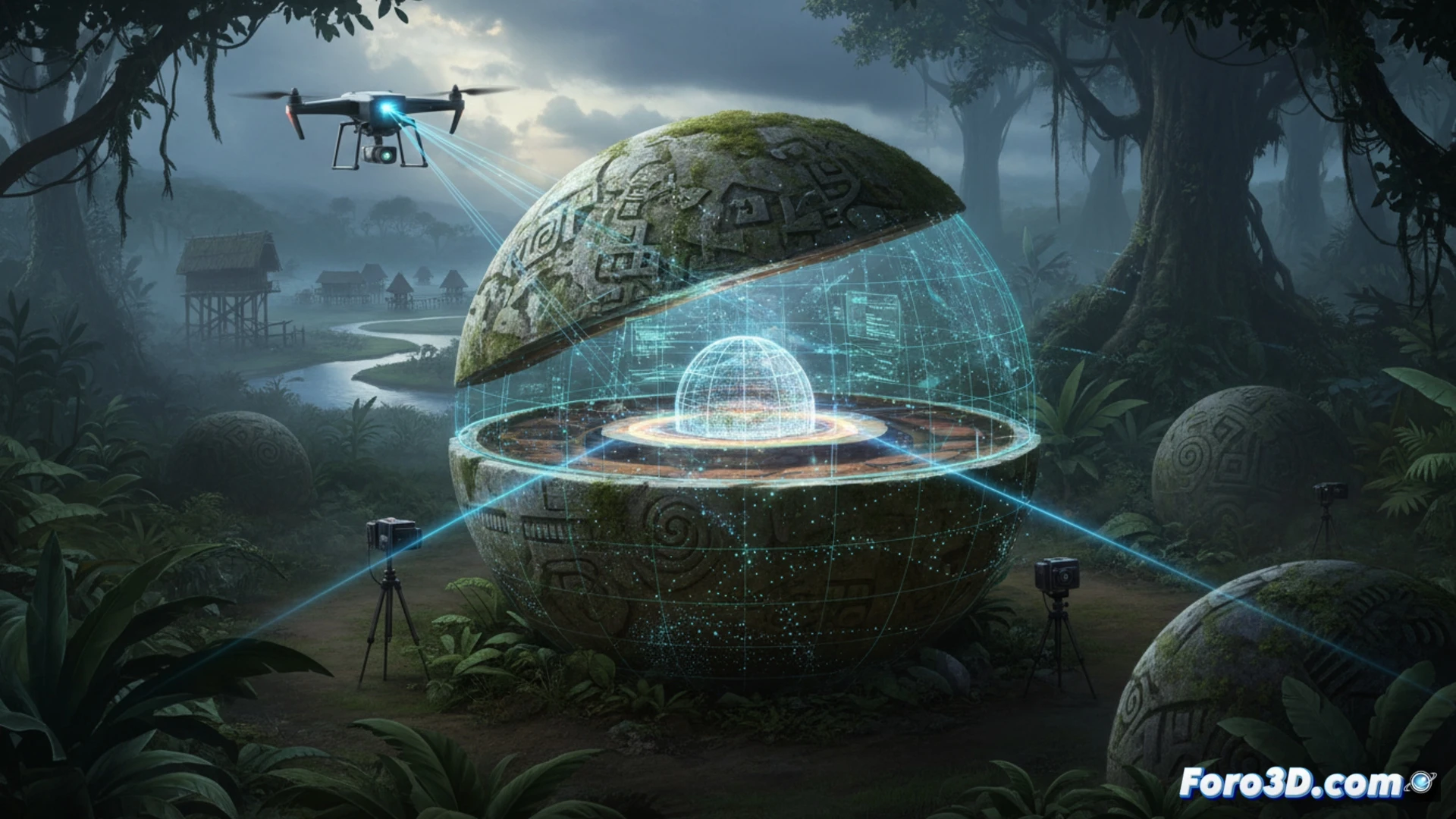
Geometric analysis using high-resolution photogrammetry 🗿
The main technique for the non-invasive study of these spheres is Structure from Motion (SfM) photogrammetry. By capturing hundreds of images from multiple angles, the software reconstructs a dense point cloud that allows measuring spherical deviation with sub-millimeter precision. This textured 3D model not only reveals wear marks and carving tools, but also allows physically simulating the rolling of the spheres on different terrains to evaluate hypotheses of river transport or wooden rollers, all without moving a single stone from its original context.
Virtual preservation against looting and weather 🌿
The greatest challenge is not only the mystery of their origin, but their physical conservation. Many spheres have been displaced or damaged by agricultural expansion and looting. Creating a high-fidelity digital archive acts as insurance against the total loss of heritage. These digital twins allow researchers worldwide to access the data without traveling to the fragile sites, democratizing the study and ensuring that, even if the stone erodes, the geometric knowledge of the Diquis culture endures in cyberspace.
What unexpected revelations about pre-Columbian manufacturing techniques has the 3D scanning of Costa Rica's petrospheres provided that could not be obtained with traditional archaeological methods?
(PS: If you dig at a site and find a USB, don't plug it in: it could be Roman malware.)