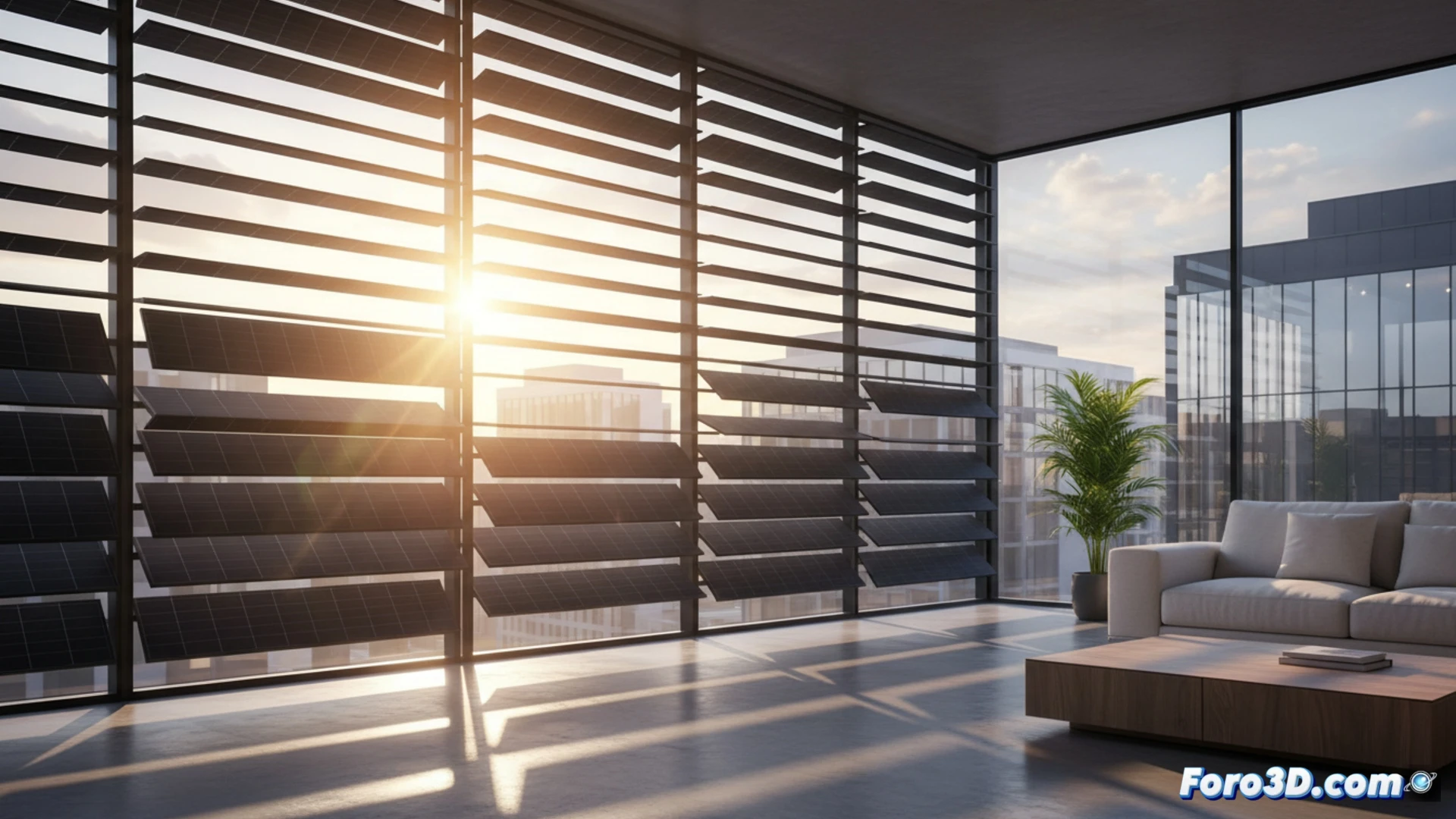
SolarGaps smart blinds represent an advancement in the integration of renewable energy with the connected home. Their ability to track the sun's trajectory in real time makes them an ideal candidate for developing a digital twin. This article analyzes how the 3D simulation of this system allows replicating its behavior, optimizing photovoltaic generation, and improving interior shading, all based on environmental and solar position data.
Digital twin architecture: data flow and 3D simulation 🔄
The SolarGaps digital twin is built from three data layers. The first is the physical sensor layer, which captures solar irradiance, time of day, and building orientation. The second layer is the 3D model of the blinds, which virtually replicates each slat and its tilt angle. The third layer is the simulation engine, which processes the information to predict energy production and projected shadow. This bidirectional flow allows the physical system to adjust its position based on the simulation, while the virtual replica is updated with real performance data, closing the predictive control loop.
Beyond shading: a window to predictive home automation 🌡️
The application of digital twins in devices like SolarGaps transcends simple automation. It allows anticipating energy consumption peaks, simulating climate scenarios, and adjusting photovoltaic production in real time. This approach turns every window into an intelligent node of a home automation network, where efficiency is not reactive but predictive. In the near future, integrating these models with home energy management systems could significantly reduce dependence on the electrical grid, demonstrating that sustainability is also built from simulation.
How does simulating a digital twin of SolarGaps blinds optimize the balance between photovoltaic generation and thermal comfort in real time?
(PS: My digital twin is right now in a meeting, while I'm here modeling. So technically, I'm in two places at once.)