A study from the Journal of Archaeological Science reveals that the Maya of the Classic period traded dogs considered exotic, transporting them over hundreds of kilometers. Dr. Elizabeth Paris, from the University of Calgary, analyzed strontium isotopes in remains from Moxviquil and Tenam Puente, in Chiapas. The results indicate that the deer were local animals, while the dogs came from very distant lowland Maya kingdoms. This finding transforms our understanding of cultural exchange in Mesoamerica.
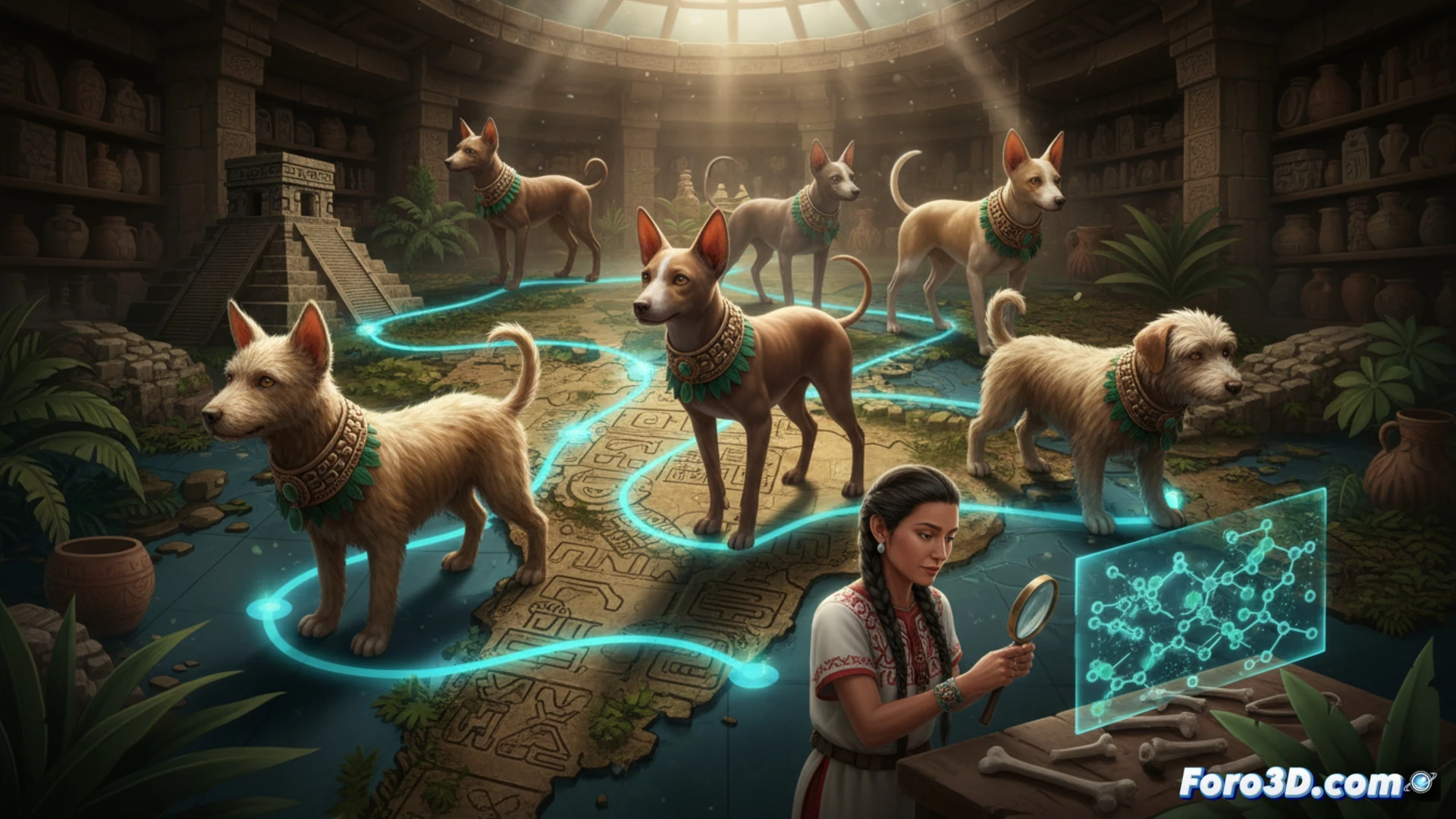
Virtual reconstruction and isotopic analysis of trade routes 🗺️
Digital archaeology offers key tools to visualize this phenomenon. Through aerial photogrammetry with drones and LiDAR scanning, it is possible to generate high-resolution three-dimensional models of the Moxviquil and Tenam Puente sites. These models allow recreating the original topography and possible access routes. Furthermore, integrating isotopic data into a 3D Geographic Information System (GIS) enables creating interactive maps showing the travel trajectories of the dogs, from the lowlands to the highlands of Chiapas. 3D morphometrics of the recovered skulls and jaws facilitates virtual comparison of canine populations, distinguishing local individuals from imported ones.
The value of digital heritage in historical reinterpretation 🏛️
The ability to digitally recreate these ecosystems and their inhabitants brings us closer to a more nuanced understanding of the Maya economy. Not only material goods were traded, but also live animals with symbolic and ritual value. Virtual reconstructions of the dogs and deer, based on actual bone proportions, offer a direct window into the past. This approach not only preserves fragile heritage but also democratizes access to knowledge, allowing any user to explore trade routes that isotopic science has revealed.
How can 3D modeling of Maya trade routes help us identify the exact origin of exotic dogs and their symbolism in Classic period society?
(PS: and remember: if you can't find a bone, you can always model it yourself)