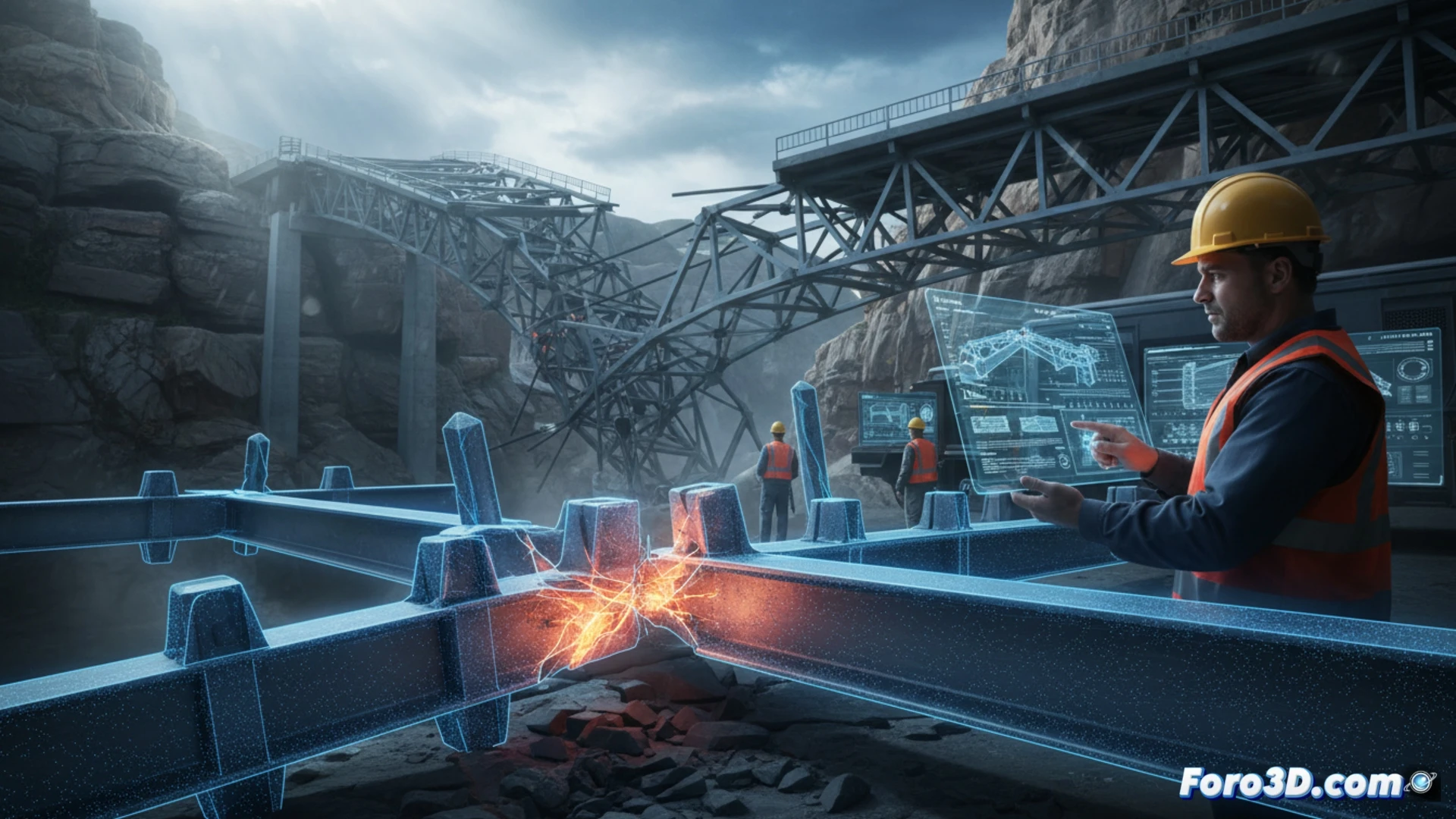
The collapse of a modular Bailey emergency bridge, which occurred after a flood, has brought the spotlight onto material fatigue. A passing truck caused the catastrophic failure of the structure. The subsequent expert investigation, supported by 3D technologies, discovered that critical wear in the connection pins and accumulated fatigue in the aluminum beams were the triggers of the failure, offering an invaluable case study for structural simulation.
Technical workflow: from point cloud to fatigue analysis 🔧
The collapse analysis was structured into four phases using specialized software. First, Leica Cyclone recorded the post-collapse geometry by capturing millions of points. Then, Tekla Structures allowed modeling the ideal structure and contrasting it with the actual deformed one. CloudCompare executed the M3C2 comparison, quantifying millimeter deviations in beams and pins. Finally, Blender visualized the highest stress zones, correlating plastic deformation with cyclic fatigue of the aluminum. This workflow revealed that microcracks in the pins, invisible to the naked eye, had already exceeded the endurance limit.
Predictive monitoring: the true value of the digital twin 🏗️
Beyond the forensic investigation, this case underscores a critical lesson for engineers: material fatigue is not a sudden event, but a detectable cumulative process. Creating digital twins through periodic point clouds allows anticipating failures in critical infrastructure. If this comparative scanning had been applied to the Bailey bridge before the collapse, the wear on the pins would have been identified in time, preventing the tragedy. Fatigue simulation ceases to be theory and becomes a tangible preventive tool.
Would you validate with destructive testing?