A critical incident at an automated port terminal has placed the limits of an STS (Ship-to-Shore) crane's control software under digital forensic scrutiny. During an unloading maneuver, the crane's boom violently struck the superstructure of the container ship. The initial expert analysis points to a discrepancy between the actual load and the declared one, but only 3D simulation can confirm whether the container's inertia exceeded the safety margins of the sway compensation system. 🏗️
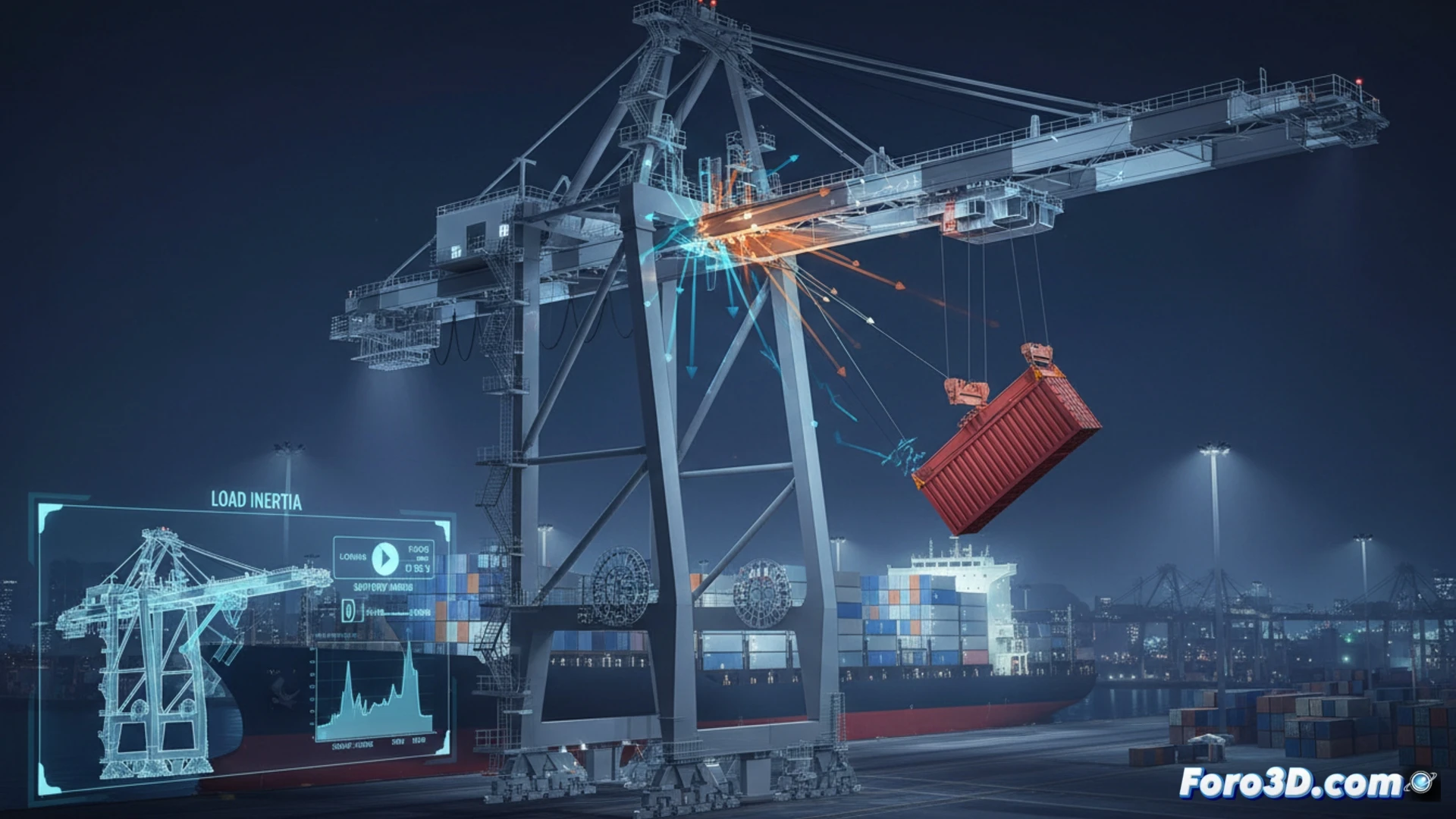
Forensic workflow: from the sway sensor to physics in Unreal Engine 5 🔬
The analysis process began with extracting raw data from the crane's sway compensation sensor. These acceleration and displacement records were imported into CloudCompare for cleaning and temporal alignment with the PLC logs. Subsequently, the team modeled the exact geometry of the suspect container and its estimated contents in Siemens NX, while the actual inertia tensor was calculated in SolidWorks based on a hypothetical load density. The culmination was the physical recreation in Unreal Engine 5, where the corrected inertia data was input to simulate the exact moment of impact. The simulation showed that the control software, upon receiving a declared weight lower than the actual one, did not activate the necessary progressive braking protocols to counteract the excessive sway.
Digital twins as witnesses in logistics accidents ⚖️
This case demonstrates that the digital twin is not just a design tool, but a witness for the prosecution in the investigation of industrial accidents. The recreation in Unreal Engine 5 allowed visualizing a failure that telemetry data alone did not explain: a miscalculated inertia that saturated the sway compensation algorithm. For the logistics sector, the lesson is clear. Load validation using 3D sensors and inertia simulations prior to operation could prevent these incidents, closing the gap between administrative declaration and the physical reality of the container.
Since the 3D expert analysis has shown that the load inertia on the STS crane exceeded the control software's predictions, what dynamic simulation methodology or real-time correction algorithm do you recommend implementing to prevent this latent failure from recurring in highly automated port environments?
(PS: 3D logistics is beautiful until you try to fit a container where it doesn't belong)