During the night shift at an aerospace assembly plant, mispositioned rivets were detected in a critical section of the fuselage. The error was not visible to the naked eye, but dimensional inspection with GOM Inspect revealed millimeter deviations. The initial hypothesis pointed to a miscalibration of the laser projection system that guides operators, possibly induced by environmental vibrations from nearby heavy machinery.
Forensic flow: logs, meshes, and temporal correlation 🔍
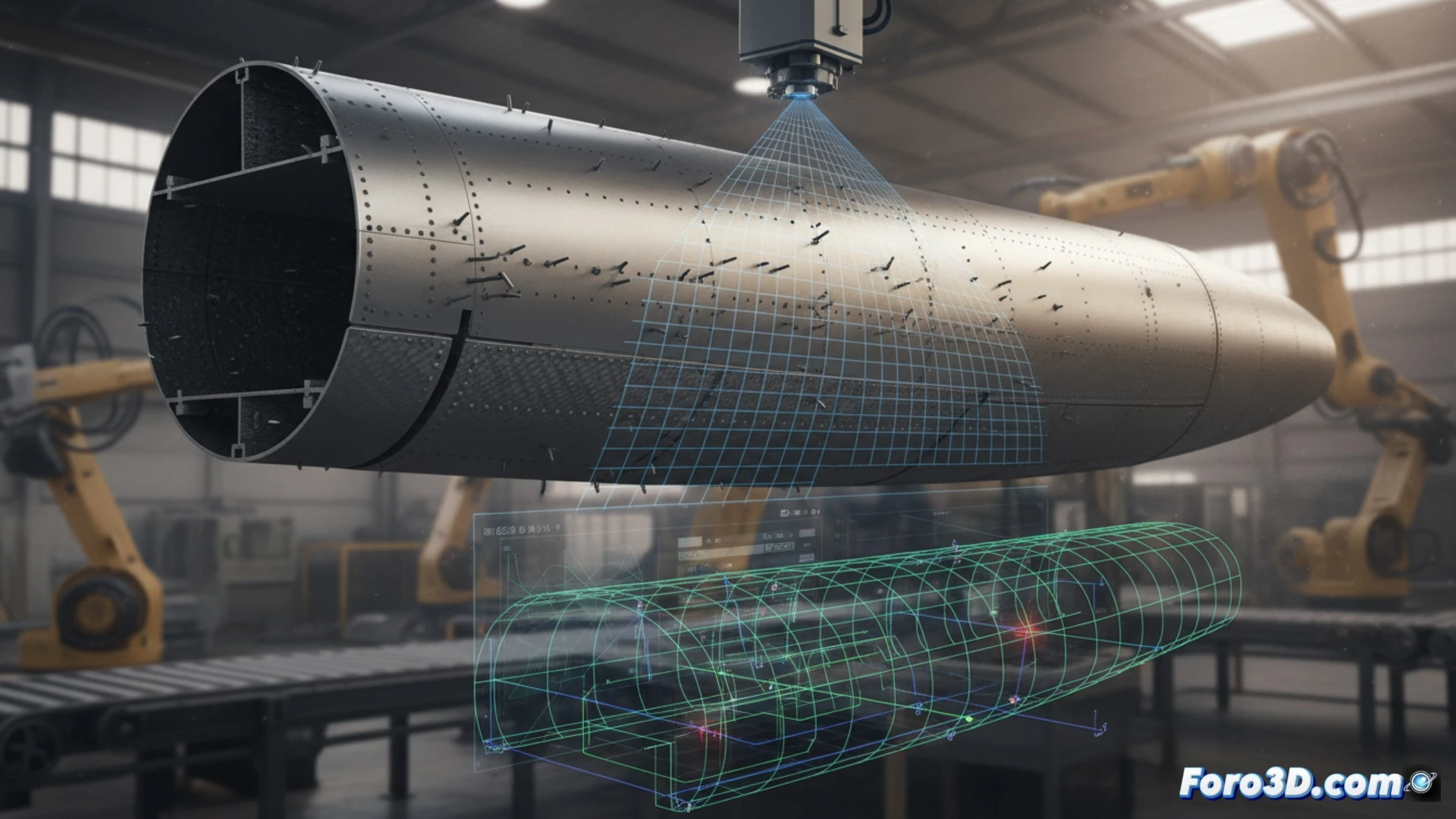
The forensic investigation began by extracting logs from the Vuforia Engine system, which records every projection pulse and the workshop's environmental conditions. A vibration peak was identified at 02:47 AM, coinciding with the start of the shift. Then, the original design files were imported from CATIA and compared with the point cloud of the fuselage scanned in GOM Inspect. The overlay showed a 0.15-degree rotation in the projector, enough to shift the reference points by 2.3 mm. Cross-analysis of timestamps confirmed that the error occurred right after a panel conveyor passed 3 meters away.
Lessons for the industrial forensic pipeline ⚙️
This case demonstrates that assembly errors are not always human; sometimes they are systemic failures in the digital guidance chain. The key to the 3D forensic investigation was correlating temporal data from logs with precise geometric models. The solution was not to recalibrate the laser, but to physically isolate it from vibration sources. For future forensic pipelines, I recommend integrating real-time vibration sensors within the Vuforia ecosystem to alert before the error materializes in the fuselage.
How can the dynamic behavior of a rivet subjected to low-frequency vibrations in a nighttime assembly environment be modeled and validated to discriminate between a process failure and material fatigue in 3D forensic investigation?
(PS: In the forensic pipeline, the most important thing is not to mix the evidence with the reference models... or you'll end up with a ghost in the scene.)