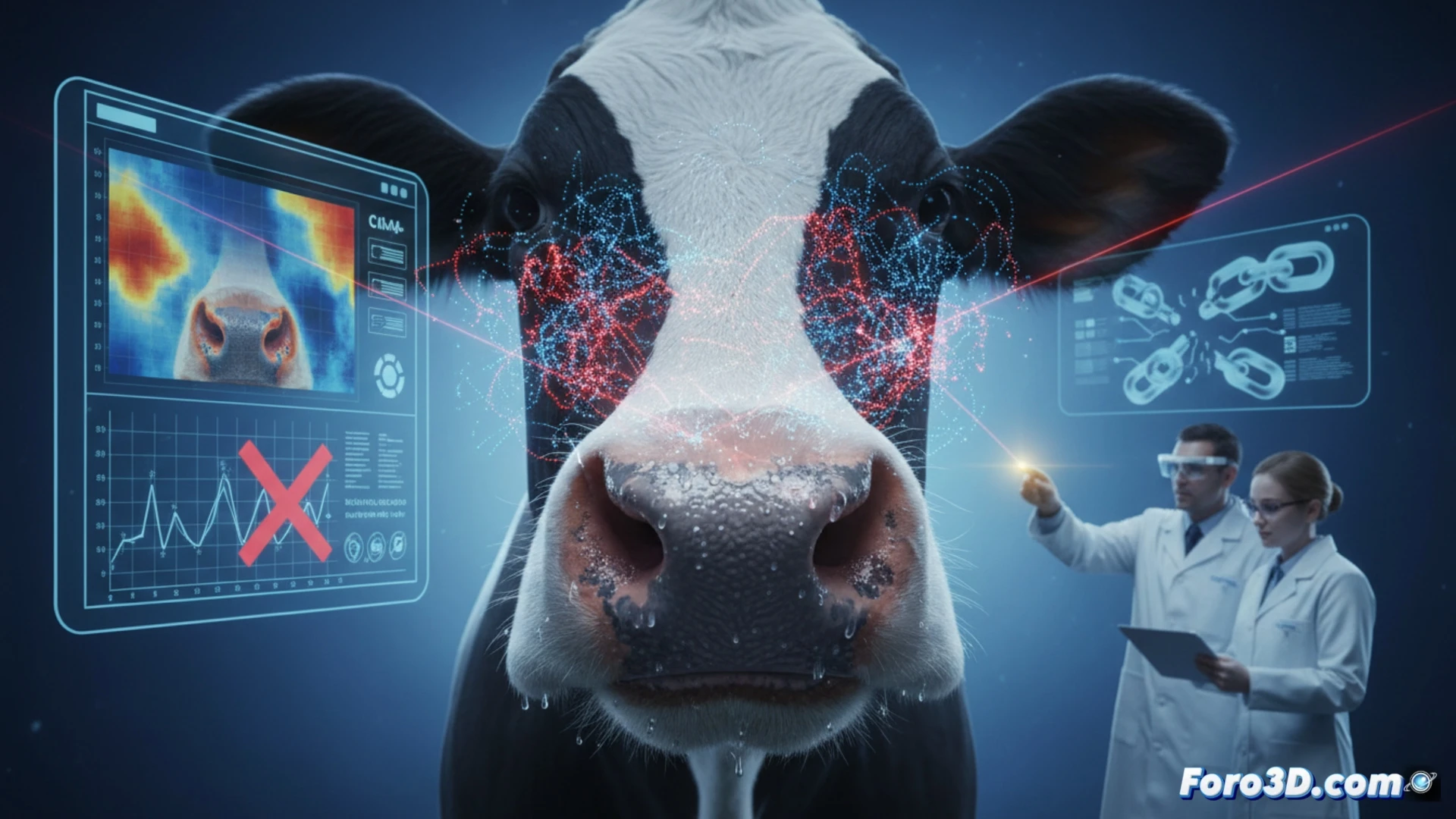
A biometric identification system based on the nose pattern of cattle has failed catastrophically, confusing the records of thousands of animals in a food safety chain. The incident, which could compromise livestock traceability, has required a technical forensic expert analysis. The main hypothesis points to variations in the moisture of the animal's muzzle altering the laser reflectance of the 3D scanner, generating systematic errors in the point cloud mapping.
Forensic Pipeline: From Scanner to Simulation in Unreal Engine 🔬
The forensic workflow begins with extracting raw data from the scanner. The first analysis is performed in CloudCompare, where the point clouds of correctly identified noses are segmented against erroneous ones. A statistical filter is applied to isolate intensity variations (reflectance) in moist areas. Subsequently, the data is exported to MATLAB for quantitative analysis. Here, the bidirectional reflectance distribution function (BRDF) of wet skin is modeled, comparing it to dry skin. A cross-correlation algorithm is executed, demonstrating a deviation of up to 2.3 mm in the perceived geometry. Finally, the scene is recreated in Unreal Engine, where dew and rain conditions on the animal's nose are simulated. The simulation with virtual laser lighting confirms that water droplets act as lenses, scattering the beam and generating ghost points in the cloud.
Lessons for Biometrics and Food Traceability 🐄
This case demonstrates that 3D identification in biological environments cannot ignore environmental variables. Moisture is not noise, but a determining factor that can break geometric correlation. For future systems, the forensic pipeline suggests the need for robust preprocessing that normalizes reflectance or the inclusion of moisture sensors in the scanner head. Without this expert analysis, the error would have been attributed to a hardware failure, when the root cause was purely optical and environmental.
Could variability in the nasal moisture of livestock induce a collapse in biometric pattern matching algorithms during the water stress conditions typical of field forensic analysis?
(PS: In the forensic pipeline, the most important thing is not to mix the evidence with the reference models... or you'll end up with a ghost in the scene.)