The locking of a rotating stage during a theatrical performance caused injuries to several dancers, triggering a complex forensic investigation. The expert analysis focused on determining whether the failure was due to a control error or a foreign object. To this end, a pipeline of 3D technologies was deployed, combining high-precision laser scanning, finite element simulation, and visual recreation, allowing the root cause of the accident to be isolated.
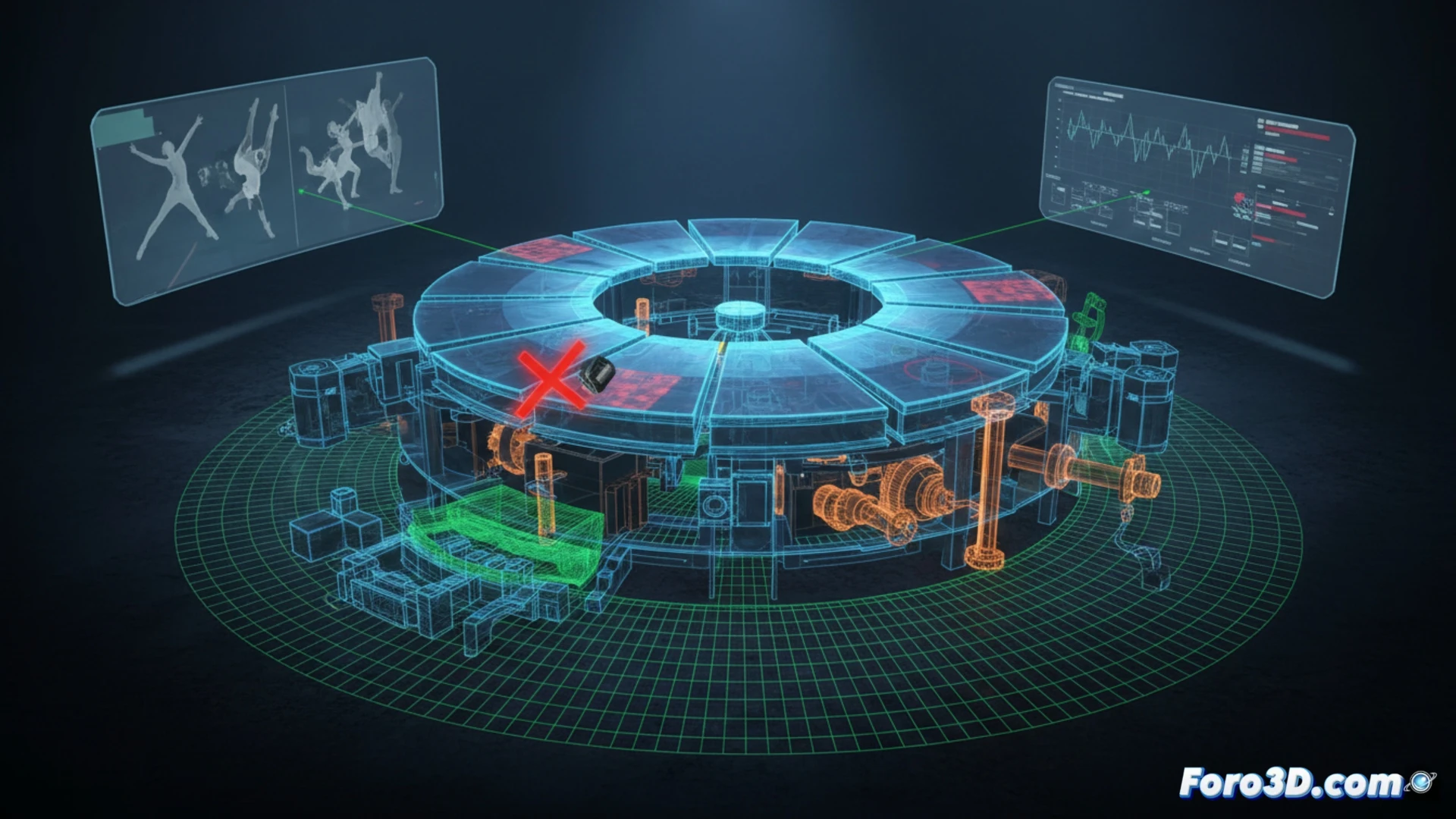
Forensic workflow: scanning, simulation, and recreation 🎭
The process began with scanning the deformed gear using FARO Zone 3D, generating a millimeter-precision point cloud that captured impact marks and altered geometry. This model was imported into Autodesk Inventor to reconstruct the original mechanism and compare the actual deformation with the theoretical one. The next phase used Siemens Star-CCM+ to simulate fluid dynamics and solid contact, evaluating how a foreign object (a detached bolt) could interrupt the rotation. Finally, Maya integrated all the data into a forensic animation showing the sequence of the lock, from the bolt's intrusion to the abrupt stop, facilitating understanding for the jury and engineers.
Lessons for stage mechanism design ⚙️
The investigation demonstrated that the control system was not responsible, exonerating the synchronization software. The failure was attributed to fatigue in a fastening element, whose detachment caused the jam. This case underscores the importance of integrating 3D scanning into predictive maintenance protocols for theaters. Additionally, the simulation in Star-CCM+ revealed that the gear's tolerance was insufficient to absorb foreign particles, suggesting a redesign of mechanical shielding systems for future installations.
What parameters of the 3D animation of the rotating stage's bevel gear allowed identifying the exact point of misalignment that caused the synchronization failure in the forensic expert analysis?
(PS: In the forensic pipeline, the most important thing is not to mix the evidence with the reference models... or you'll end up with a ghost in the scene.)