The failure in the braking zone of a launch roller coaster exposed a critical vulnerability in the magnetic braking systems. When the train failed to stop in time, the forensic investigation focused on the alignment between the copper fins and the permanent magnets. The main hypothesis pointed to deformations induced by eddy currents, a phenomenon that generates localized heat and thermal fatigue in the conductors. To validate this, laser metrology and electromagnetic simulation were used.
Laser Metrology and SolidWorks Reconstruction 🔧
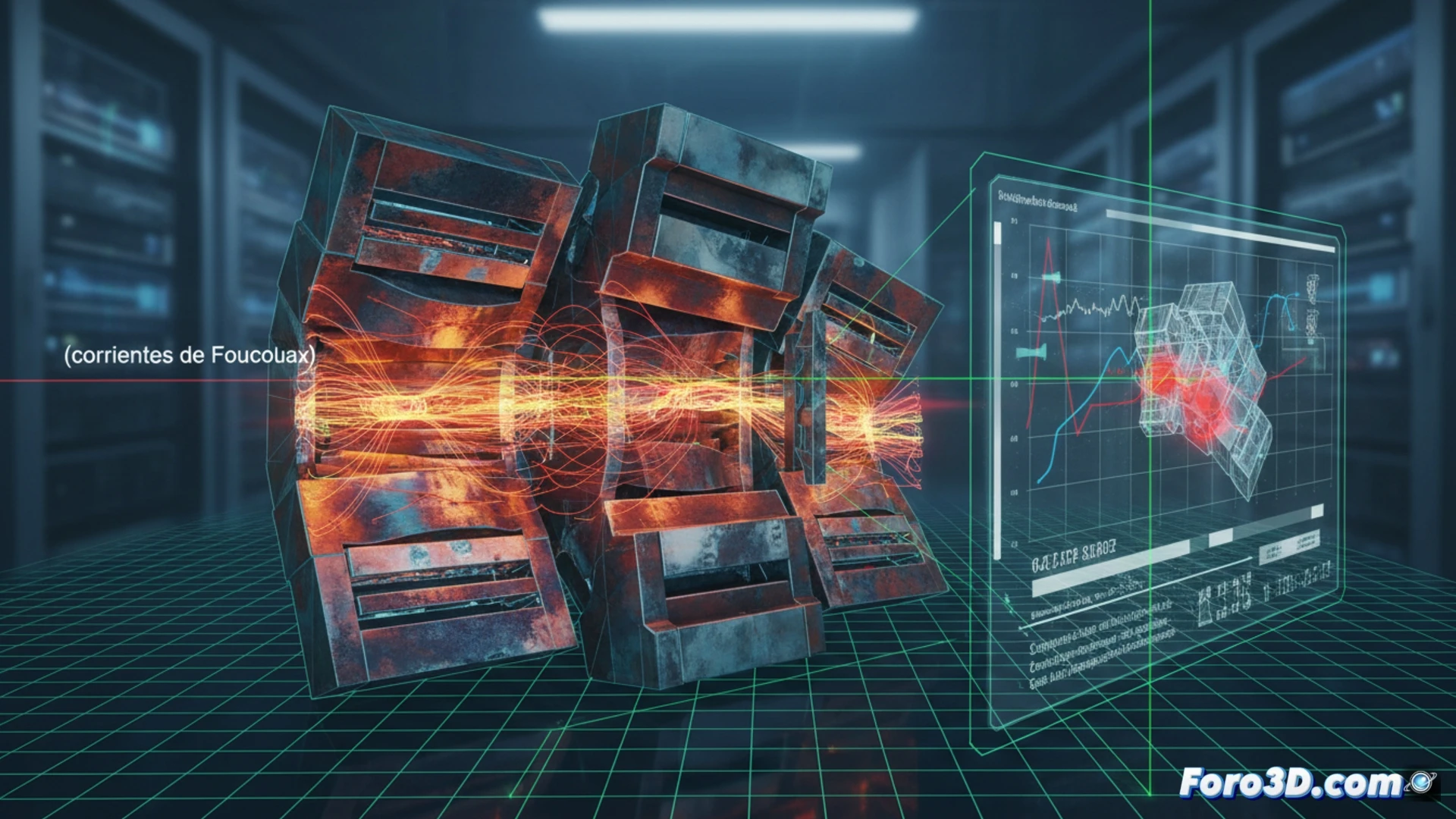
The first step of the forensic analysis involved scanning the copper fins with a high-precision laser metrology system. The data obtained was processed in GOM Control X to generate a point cloud that revealed geometric deviations. Micro-deformations of up to 0.8 mm were detected on the fin edges, areas where eddy current density is highest. Using SolidWorks, the original CAD model was reconstructed and compared with the deformed geometry. This analysis allowed quantifying the loss of parallelism between the fins and the magnets, a factor that drastically reduces braking force. The simulation in Ansys Maxwell confirmed that these deformations altered the magnetic flux, generating hot spots that accelerated material fatigue.
The Forensic Lesson of Magnetic Alignment ⚡
The case demonstrates that material fatigue in magnetic braking systems depends not only on mechanical cycles but also on thermal and electromagnetic interaction. Eddy currents, although useful for braking, degrade copper asymmetrically if the initial alignment is not perfect. 3D forensic analysis, combining laser metrology and simulation, becomes an indispensable tool for predicting these failures. The next time a launch train stops smoothly, let us remember that the millimeter precision of its fins is what prevents disaster.
How can the distribution of eddy currents in a magnetic brake be modeled in 3D to accurately predict material fatigue in the braking zone of a launch roller coaster?
(PS: Material fatigue is like yours after 10 hours of simulation.)