Documentation of a wildlife attack requires a scientific rigor that goes beyond simple observation. When an animal causes injuries or property damage, the expert faces the challenge of interpreting a dynamic and violent scene from static evidence. Photogrammetry and 3D scanning have become essential tools for capturing the scene with millimeter precision, allowing the recording of footprints, claw marks, and the exact position of the victim without contaminating the evidence.
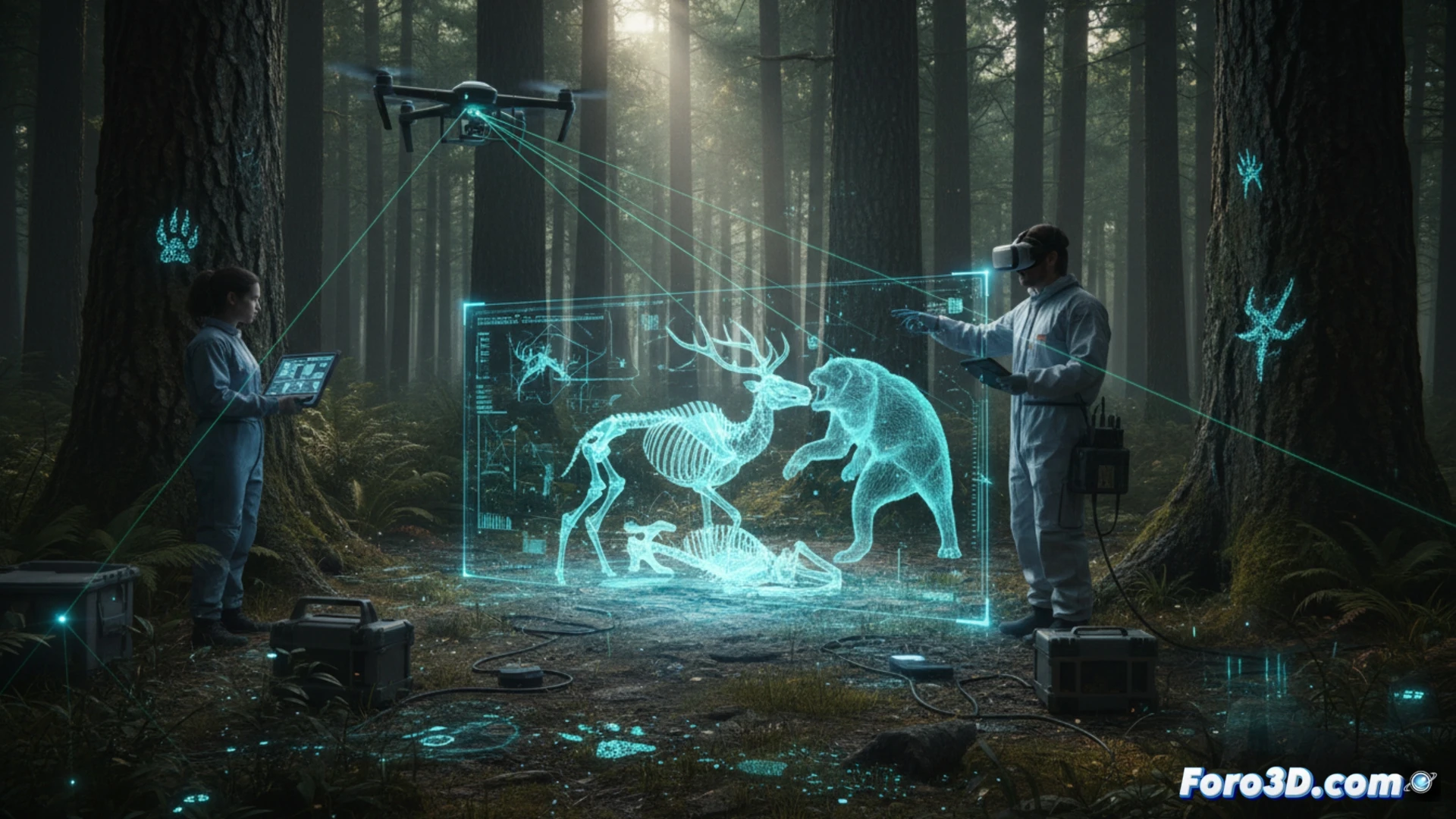
Technical Workflow for Scene Reconstruction 🔍
The process begins with the massive capture of high-resolution images from multiple angles, prioritizing impact zones and drag marks. Using Structure from Motion (SfM) software, a dense point cloud is generated that models the terrain and objects. From this mesh, the model can be scaled and attack vectors projected. The next step is biomechanical simulation: a skeletal model of the suspected animal (bear, feline, canine) is imported and its posture is adjusted to match the bite marks on the 3D model of the victim. This allows calculating the impact angle, relative force, and approach trajectory, data that can be decisive in a trial or in an animal behavior study.
The Value of Simulation in the Face of Subjectivity ⚖️
The main advantage of this methodology is objectivity. A 3D expert model does not lie or forget; it can be reviewed by any opposing expert from any angle. By simulating the dynamics of the attack, unviable hypotheses are discarded. For example, it can be demonstrated that the wounds are not compatible with a frontal attack, but rather with a lateral ambush. This approach transforms a confusing scene into an irrefutable visual narrative, raising the standard of expert evidence and offering justice both to the victims and to the understanding of the wildlife involved.
How can the three-dimensional reconstruction of bite marks and paw prints in a wildlife attack objectively differentiate between a defensive attack and a predatory one in the forensic analysis of the scene?
(PS: In scene analysis, every scale witness is a little anonymous hero.)