The explosion of a high-security vault no longer leaves gunpowder residue, but an STL file. In this forensic synopsis, we analyze how a team of experts used 3D scanning microscopy to capture the micro-impact marks on a lock's cylinders. The goal was to demonstrate that a key manufactured with 3D printing, after a bumping process, could manipulate the pistons without leaving evidence of mechanical forcing visible to the naked eye.
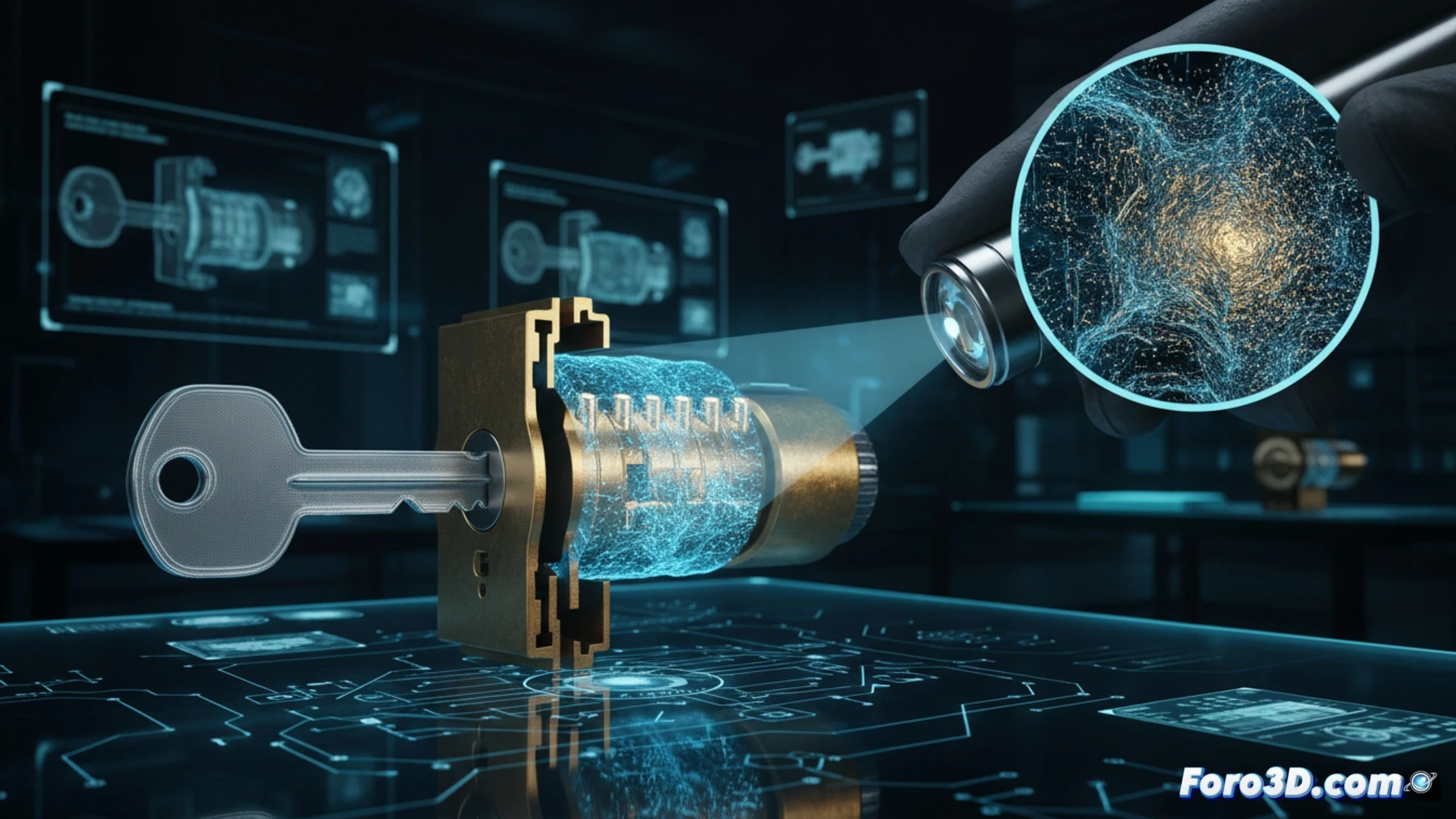
Forensic Workflow: From Microscope to Mechanical Simulation 🔬
The process begins with microscopic scanning of the cylinders using an optical profilometer. Surface images are processed in Geomagic Design X to generate a high-resolution CAD model of the notches and pistons. With this data, reverse engineering of the internal geometry is performed, identifying the striking marks generated by the impact of the bumping key. Subsequently, the system's kinematics are exported to MATLAB, where the interaction between the 3D printed key and the pistons is simulated. The simulation calculates contact forces and the opening sequence, validating that the key profile is capable of aligning the pistons without damaging the cylinder.
Implications of the Vulnerability in High-Security Systems ⚠️
This expert appraisal demonstrates that physical security no longer depends solely on metal, but on the software's ability to replicate movement. The combination of KeyShot for forensic visualization and MATLAB for contact dynamics allows experts to present irrefutable proof: the vault was opened through a digital bumping attack, not by brute force. This case establishes a new standard in the forensic pipeline, where 3D scanning and mechanical simulation are the definitive tools for documenting the exploitation of high-security systems.
It is possible to reconstruct the exact sequence of manipulation of a high-security vault from the micro-imperfections captured in a 3D scan of its internal surface.
(PS: don't forget to calibrate the laser scanner before documenting the scene... or you might be modeling a ghost)