The character of Patriot, Eli Bradley, represents a unique fusion between sequential art and social activism. Created by Allan Heinberg and Jim Cheung, this young leader of the Young Avengers uses a variant of the super-soldier serum not only to fight crime but to honor the legacy of his grandfather, a forgotten African American super-soldier. This visual narrative raises questions about historical memory and social justice, themes that today find a powerful ally in digital tools.
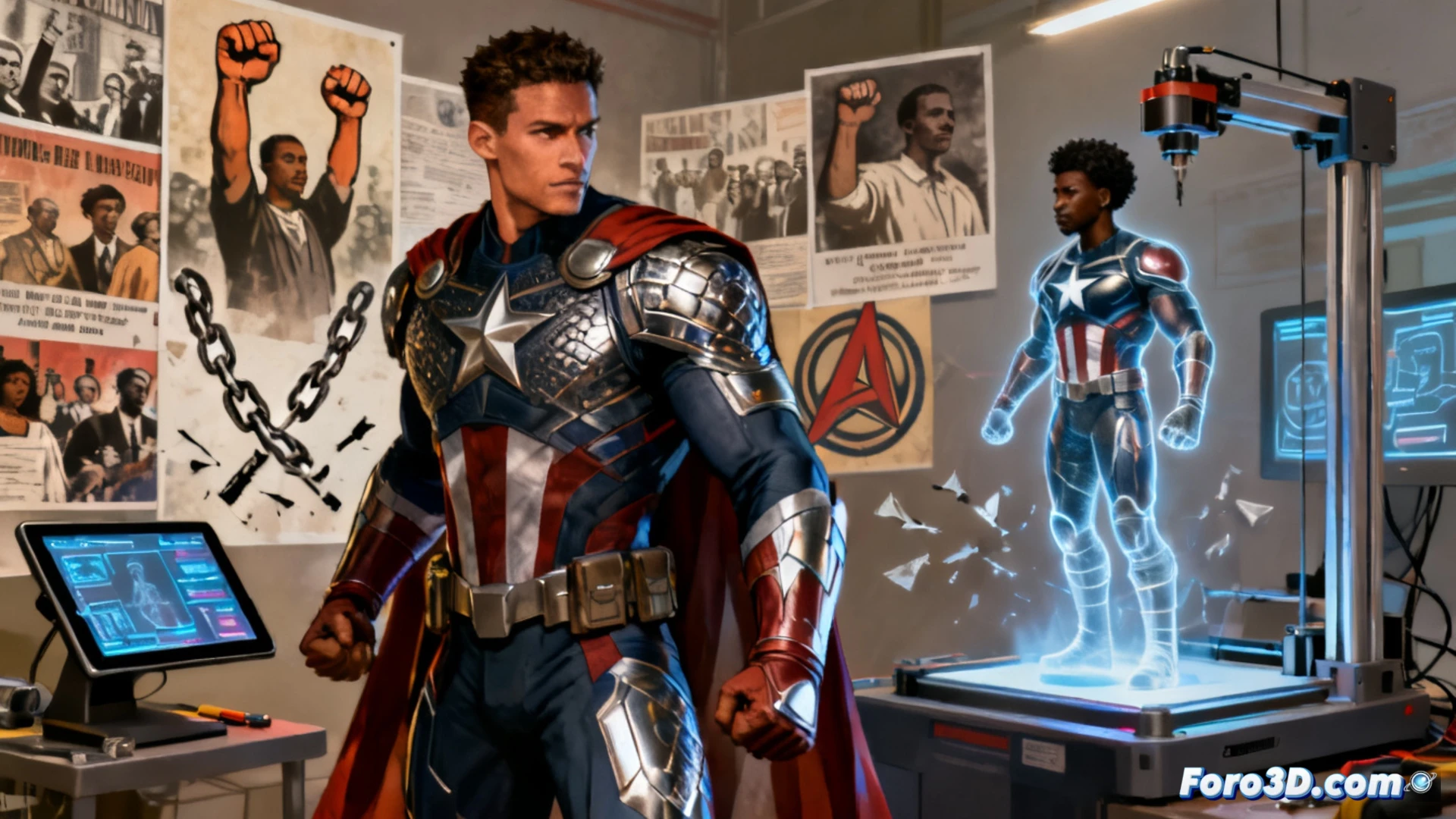
Technical reconstruction: from comic to 3D modeling 🎨
For 3D artists, Patriot offers a fascinating technical challenge. His design, with a mask that partially conceals his young face and a cape that flows with movement, is ideal for practicing fold modeling and dramatic lighting. On platforms like Blender or ZBrush, creators can recreate key scenes, such as the serum injection or his heroic leap. The use of PBR textures allows capturing the metallic sheen of his armor and the worn fabric. Additionally, animating his acrobatic movements requires precise rigging, making his model an excellent project for action character portfolios.
Virtual reality and visual justice: an interactive legacy 🕶️
Beyond static modeling, Patriot is a perfect candidate for virtual reality experiences. Imagine a scene where the user, as Eli, discovers his grandfather's hidden files in the Super-Soldier Laboratory. This immersion not only entertains but triggers reflection on historical erasure. 3D fan arts and VR environments are already exploring this line, turning digital art into a tool for activism. By rendering his story, creators not only honor the character but amplify a message of resistance and memory that transcends the panel.
How can 3D modeling of Patriot's, Eli Bradley's, suit and iconography serve as a tool for digital activism to re-signify the legacy of African American superheroes in sequential art
(PS: at Foro3D we believe all art is political, especially when the computer freezes)