The recent news about defects in safety glass due to particle inclusions brings back to the table a classic problem in materials science: contaminant-induced fragility. Although tempered glass is known for its high compressive strength, any solid impurity trapped during the melting process acts as a stress concentrator. From a fatigue simulation standpoint, these particles generate a heterogeneous stress field that drastically reduces the material's fracture threshold, turning an apparently sound panel into a structural time bomb.
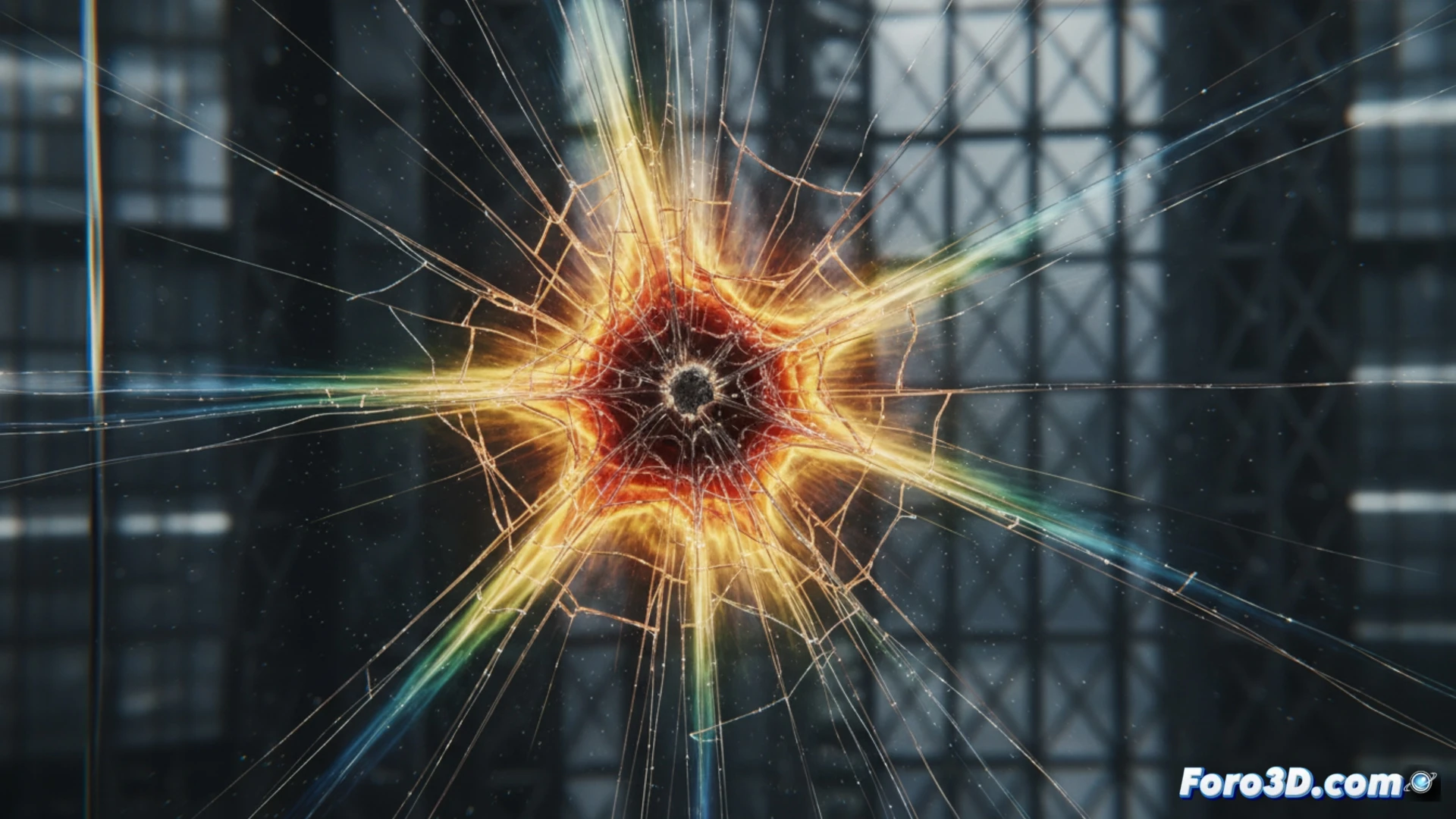
3D modeling of crack nucleation by inclusions 🔬
To understand the phenomenon, we have developed a 3D finite element model that reproduces the behavior of a safety glass sheet with an unmelted spherical silica inclusion inside. When applying a cyclic load equivalent to wind pressure or thermal impacts, the simulation software reveals how the difference in elastic modulus between the particle and the glass matrix generates localized stress peaks up to three times the nominal value. The crack does not initiate at the edge of the panel, but at the particle-glass interface, propagating in a fan shape until reaching the surface. In contrast, the defect-free model shows a uniform stress distribution and a service life up to ten times longer. The 3D visualization allows precise identification of the fracture path, validating the patterns observed in the reported real failures.
Lessons for predictive quality control ⚙️
This analysis demonstrates that traditional visual inspection is not sufficient to guarantee the integrity of safety glass. Fatigue simulations suggest implementing machine vision systems with submillimeter inclusion detection algorithms during the tempering process. Furthermore, predictive modeling allows establishing tolerance thresholds: a particle of just 50 microns can compromise the panel's strength if located in the maximum design stress zone. Incorporating this data into manufacturing standards would not only reduce claims but also raise the safety standard in facades and windshields.
Is it possible to accurately predict, through finite element simulation, the exact point of fatigue crack initiation in tempered glass based on the morphological and compositional characterization of a microscopic particle inclusion?
(PS: Material fatigue is like yours after 10 hours of simulation.)