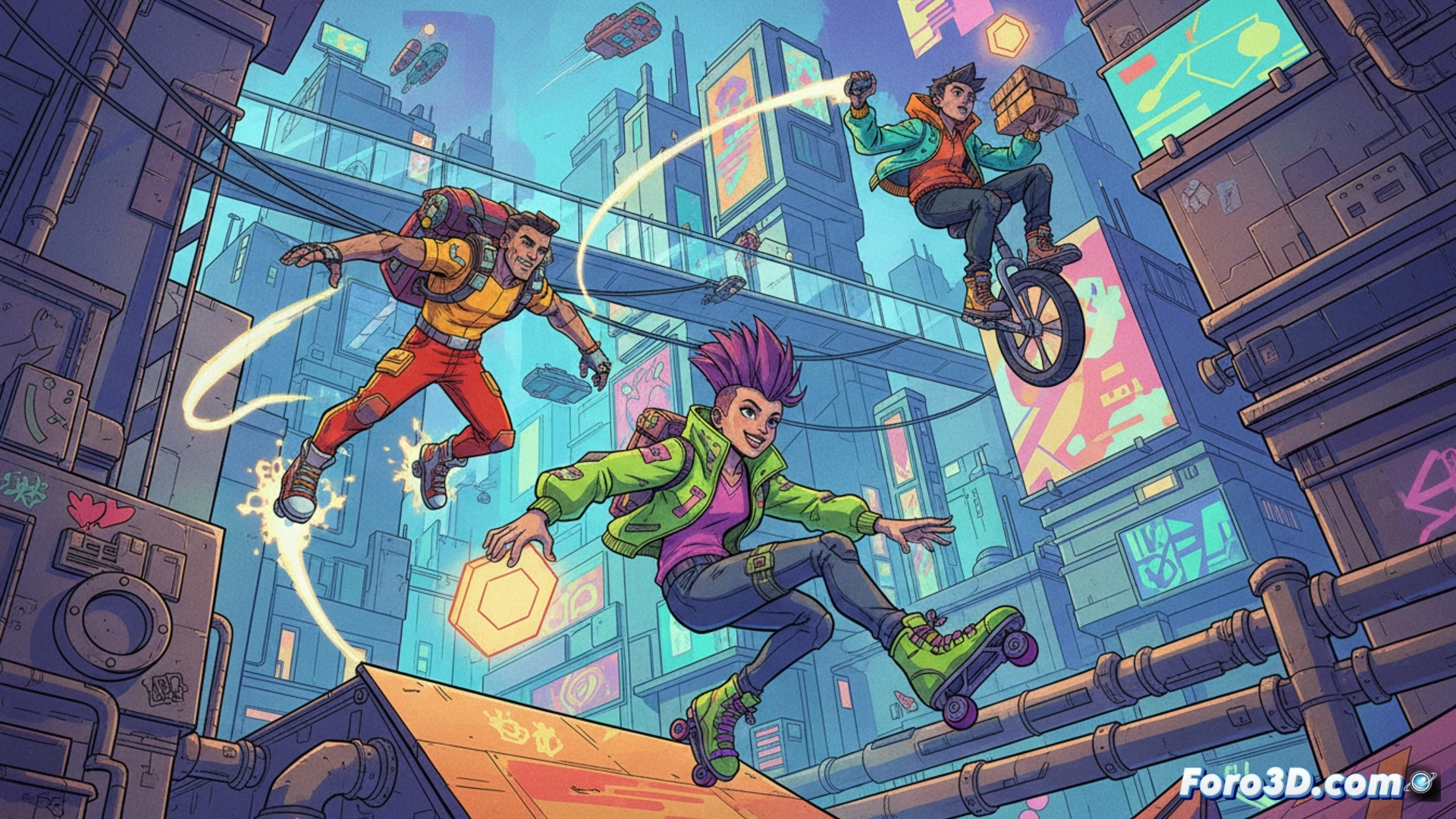
Parcel Corps is an indie title that demonstrates how a small team can achieve a huge visual impact through smart art direction. The game uses Unity as its main engine, combined with Blender for 3D modeling and Substance Painter for textures. Its cel-shaded aesthetic, with thick contour lines and saturated colors, pays direct homage to classics like Jet Set Radio. This article breaks down the technical pipeline behind this style, offering practical lessons for developers seeking a vibrant finish without relying on photorealistic graphics.
Texturing Pipeline and Real-Time Optimization 🎨
The process begins in Blender, where urban environments and characters are modeled with clean geometry and low polygon density, prioritizing clear silhouettes that enhance the cartoon effect. Then, in Substance Painter, textures are applied with flat shadows and solid colors, using edge generators to simulate pencil or marker strokes. The key lies in baked light maps: fixed shadows are generated in Blender and integrated into the Substance albedo, reducing the load of dynamic lights in Unity. For contour lines, a custom shader in Unity detects edges using the normal angle and depth map, drawing black strokes of variable thickness. This ensures stable performance even on modest hardware, essential for an indie game.
Indie Lessons for a Visual Style with Limited Resources 🚀
Parcel Corps shows that technical limitation can be a creative advantage. By opting for cel-shading, the team avoided the need for ultra-realistic textures, complex lighting, or real-time soft shadows. The saturated color palette and thick lines not only evoke nostalgia but also hide modeling imperfections and allow assets to look consistent at different camera distances. For indie developers, the lesson is clear: investing time in a solid outline shader and baked textures from Blender can save months of later optimization. The result is a vibrant, energetic world that runs without sacrificing smoothness.
How does the combined use of Unity and Blender in Parcel Corps optimize the workflow to achieve a vibrant cel-shaded look without sacrificing performance in a small indie development team?
(PS: 90% of development time is polishing, the other 90% is fixing bugs)