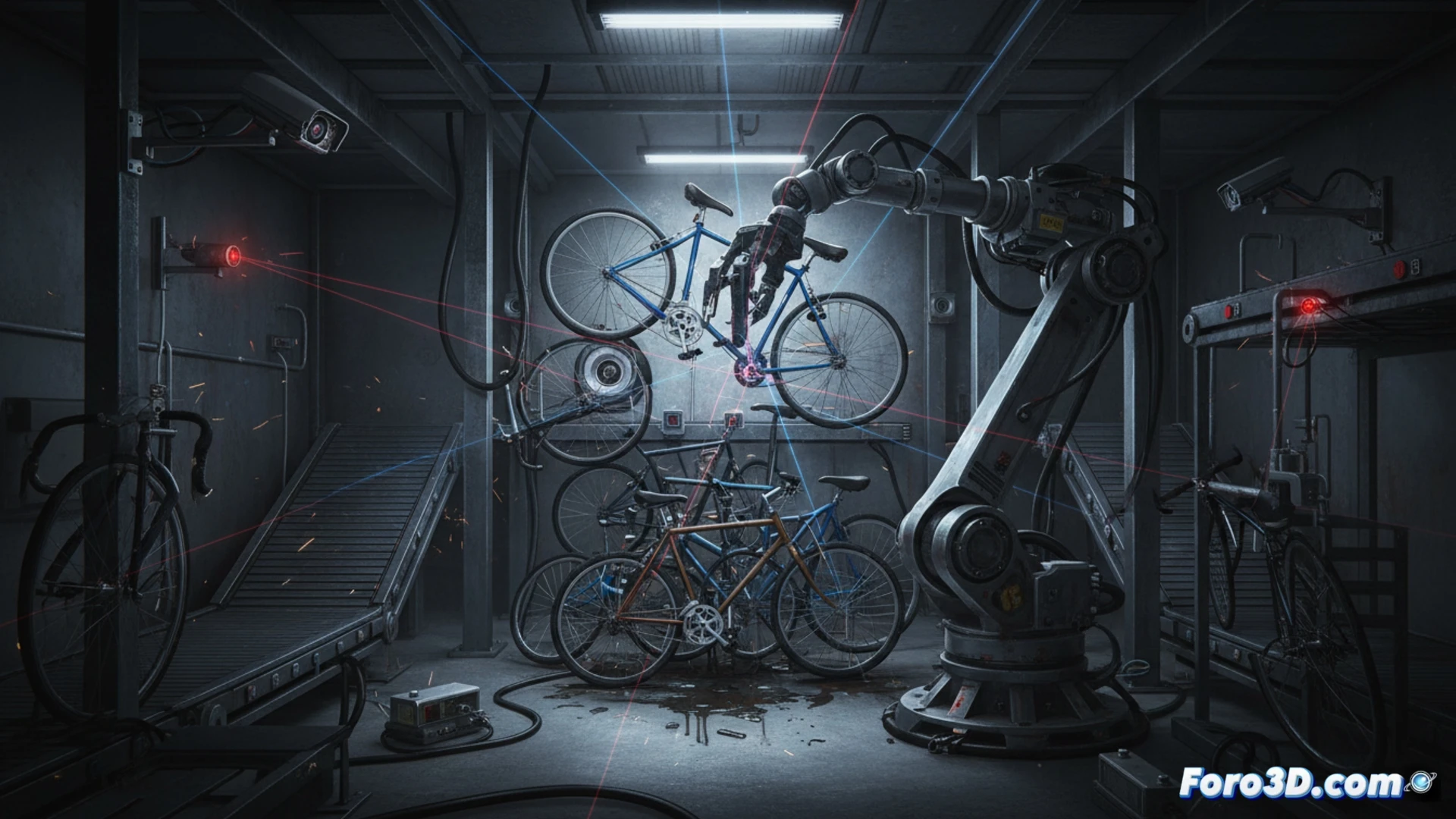
An automated bicycle parking system has suffered a critical failure in its stacking module. The error, identified as a parallax problem in the robot's shape recognition, caused the mechanical arm to apply compressive force on poorly positioned units, crushing them. This incident exposes a classic vulnerability in robotic perception: the reliance on precise sensory calibration for safe object manipulation in dynamic environments.
Technical diagnosis: Gazebo simulation and LiDAR reconstruction 🛠️
To reconstruct the damaged inventory and analyze the failure sequence, the engineering team turned to a workflow combining simulation and 3D data processing. First, the scenario was replicated in Gazebo, using robot and bicycle models designed in Solid Edge. The simulation revealed that the vision system, when calculating depth, suffered from a parallax error: it detected two bicycles where there was only one, ordering the arm to perform a gripping movement that collided with the frame of the lower bicycle. Subsequently, a LiDAR scan of the storage area was performed. The resulting point cloud was processed in CloudCompare to align the geometries of the surviving and deformed bicycles, allowing quantification of structural damage and validation of the parallax error hypothesis in the digital twin.
Lessons for warehouse automation ⚙️
This case underscores that the reliability of an automated system lies not only in the power of its actuators, but in the robustness of its sensory pipeline. A simple parallax error, caused by poor camera calibration or incorrect depth interpretation, can generate uncontrolled destructive force. For dense storage applications, where objects are close together, it is vital to implement sensory redundancy and validate perception through stress simulations in environments like Gazebo before real-world deployment.
How can a computer vision system correct the parallax error in a robotic stacking module to avoid damage due to lack of precise depth?
(PS: Simulating robots is fun, until they decide not to follow your orders.)