The structural failure of an experimental solar sail in orbit provided a key case study for fatigue simulation in composite materials. Telemetry images revealed that the carbon fiber mast could not withstand uneven solar radiation, generating thermal buckling that prevented the full deployment of the surface. This article details the technical workflow applied to model the phenomenon.
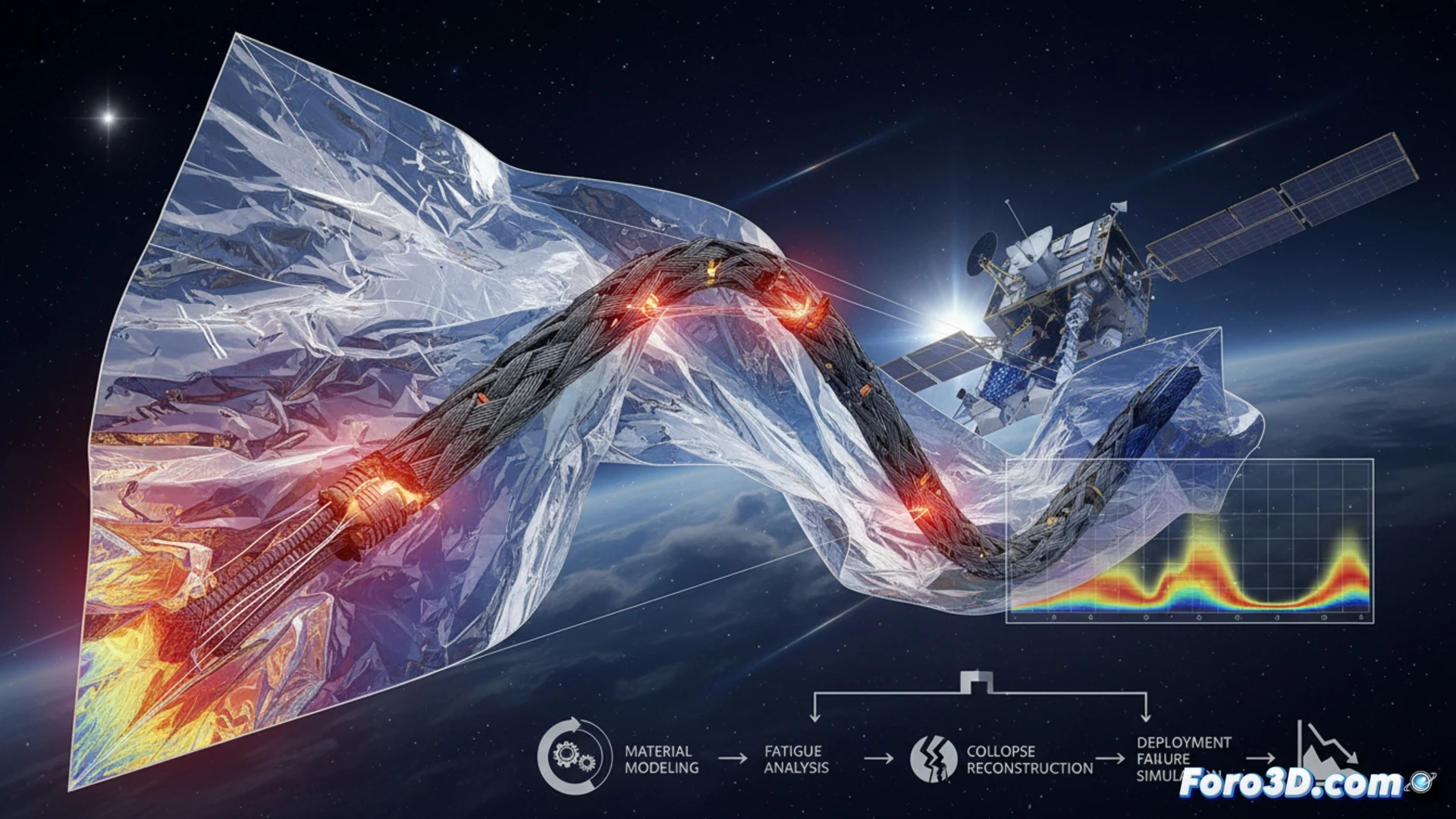
Workflow: from telemetry to structural deformation 🛰️
The process began with the geometric reconstruction of the mast in Ansys SpaceClaim, using angular position data extracted from visual telemetry. Subsequently, in Rhino with Grasshopper, a surface temperature gradient was defined based on the differential insolation of the orbital profile. This gradient was applied as a thermal load on the finite element model, simulating the differential expansion of the composite material. The resulting deformation was exported to Cinema 4D for integration into the scene and finally rendered in KeyShot, allowing precise visualization of the critical buckling point and the distribution of residual stresses.
Lessons for fatigue simulation in extreme environments ⚙️
The case demonstrates that thermal buckling simulation not only explains a past failure but is essential for predicting the lifespan of carbon fiber space structures. The integration of tools like SpaceClaim and Grasshopper allows replicating real stress conditions that ground tests cannot match. For the materials fatigue community, this workflow reinforces the need to model asymmetric thermal loads as a critical degradation factor in composites.
Which parameters of the finite element simulation were most critical to accurately reproduce the progression of thermal buckling and fatigue in the solar sail before the structural failure in orbit?
(PS: Material fatigue is like yours after 10 hours of simulation.)