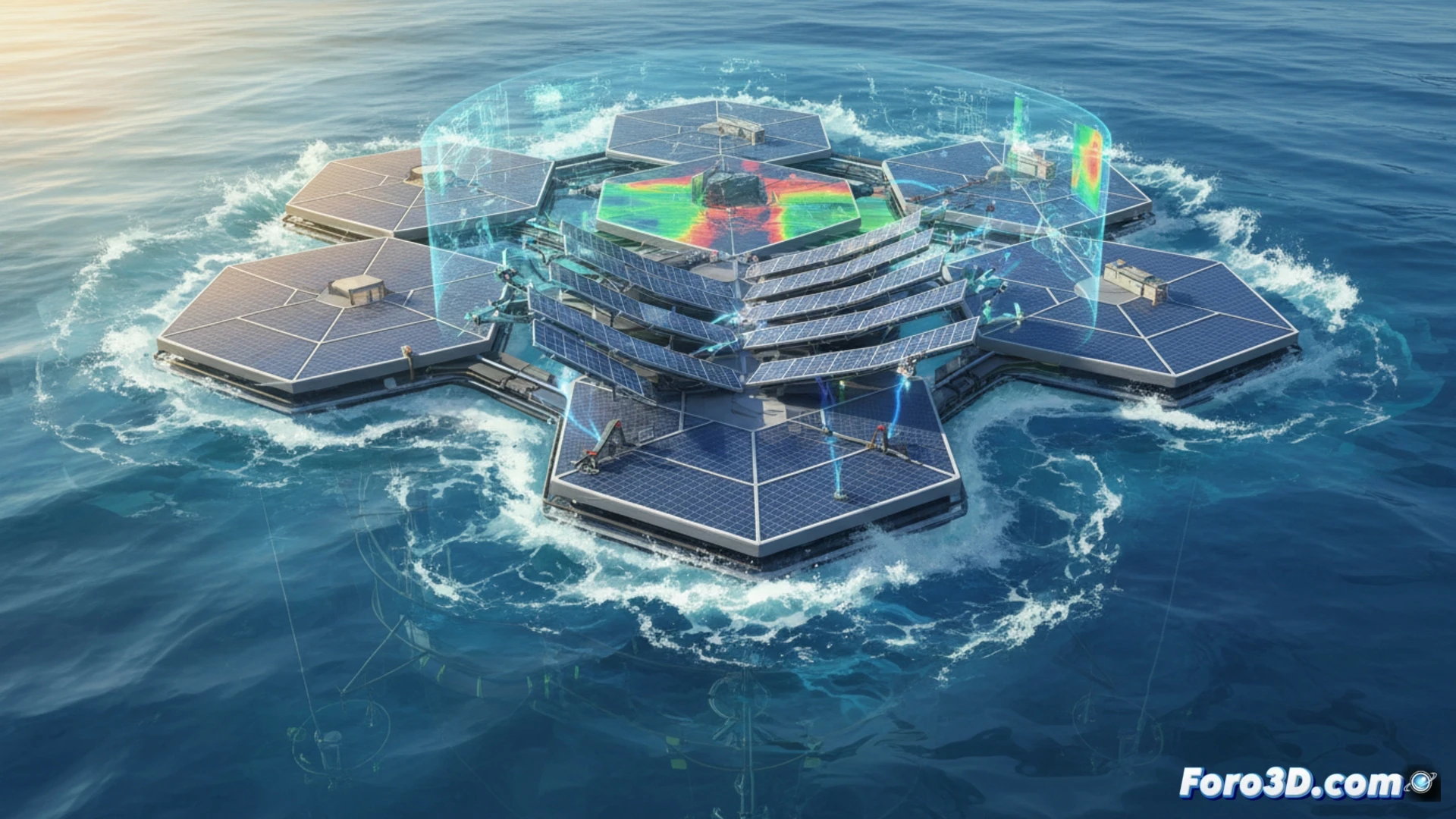
An island of floating photovoltaic panels in a reservoir suddenly collapsed, submerging underwater without warning. The failure was not due to fatigue or overload, but to a phenomenon of elastic instability known as snap-through. The key to understanding it was a digital twin that precisely replicated the interaction between the waves and the stiffness of the connectors.
Dynamic Modeling: OrcaFlex, Rhino 3D, and SAP2000 in Action ⚙️
The digital twin was built by integrating three specialized tools. OrcaFlex simulated the fluid dynamics and reservoir waves, calculating the variable hydrodynamic forces on the platform. Rhino 3D modeled the exact geometry of the panels and the floating structure, allowing adjustment of mass distribution and connector shape. Finally, SAP2000 performed the nonlinear stiffness analysis, detecting the critical point where the structure abruptly lost stability. The simulation showed that, upon reaching a specific wave height, the connectors deformed beyond their elastic limit, causing the sudden buckling that sank the island.
Lesson for the Niche: Preventive Simulation against Hidden Failures 🧠
This case demonstrates why digital twins are indispensable in floating infrastructure. Without the virtual replica, the snap-through failure would have been impossible to predict with traditional static calculations. Now, any solar panel project on water should include a complete dynamic simulation before actual construction. The technology already exists; it just needs to be applied systematically to prevent a solar island from becoming an unwanted artificial reef.
As a structural engineer, how did the digital twin manage to identify the sudden buckling failure mode in the floating structure before the collapse occurred on the solar island?
(PS: don't forget to update the digital twin, or your real twin will complain)