Palantir has published groundbreaking quarterly results: $1.63 billion in revenue, 85% more than the previous year, with an annual forecast close to $7.66 billion. Founded in 2003 by Peter Thiel and Alex Karp, the company has established itself as the technological arm of US intelligence. Its products Gotham, Foundry, and Maven AI not only process data but also define the critical paths of the defense supply chain, from target identification to troop logistics.
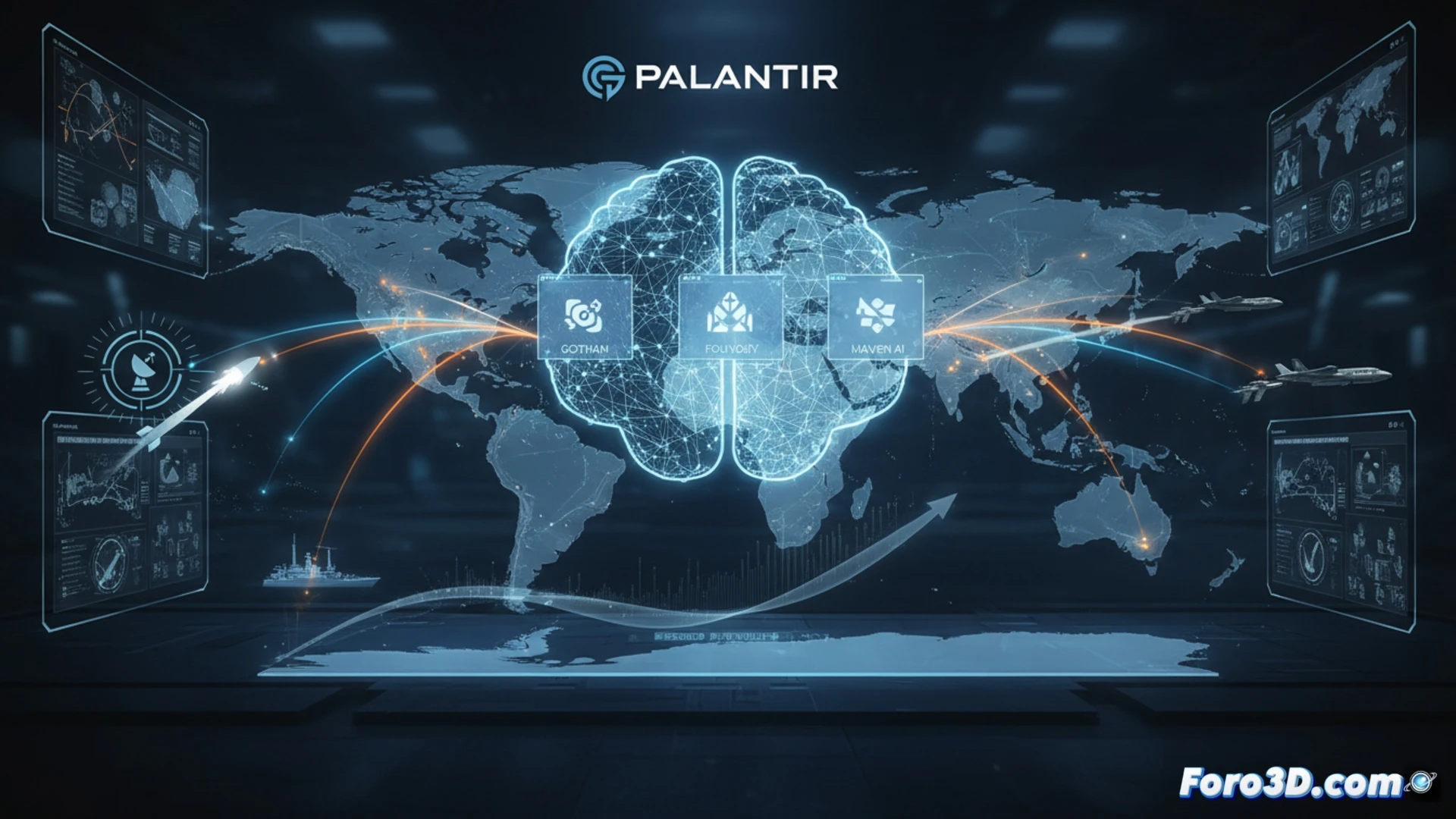
3D Visualization of Data Routes and Geopolitical Dependencies 🌐
To understand Palantir's impact on the global supply chain, it is necessary to model in 3D the data flows connecting the CIA, FBI, and Pentagon with their allies. Gotham software integrates scattered data from satellites, sensors, and human sources into coherent maps, creating a dependency mesh where the United States is the central node. Foundry, for its part, extends this network to the commercial sector, with 133% growth in the quarter to $595 million. Visualizing these connections allows simulating disruption scenarios: if an allied country restricts access to its intelligence data, or if a European regulation blocks the export of Maven AI, the system collapses in real time. The US government business, which generated $687 million, is the pillar supporting the entire architecture.
Regulatory Risk and the Monopoly of Military Analysis ⚠️
The controversy surrounding Maven AI, the command and control system that identifies targets in real time for the military, exposes the fragility of this chain. CEO Alex Karp insists that the United States remains the core of the business, but accelerated growth depends on global demand for data analysis. Any regulation restricting the sale of surveillance technology to foreign governments, or an embargo on critical components such as high-performance chips, could divert supply routes. In a world where artificial intelligence defines wars, Palantir does not just sell software: it controls the most sensitive links in the Western defense supply chain.
How can Palantir's expansion in the global intelligence supply chain redefine geopolitical control over strategic data and military logistics in a context of growing trade fragmentation between blocs such as the United States and China
(PS: simulating technological dependency is easy, the hard part is not depending on coffee while doing it)