Detection of a fission gas leak in a nuclear reactor triggered a 3D forensic investigation. Using micro-CT and Volume Graphics, the Zircaloy cladding was analyzed to determine whether the oxide layer thickness exceeded the critical limit, causing a burst due to internal pressure. This case exemplifies how material fatigue under extreme conditions can lead to catastrophic failure of critical components.
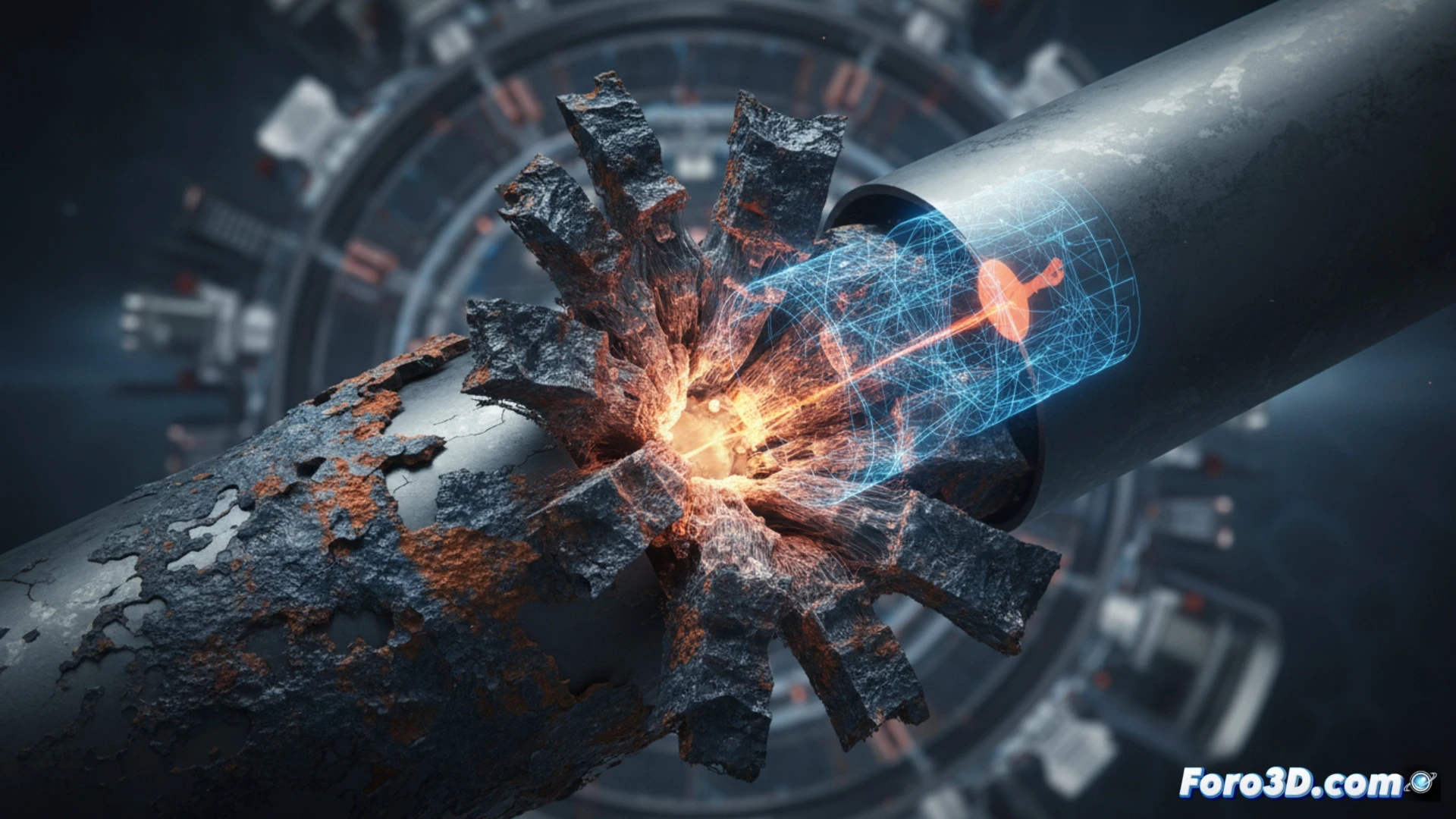
Correlation between oxide thickness and degradation models in MATLAB 🔬
Micro-CT allows obtaining volumetric cross-sections of the cladding with micrometric resolution. In Volume Graphics, the oxide layer is segmented to measure its thickness at each point on the surface. This data is exported to MATLAB, where degradation models are implemented to simulate oxide evolution as a function of time and temperature. The comparison between the measured thickness and the critical thickness (calculated by fatigue simulations under internal pressure) reveals the exact point where the burst occurred. Integrated 3D visualizations show the progression of the oxide and the plastic deformation prior to rupture.
Lessons for fatigue simulation in nuclear materials ⚛️
This analysis demonstrates that cladding fatigue depends not only on mechanical cycles but also on chemical degradation. The combination of micro-CT, Volume Graphics, and MATLAB allows validating predictive lifespan models. For simulation engineers, this case underscores the need to include variables such as oxide thickness in failure criteria, thus preventing premature ruptures in future fuel element designs.
How does the three-dimensional morphology of Zircaloy claddings, revealed by micro-CT, influence the prediction of fatigue failures under oxidation and burst conditions in a nuclear reactor?
(PS: Material fatigue is like yours after 10 hours of simulation.)