Osteopathy requires constant and repetitive physical contact, making the therapist's body its primary tool and, paradoxically, its first patient at risk. Epidemiological data reveal an alarming incidence of musculoskeletal disorders in this group, where manual manipulation and forced postures generate progressive wear and tear. This article proposes an interactive 3D visualization of these dangers, transforming abstract statistics into predictive models of fatigue and injury.
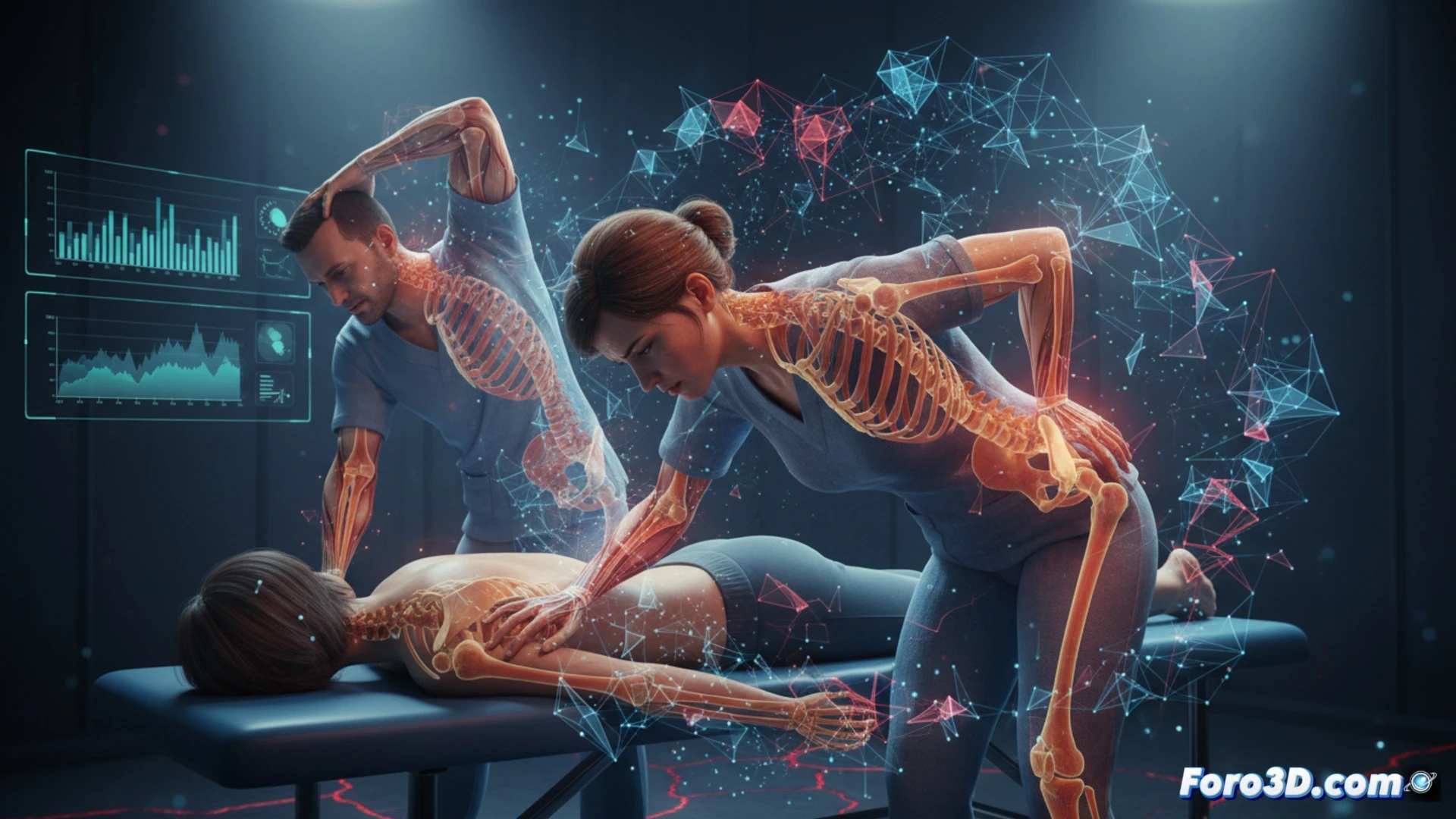
Body mapping of injury: heat maps and biomechanical simulations 🧬
Using volumetric graphics, we can represent the prevalence of injuries in key areas of the osteopath: a heat map on a 3D anatomical model would show that 78% of professionals report chronic low back pain, followed by 65% in wrists and thumbs. Postural simulation, based on motion capture, allows visualizing the accumulation of tension in the cervical spine during a 45-minute session, while a timeline graph projects the risk of disc herniation after 10 years of practice. Comparatively, osteopaths have a 40% higher incidence of hand injuries than generalist physiotherapists.
Stress and biology: the invisible risks in the consultation room 🦠
Beyond physical overexertion, exposure to biological risks and mental fatigue are critical factors. A 3D particle dispersion model can simulate the spread of aerosols during a close cervical manipulation, while an interactive thermogram shows how sustained concentration raises the therapist's heart rate. Visualizing this data allows for designing personalized active breaks and redesigning the clinical workflow, demonstrating that the osteopath's health is as vital as that of their patients.
As osteopathy turns the therapist's body into its main tool, 3D biomechanical metrics reveal the areas of highest risk for chronic injury during high-frequency repetitive maneuvers
(PS: at Foro3D we know that the only epidemic affecting us is the lack of polygons)