The craft of wood carving involves severe occupational risks: cuts from gouges and chisels, flying splinters, exposure to carcinogenic wood dust, eye strain, and forced postures. But the most silent and cumulative damage is musculoskeletal disorders of the wrist and hand, resulting from hours of manual detail and overexertion with tools. Faced with this scenario, 3D technology offers a solution through customized orthoses that prevent and mitigate these injuries.
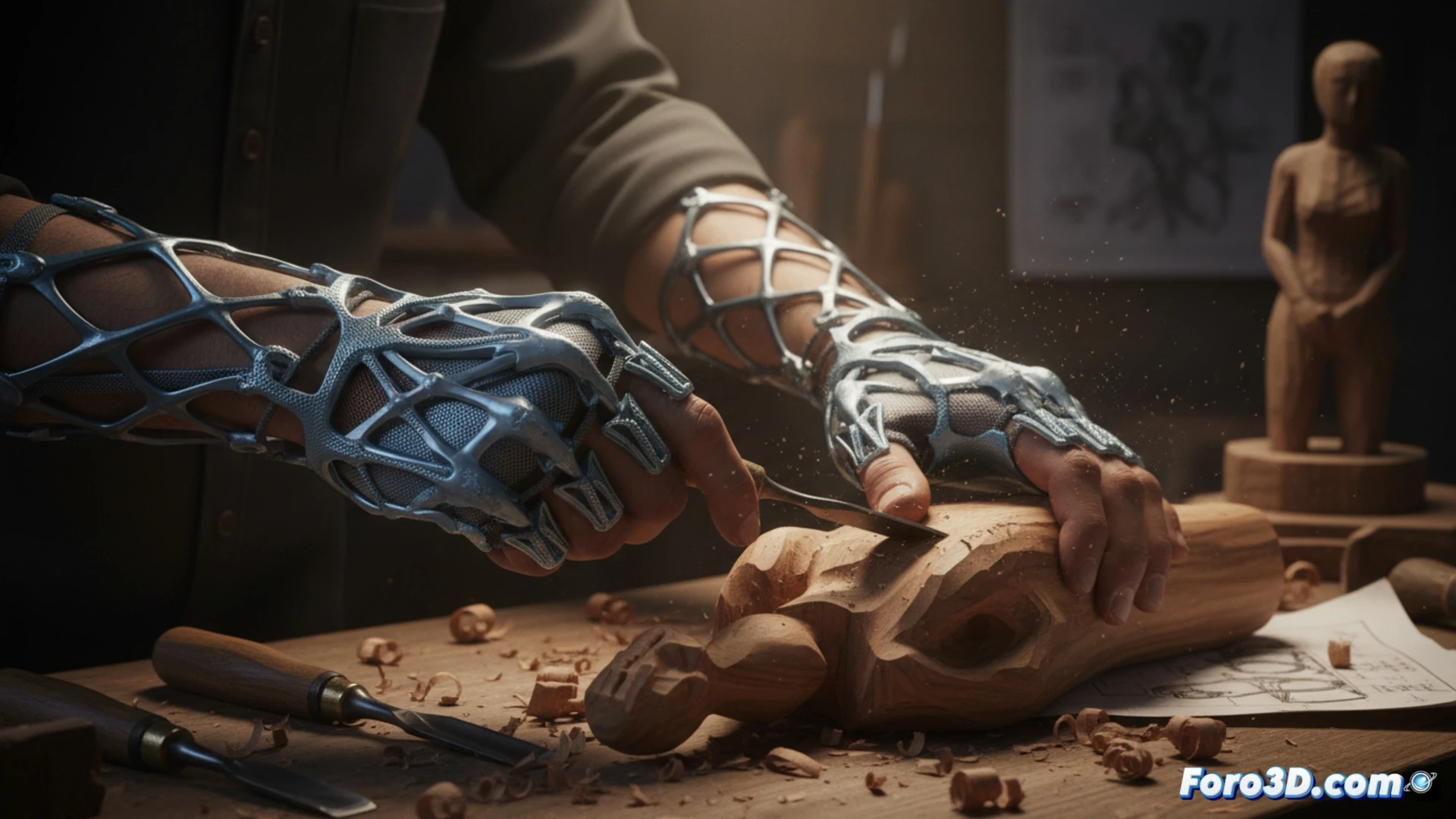
Parametric design and 3D scanning for workplace ergonomics 🛠️
The process begins with a 3D scan of the carver's hand and wrist, capturing the exact anatomy in working positions. Using parametric design software, a dynamic orthosis is modeled that immobilizes overloaded joints without blocking fine finger movement. Manufactured through additive printing in flexible materials like TPU or nylon, this splint distributes the forces from hammer strikes and reduces tendon tension. Unlike generic orthoses, 3D customization ensures a perfect fit that does not interfere with handling gouges.
From manual craftsmanship to digital prevention 🖐️
The transition does not aim to eliminate the craft, but to protect the artisan. While manual carving exposes workers to eye strain and forced postures, 3D orthoses act as passive exoskeletons that correct biomechanics. In rehabilitation, progressive splints are printed that allow the carver to safely resume their work after an injury. This approach demonstrates that 3D printing not only replaces artisanal techniques but makes them sustainable by preserving the health of those who perform them.
How can the customization of 3D-printed orthoses adapt to the repetitive movements of the carver to reduce injuries without limiting manual dexterity?
(PS: 3D prosthetics are so customized they even have fingerprints.)