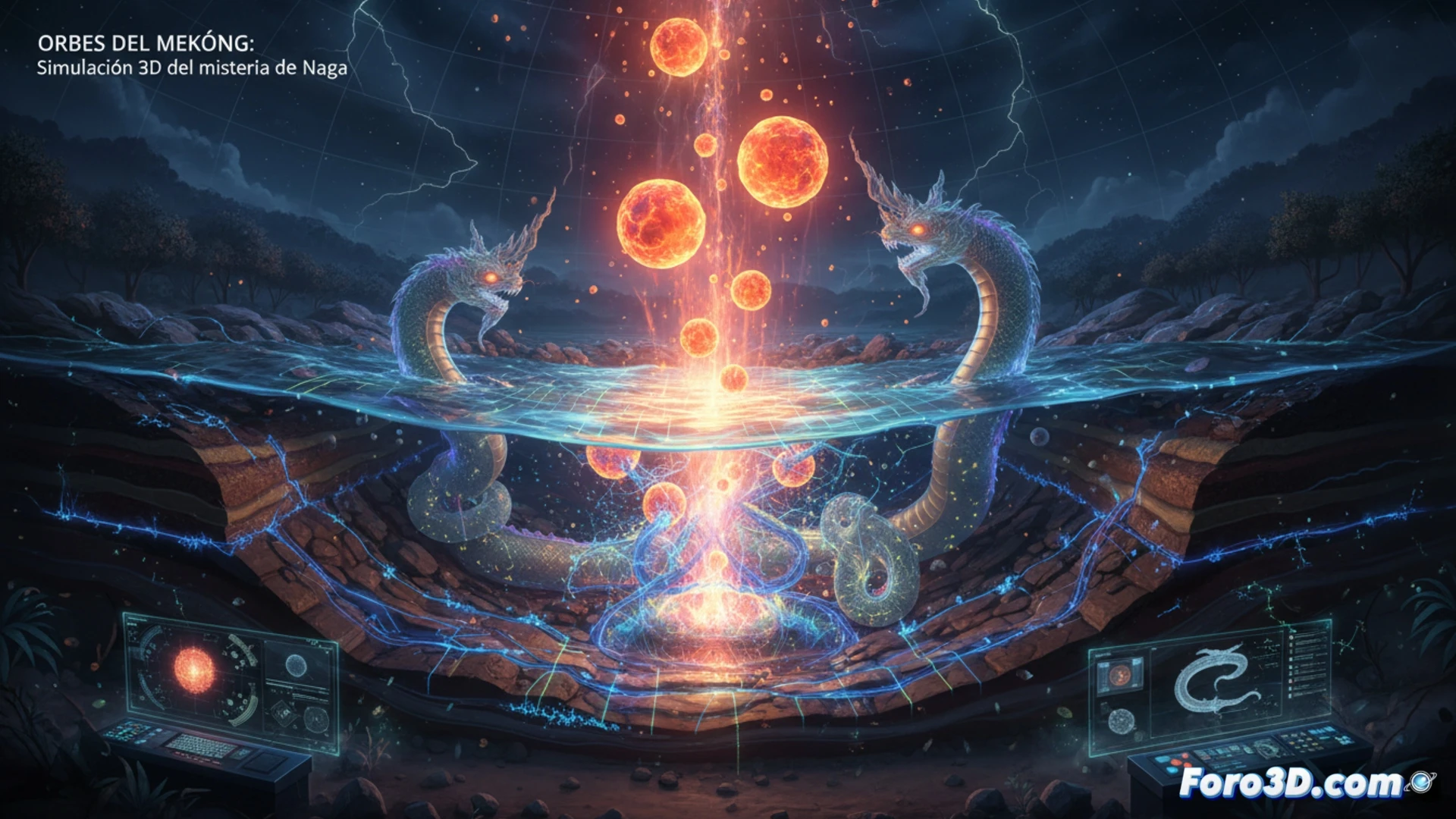
Every October, during the full moon, the Mekong River in Thailand releases reddish spheres of light that rise without combustion or sound. Known as the Naga Fireballs, this phenomenon challenges conventional physics. By applying scientific visualization tools such as VGSTUDIO MAX and COMSOL Multiphysics, it is possible to model the interaction between underground gases and electromagnetic fields, offering a technical framework to unravel their origin.
Tomography and bio-electromagnetic modeling of trajectories 🔬
The first step in analyzing these orbs would be to reconstruct their internal structure using computed tomography. With Materialise Mimics, the riverbed sediment can be segmented to identify pockets of methane or phosphine gas. Then, VGSTUDIO MAX would allow visualizing soil porosity and simulating the release of these gases under pressure. By integrating COMSOL Multiphysics in its bio-electromagnetism module, one could model how atmospheric ionization would induce the formation of a cold plasma, explaining the luminosity and disappearance without thermal residue. Computational fluid dynamics (CFD) simulations in COMSOL would help predict upward trajectories of hundreds of meters, adjusting variables such as humidity and air density.
Digital hypotheses for a natural enigma 🌌
The big question is why these orbs leave no trace. With 3D visualization, we can speculate about cold combustion or a chemiluminescent reaction without a flame. By overlaying electromagnetic field data onto the geological model in VGSTUDIO MAX, researchers could test whether a piezoelectric field generated by the rock beneath the river acts as a catalyst. Data science thus turns a legend into a quantifiable hypothesis, demonstrating that simulation software serves not only industry but also to explore the limits of the inexplicable on our planet.
We can model the Mekong fireballs as plasma particles with meteorological and geological data to rule out combustion, so what physical parameters must be adjusted in a 3D engine like Unreal Engine or Houdini to simulate their ascent without sound or visible thermal deformation?
(PS: if your manta ray animation isn't exciting, you can always add documentary music from channel 2)