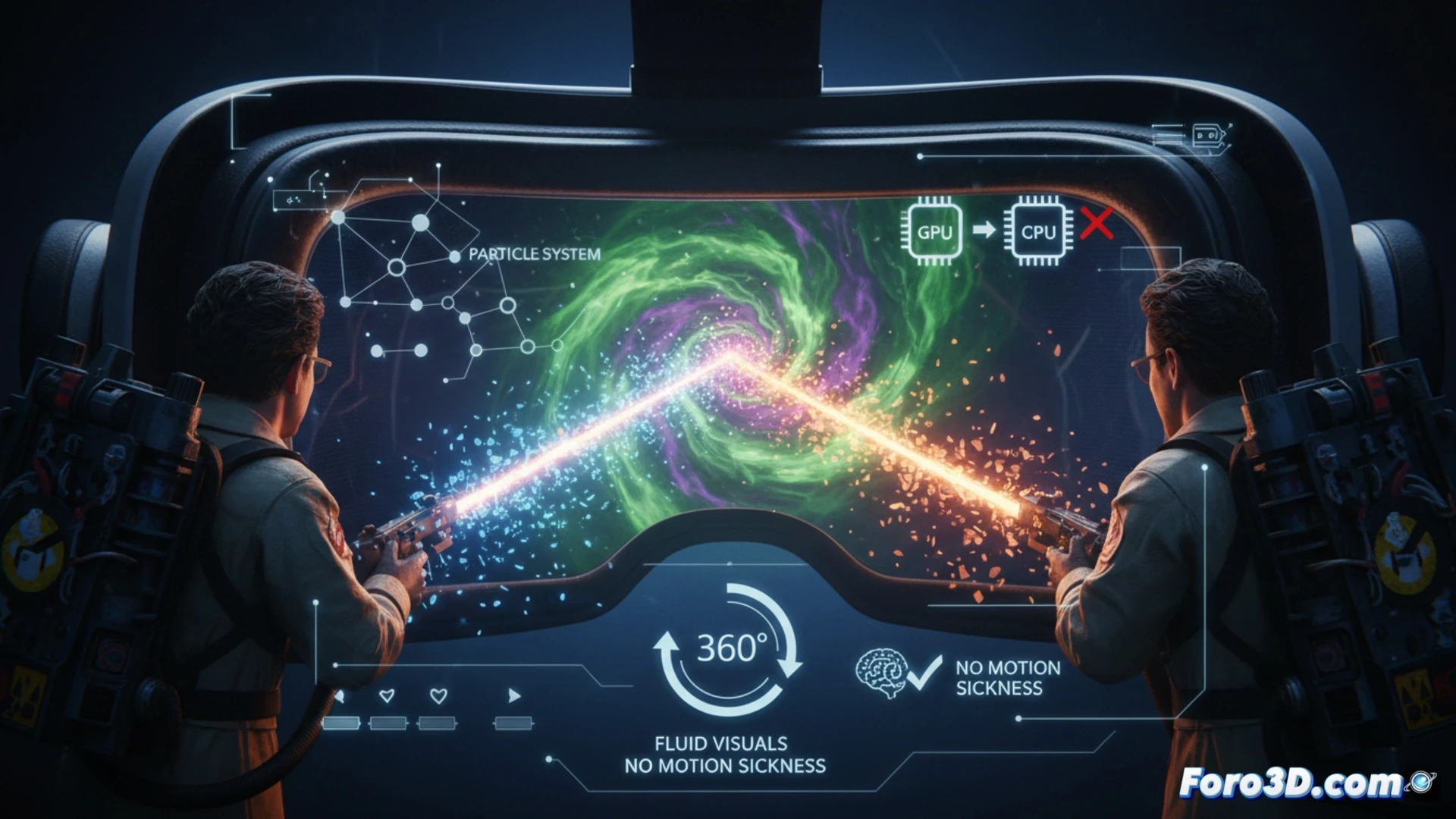
The development of Ghostbusters: Rise of the Ghost Lord presented a unique technical challenge for the studio: translating the iconic proton beams into virtual reality without sacrificing visual fluidity. In Unreal Engine 4, the team had to balance 360-degree spectral particle simulations with the demanding frame rate required to prevent motion sickness in VR. The key lay in optimizing the beam materials using GPU particle modules, reducing CPU overhead while maintaining the feeling of enveloping kinetic energy.
Workflow between Maya, ZBrush, and Unreal Engine 4 for spectral assets 🎨
The artistic pipeline began in Autodesk Maya for rigging and base animation of the ghosts, while ZBrush was used to sculpt the organic details of the creatures, leveraging its dynamic brushes to create translucent textures. Once retopologized in Maya, the assets were imported into Unreal Engine 4 where materials based on Shader Model 5 were applied. For dynamic lighting, the team deployed volume lights and point spotlights in enclosed environments such as warehouses and laboratories. This setup allowed for generating hard shadows and sudden flashes, crucial elements for provoking tension in the player, as light behaves as a visual lure that anticipates the appearance of a specter.
Technical lessons for VR developers 🎮
The case of Ghostbusters: Rise of the Ghost Lord demonstrates that immersion in VR depends not only on high-resolution modeling, but on the intelligent management of particle and light resources. For any developer working with Unreal Engine 4, the lesson is clear: prioritize the use of GPU particle systems and limit the number of dynamic lights per scene, using precomputed cubemaps for static surfaces. This ensures that the visual scare does not become a performance drop that breaks the magic of virtual reality.
How did they manage to optimize the performance of particle systems and proton beams in Unreal Engine 4 to maintain an immersive virtual reality experience without sacrificing visual fidelity in Ghostbusters: Rise of the Ghost Lord?
(PS: 90% of development time is polishing, the other 90% is fixing bugs)