A high-production 3D-printed plant-based meat line suffered a critical shutdown due to a pressure explosion. The initial diagnosis pointed to a nozzle blockage, but in-depth analysis revealed a more complex phenomenon: protein crystallization induced by faulty temperature control. This incident, far from being an isolated failure, becomes a perfect case study for industrial process simulation. 🔥
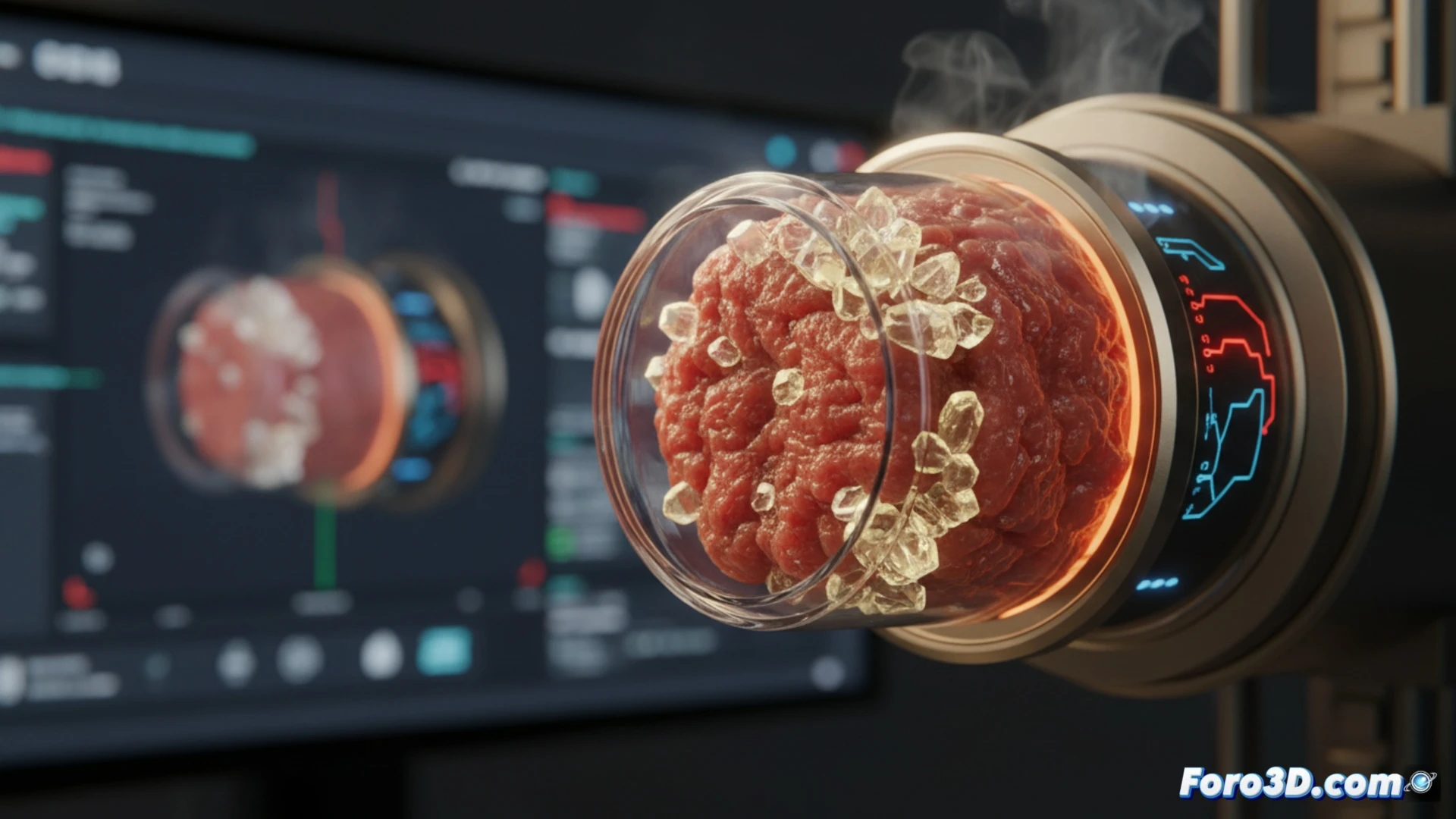
Multiphysics modeling with Flow-3D and Siemens NX to predict critical points 🧪
To replicate the failure and prevent its recurrence, a digital twin of the print head was used. Siemens NX modeled the exact geometry of the nozzle and extrusion channel, while Flow-3D simulated the non-Newtonian fluid dynamics of the protein paste. The coupled thermal simulation showed that, in certain low-flow velocity zones, the temperature dropped below the protein crystallization threshold. This thermal dead spot generated solid nuclei that grew until completely blocking the passage, raising internal pressure to the point of head explosion.
Lessons for 3D food production logistics 🚀
The case underscores the need to integrate fluid and thermal simulations before scaling recipes to high-production environments. A digital twin not only predicts mechanical failures but also allows redesigning the head temperature profile or extrusion speed to avoid the danger zone. In a sector where product consistency is key, preventive simulation becomes the standard for ensuring operational continuity and line safety.
What are the most effective methods to prevent protein crystallization in the nozzle during high-pressure and high-temperature 3D printing of plant-based meat?
(PS: visualizing logistics flows is like watching ants... but with less order and more budget)