The legend of the Money Pit on Oak Island, Nova Scotia, has fascinated treasure hunters for centuries. It is said that a system of tunnels and water traps protects a massive treasure yet to be recovered. Today, digital archaeology offers a new perspective: instead of picks and shovels, we use LiDAR scanners and photogrammetry to unveil the secrets of this intricate underground network from the surface.
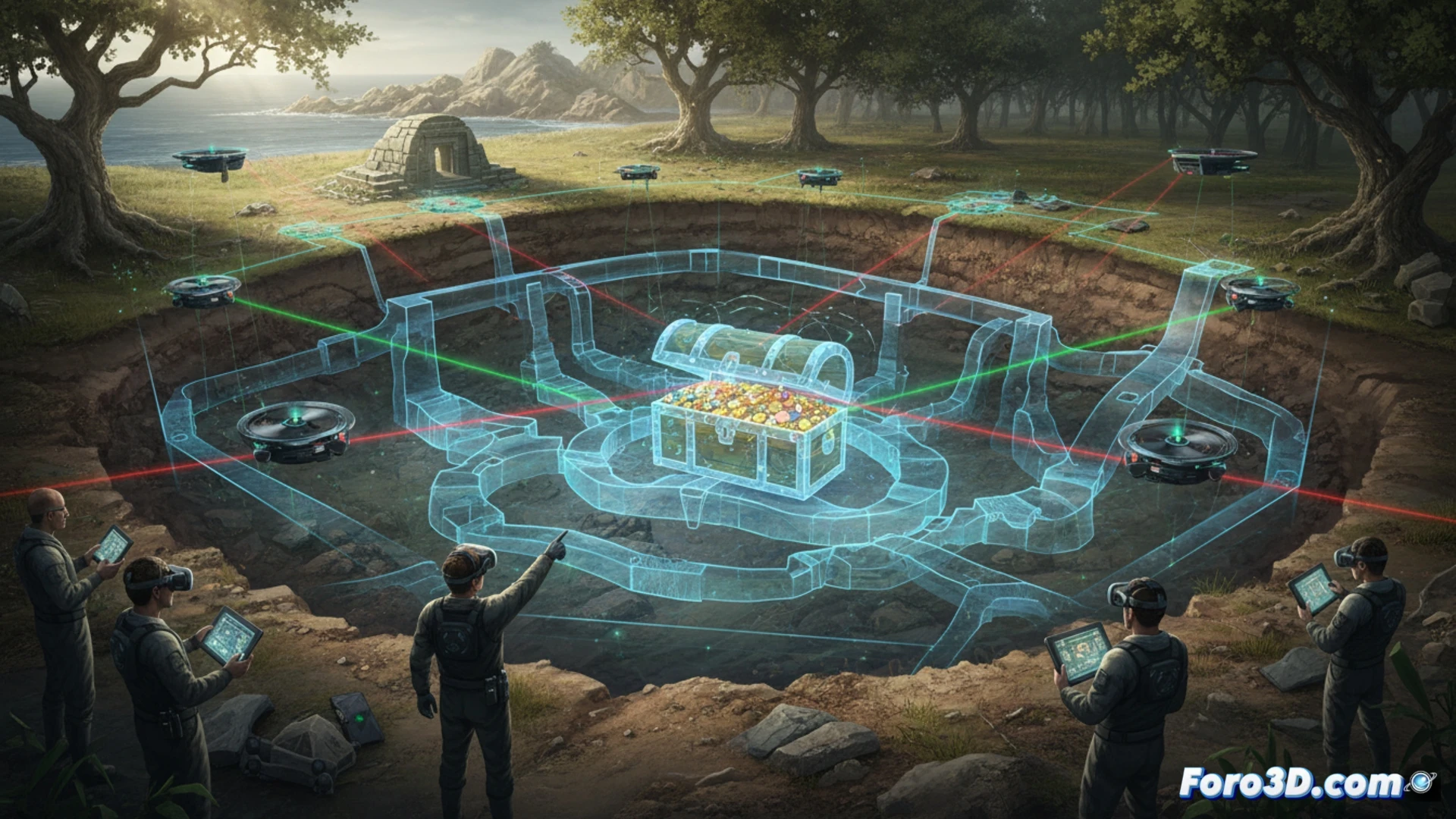
Photogrammetry and hydraulic simulation of the tunnel system 💧
The key to understanding Oak Island lies in its hydraulic engineering. Modern teams have applied terrestrial and aerial LiDAR scanning to generate high-density point clouds, creating digital elevation models that reveal anomalies beneath the ground. With this data, the network of tunnels and chambers has been virtually reconstructed. The next step is CFD (computational fluid dynamics) simulation. These models allow recreating the flow of seawater that floods the main shaft, validating the theory of traps designed to drown any excavator. Photogrammetry of artifacts recovered from previous excavations also helps date the different construction phases of the system.
Preserving the mystery, understanding history 🏛️
The great advantage of digital archaeology is its ability to document without destroying. Each excavation on Oak Island has compromised the integrity of the original system. Today, 3D reconstruction allows researchers to analyze the mechanics of the traps and the layout of the tunnels without removing a single stone. This approach not only preserves the heritage for future generations but also brings us closer to answering the big question: whoever built this masterpiece of hydraulic engineering invested a titanic effort to ensure their secret was never stolen.
What 3D scanning technology has been used to model the underground tunnels of Oak Island and how does it allow distinguishing artificial structures from natural geological formations without the need for excavation.
(PS: If you dig at a site and find a USB drive, don't plug it in: it could be Roman malware.)