The NZXT H9 Elite arrives on the market promising a revolution in PC aesthetics, but for 3D modeling and rendering professionals, aesthetics aren't everything. This dual-chamber chassis, with its wraparound tempered glass panels, aims to be the perfect showcase for high-end hardware. However, the real question is whether its design prioritizes the functionality demanded by an intensive 3D workflow, where cooling and GPU space are critical.
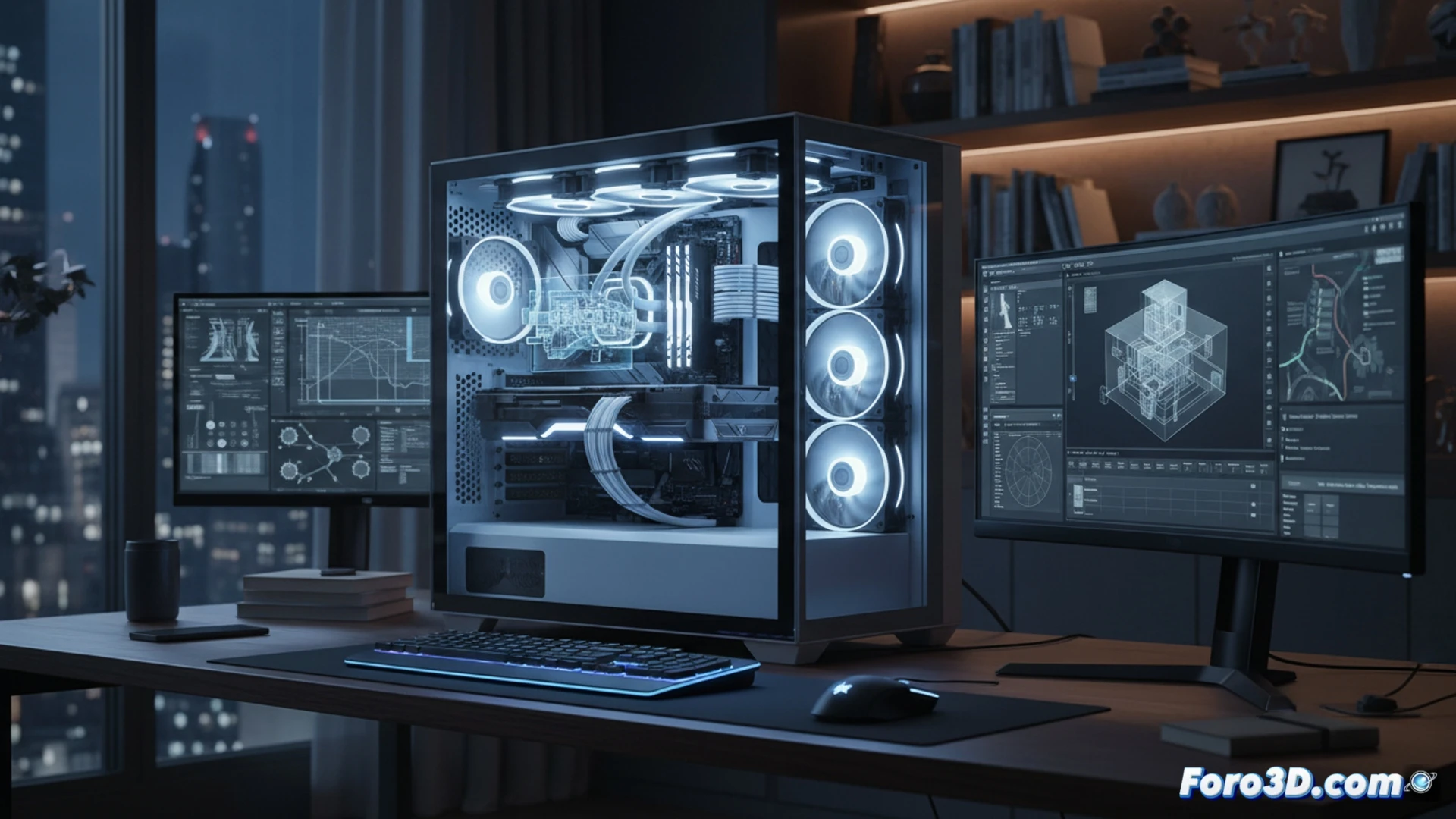
Technical analysis: Airflow and capacity for professional hardware 🔥
The H9 Elite adopts a dual-chamber design that separates the power supply and hard drives from the main compartment, freeing up space for the motherboard and GPU. For a 3D workstation, this is crucial, as it allows for accommodating large graphics cards (up to 435mm in length) without obstructions. The weak point, however, is the airflow. The tempered glass front panel, while beautiful, restricts air intake. NZXT compensates for this with three 120mm fans (two side and one rear) and the ability to mount radiators up to 360mm on the top and side. For continuous rendering with CPU and GPU at 100%, it is recommended to swap the fans for high static pressure models or use a radiator configuration to avoid thermal throttling.
Cable management and accessibility: A necessary luxury for 3D builds? ⚙️
Cable management is one of this chassis's strong points. The dual chamber allows all excess cabling to be hidden behind the motherboard tray, offering a clean interior that doesn't interfere with airflow. For a 3D professional who frequently upgrades components, this accessibility is a significant time saver. However, the H9 Elite's premium price may not be justified if your priority is pure cooling. In that context, a case like the Fractal Design Meshify 2 offers superior airflow at a lower cost, albeit sacrificing the wraparound glass aesthetics. The H9 Elite is, therefore, an ideal choice for those seeking a workstation that is as powerful as it is visually striking.
Considering the workflow of a 3D modeler, the dual-chamber design of the NZXT H9 Elite, which prioritizes aesthetics over direct airflow to components, can cause a temperature increase in the GPU during long renders that may harm sustained performance.
(PS: remember that a powerful GPU won't make you a better modeler, but at least you'll render your mistakes faster)