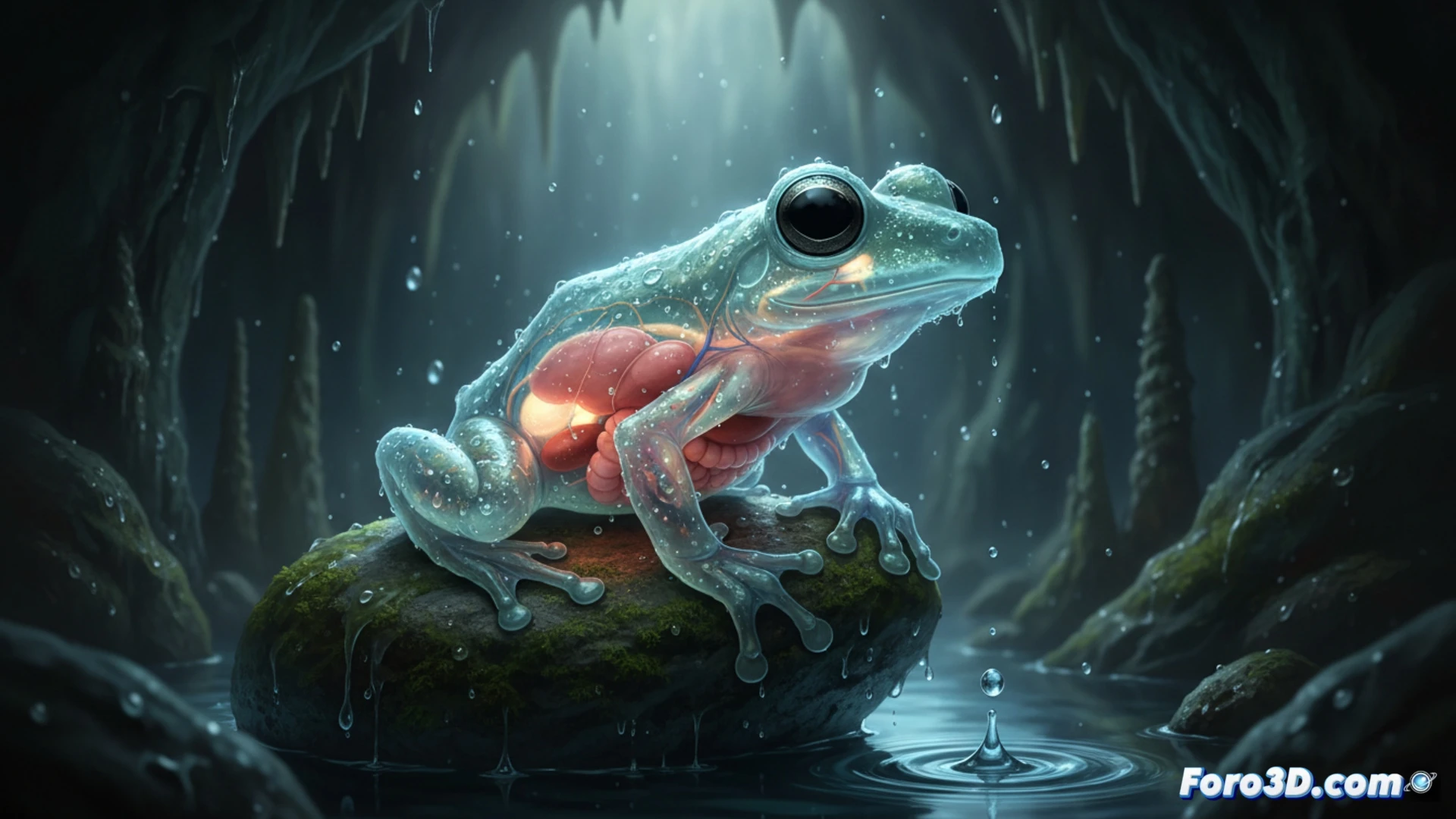
The discovery of Teratohyla sornozac in Ecuador represents a milestone for herpetology. This new species of glass frog possesses a unique quality: its call mimics the sound of a water droplet falling in an abyssal cave. For scientific visualization, this finding opens the door to detailed 3D models that capture its extreme transparency, allowing observation of internal organs without dissection. The digital representation of its anatomy is crucial for understanding its physiology and behavior.
Anatomical Modeling and Transparency Simulation 🐸
The main technical challenge for a 3D artist is replicating the diaphaneity of Teratohyla sornozac. Its ventral skin allows seeing the heart, liver, and digestive tract, which demands advanced rendering techniques for translucent materials (subsurface scattering). An accurate model must include a high-resolution mesh for the organs, with textures that simulate iridescence. Additionally, a simulation of its habitat in the Ecuadorian cloud forest can be created, integrating volumetric lighting to recreate the understory and a particle system for dew droplets on heliconia leaves.
The Call as a Digital Soundscape 🔊
The acoustic representation of this frog is as vital as the visual one. Its call, described as a solitary drop in a cave, can be modeled through granular synthesis. By combining real spectrogram data with a 3D audio environment, science communicators can immerse the viewer in the nocturnal ecosystem. This resource is ideal for interactive documentaries or virtual reality applications, allowing biologists and enthusiasts to experience the species' behavior without disturbing its fragile Amazonian habitat.
In the 3D modeling of the glass frog Teratohyla sornozac, what is the greatest technical challenge in accurately replicating the transparency and light refraction effect in its tissues and visible viscera?
(PS: if your manta ray animation doesn't excite, you can always add some documentary music from channel 2)