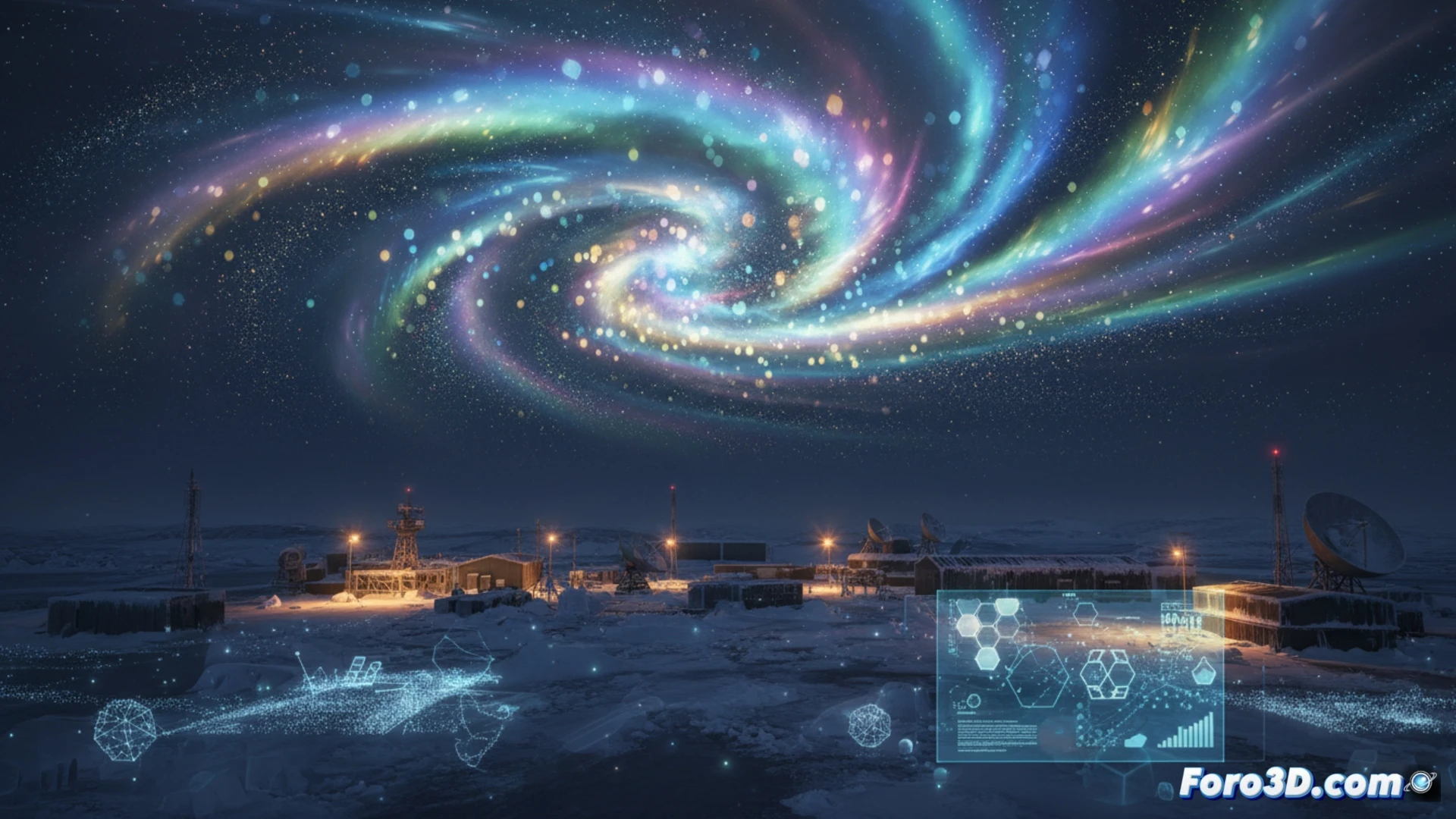
McMurdo Station, in the middle of the austral winter, is the setting for one of the rarest optical displays on the planet: polar stratospheric clouds glowing with pastel colors. This phenomenon, known as iridescence, occurs when sunlight diffracts through hexagonal ice crystals of nearly uniform size. Far from being a simple visual effect, accurately modeling it requires understanding particle physics and light scattering, a challenge we have tackled by combining three leading graphics engines.
Controlled Diffraction: From Physics to Volumetrics in Houdini 🌈
To recreate iridescence with scientific fidelity, we started in Houdini by generating a particle volume with a narrow size distribution (radius between 5 and 10 microns). We applied a custom volumetric shader that simulates Mie diffraction, calculating the scattering angle for each wavelength. This volume was exported as a VDB field for Unreal Engine 5. There, the Sky Atmosphere system was adjusted to emulate the Antarctic atmosphere, reducing Rayleigh scattering and increasing the reflectivity of the snowy ground. The result is a render where pastel tones (green, pink, and blue) appear only when the camera is positioned at the exact angle of 10 to 15 degrees relative to the sun, replicating real observations from McMurdo Station.
The Realism Dilemma: Validation Against Real Data 🔬
The greatest difficulty was not technical, but validation. We compared our render with spectral photographs taken from the Antarctic station. While the real images show more muted saturation due to low winter light, our model in Blender's Cycles tended to oversaturate the colors. The solution was to limit the light source intensity to 0.8 lux and use a post-process with logarithmic curves. This case demonstrates that scientific visualization does not seek absolute beauty, but rather precision in representing a phenomenon that, due to its rarity, few human eyes have witnessed directly.
Which light scattering simulation technique in volumetric media is most efficient for reproducing the iridescence effect in Antarctic clouds using Unreal, Blender, or Houdini?
(PS: fluid physics for simulating the ocean is like the sea: unpredictable and you always run out of RAM)