In a struggle, the smoke and particles from a gunshot do not lie, but they do disperse. Forensic science has adopted a 3D pipeline that combines laser scanning, fluid simulation, and visualization to answer the key question: who held the weapon and in what position. This article breaks down the technical workflow that turns microscopic residues into definitive ballistic evidence.
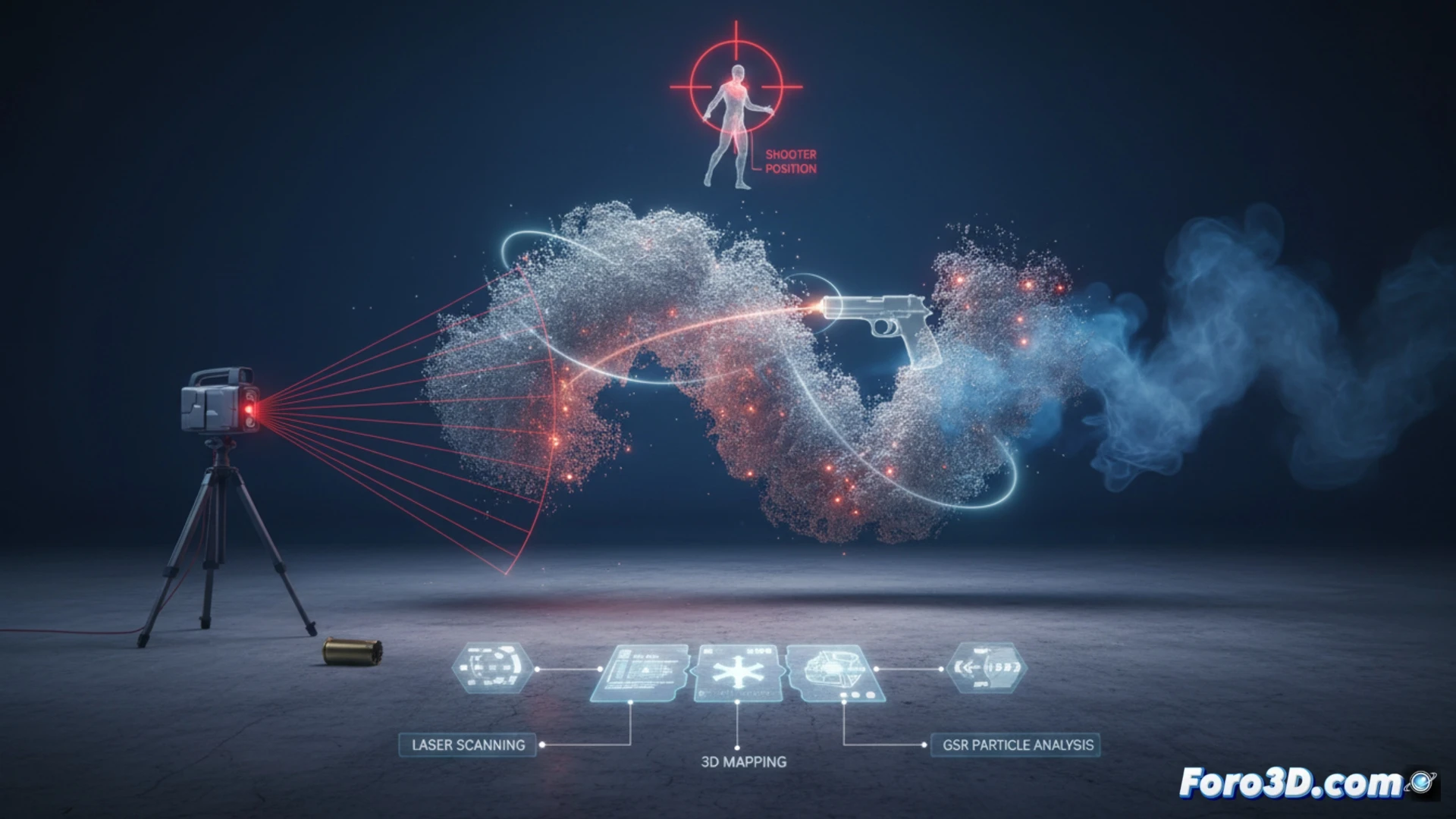
Capture, Simulation, and Rendering of GSR 🔬
The process begins with Faro Scene to capture the exact geometry of the room, including furniture and wall angles. On this point cloud, the microscopic location of each gunshot residue (GSR) particle is mapped using Python and particle libraries, generating a 3D density map. This map is exported to Ansys Fluent, where the gunshot gas plume is simulated as a compressible fluid. The simulation calculates inverse ballistic trajectories, adjusting variables such as muzzle velocity and object obstruction. Finally, Blender integrates the 3D model of the scene with the gas plume animation, allowing investigators to overlay the position of the weapon and the arms of those involved at the exact moment of the shot.
Forensic Certainty and the Ghost of Dispersion ⚖️
The great advantage of this pipeline is the elimination of guesswork in scenes with multiple suspects. By correlating GSR dispersion with fluid dynamics, it can be determined whether the barrel was pressed against the body or if the arm was extended during the struggle. However, the technical limitation is the sensitivity to the turbulence model in Ansys Fluent, as small variations in ventilation or ambient temperature can alter the simulated plume. Additionally, the accuracy of the mapping depends on the scanner's resolution and processing time, making this method viable only in cases of high evidentiary value.
What technical and methodological challenges does the three-dimensional reconstruction of gunshot residue dispersion in complex environments, such as struggles or open spaces, present to ensure its admissibility as evidence in a court of law?
(PS: In the forensic pipeline, the most important thing is not to mix the evidence with the reference models... or you'll end up with a ghost at the scene.)