The Long Jaunt study has released Norland, a medieval kingdom simulator that challenges the graphical conventions of the genre. Instead of pursuing photorealism, the team opted for an aesthetic of paper-cutout characters, combined with a detailed 2D environment. This decision not only defines the game's visual identity but also imposes specific technical challenges in Unity, particularly in managing large populations and the facial expressiveness of subjects.
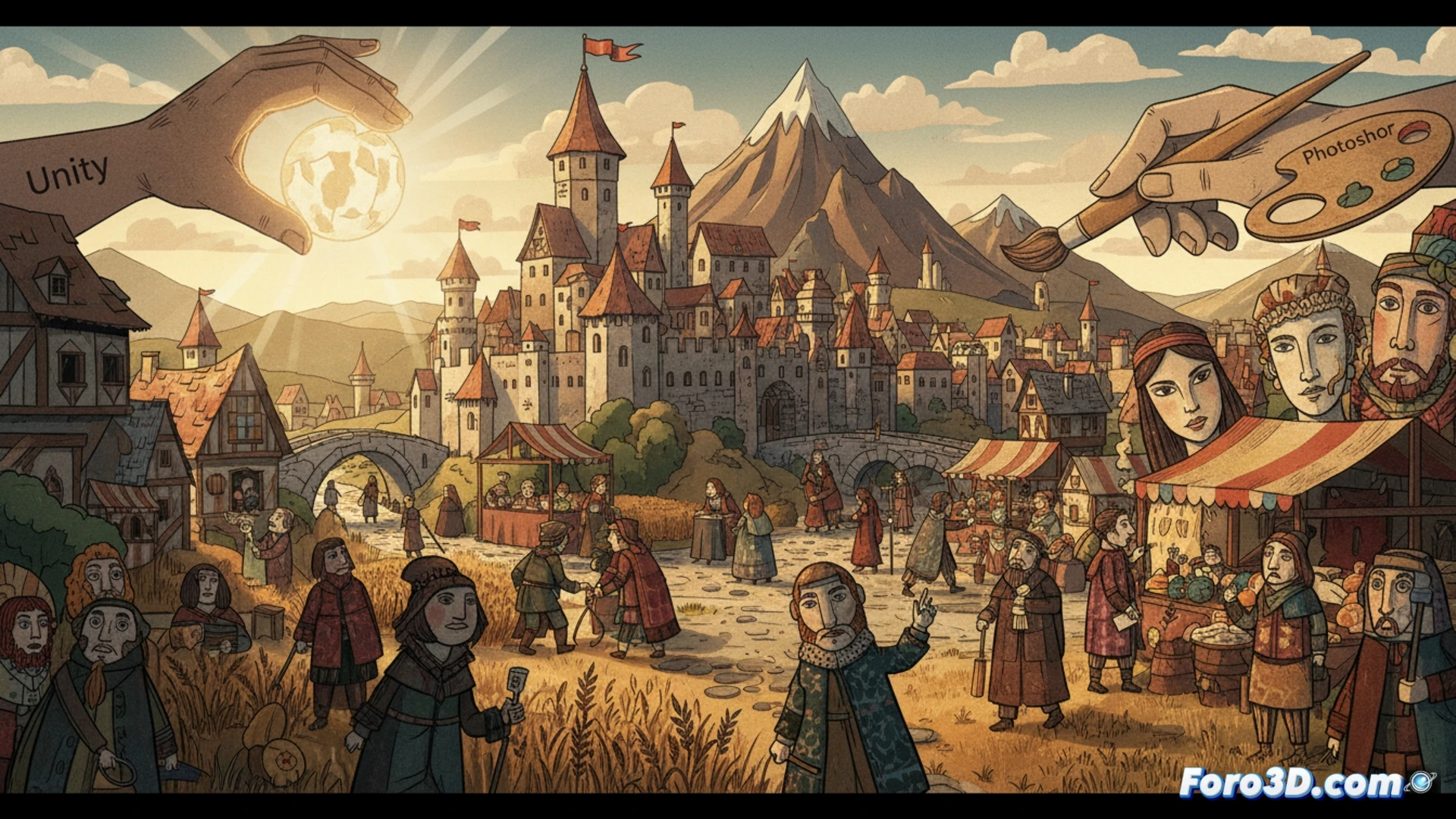
Artistic pipeline: from Photoshop to procedural 2D animation 🎨
The concept art for Norland is created in Photoshop, where each character is designed as a flat-layer puppet. Artists separate limbs, torso, and head into individual PNG files, optimized for Unity to reassemble them using a 2D bone system (Sprite Skinning). The technical key lies in procedural animation: instead of storing hundreds of pre-rendered sprites, the engine calculates transitions between states (sadness, hunger, joy) in real-time by interpolating the face layers. This reduces memory usage and allows hundreds of villagers to visually react to simulation events without overloading the renderer. Additionally, Unity's Tilemap system is used for the ground and buildings, combined with a dynamic sorting layer that automatically manages visual depth, preventing characters from incorrectly overlapping when walking through alleys.
Visual optimization for living cities without sacrificing detail ⚙️
Managing a city with over 200 characters on screen requires aggressive optimization strategies. Norland uses Region Culling in Unity, which disables the rendering of sprites outside the camera's field of view while keeping their simulation logic active. For expressiveness, facial LOD (Level of Detail) is applied: distant characters display only a static full-body sprite, while nearby ones load the facial animation layers. This approach maintains the illusion of a bustling kingdom without compromising performance, demonstrating that a simple, well-executed aesthetic can be more effective than an excess of polygons.
How does Long Jaunt optimize the production pipeline between Unity and Photoshop to maintain the living paper aesthetic without sacrificing performance in Norland?
(PS: a game developer is someone who spends 1000 hours making a game that people complete in 2)