In July 2020, the Presena Glacier in the Italian Alps turned an intense crimson due to a massive bloom of snow algae, known as blood algae. This biological phenomenon, accelerated by sudden temperature changes and high solar radiation, not only surprised scientists but also inspired a scientific visualization project. In this technical article, we break down the pipeline used to digitally recreate this effect in Blender, Substance Painter, and Unreal Engine, combining real data with shader and texturing tools.
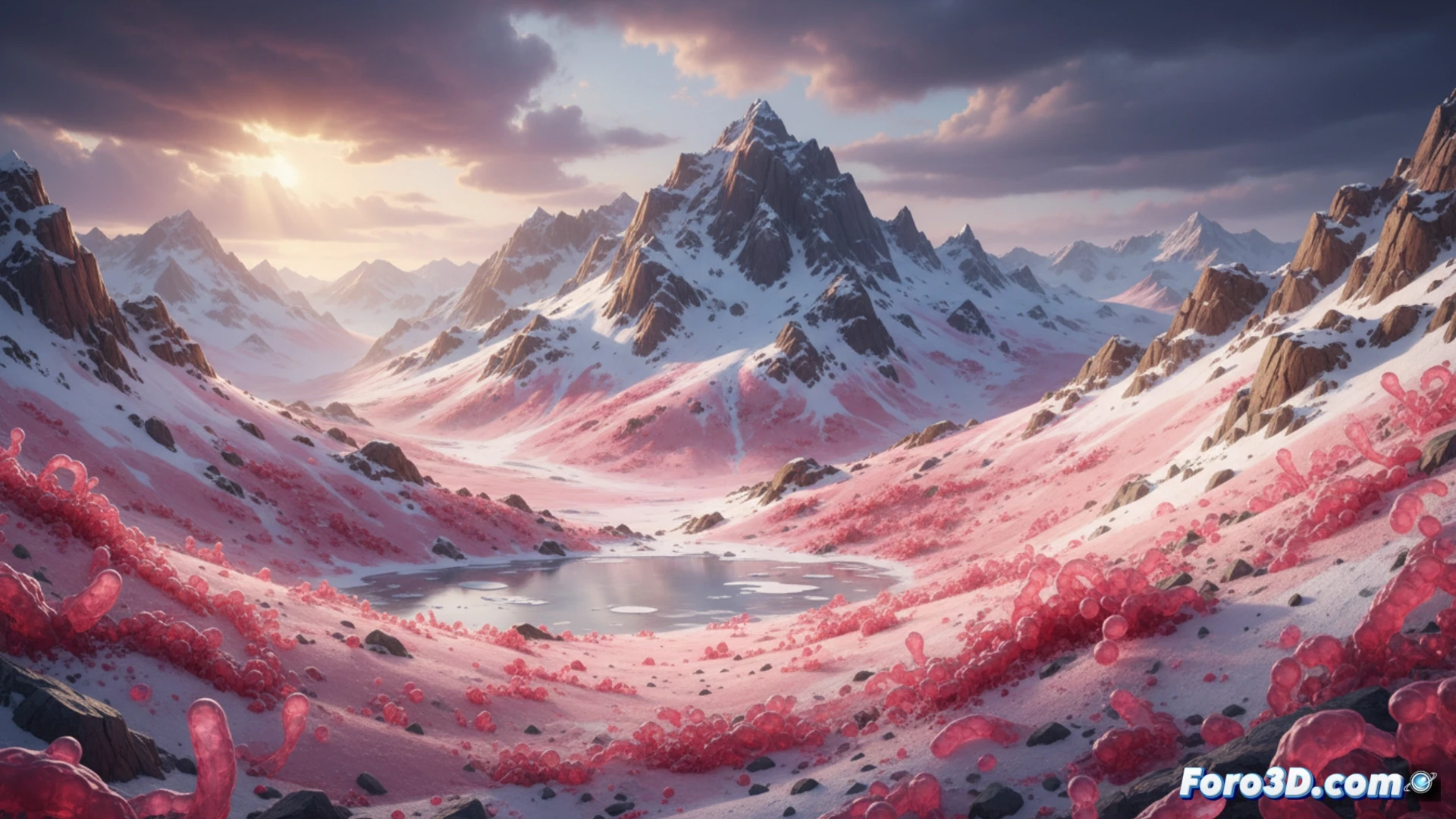
Technical pipeline: shader and texturing for algae proliferation 🧊
The modeling began in Blender, where a snow surface was generated using geo-nodes to simulate the porosity and irregular accumulation of the snowpack. The real challenge was the texture mapping in Substance Painter, where a base white snow material was designed with height and roughness variations. Over this layer, procedural masks were applied representing the concentration of algae: dark red and satin pink patches with diffuse edges that mimic pigment absorption by moisture. Displacement maps were used to slightly sink the affected areas, simulating localized melting. The final shader in Blender combined a translucency node for the snow and a spectral absorption node for the red pigment, replicating how light passes through the cells of Chlamydomonas nivalis. Finally, the scene was exported to Unreal Engine, where it was integrated with dynamic lighting and a particle system to simulate UV radiation, allowing an interactive visualization of the environmental impact.
Science and art: the educational value of pink snow 🌍
Beyond technical realism, this project demonstrates how 3D visualization can bring complex phenomena closer to the general public. Pink snow is not just a visual spectacle; it is an indicator of accelerated melting and climate change. By accurately modeling the interaction between solar radiation and algae biology, we offer an educational tool that transcends static photography. Unreal Engine, in this context, is not just a game engine, but a canvas for scientific outreach, where the viewer can explore the virtual Alps and understand, through texture and color, the consequences of a changing climate.
What software do you recommend for visualizing animal tracking data?