In February 2007, the inhabitants of Omsk, Siberia, witnessed an unusual event: a deep orange snowfall covered the region. Initially attributed to industrial pollution, a multidisciplinary analysis revealed that the origin was sandstorms carrying mineral dust from Kazakhstan. The key to understanding this phenomenon was not just chemistry, but the ability to visualize in three dimensions the structure and composition of the particles, a challenge addressed with simulation and volumetric reconstruction tools.
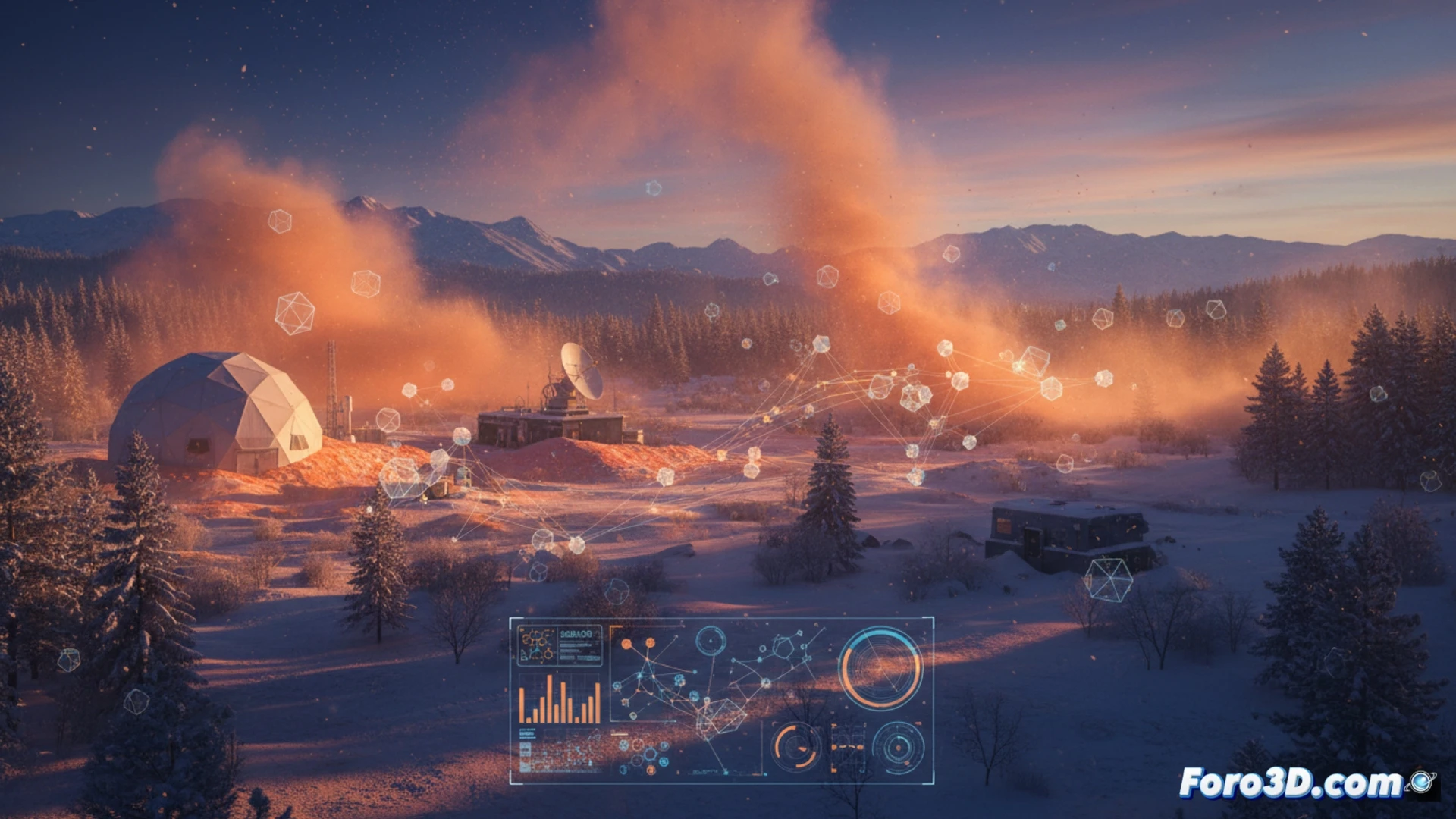
Volumetric Reconstruction with VGSTUDIO MAX and Bioelectromagnetic Simulation in COMSOL 🧊
To unravel the nature of the dust, researchers used VGSTUDIO MAX to perform high-resolution computed tomography of the snow samples. This software allowed them to reconstruct the internal morphology of the particles in 3D, revealing a porous clay matrix with iron oxide inclusions. The visualization showed that the orange color was not superficial, but due to the internal distribution of iron, with concentrations reaching 12% by volume. Subsequently, COMSOL Multiphysics was used in its Bio-electromagnetism module to simulate how these particles interacted with natural electromagnetic fields during their atmospheric transport. The scattering maps generated in COMSOL demonstrated that iron acts as a magnetic dipole, altering the trajectory of sandstorms and facilitating their deposition on Siberian snow.
Scientific Visualization as a Bridge Between Data and Phenomenon 🔬
The case of the orange snow demonstrates that scientific visualization is not mere decoration, but a discovery tool. Thanks to the 3D reconstruction from VGSTUDIO MAX, the hypothesis of chemical pollution could be ruled out and a natural geological process confirmed. Furthermore, the simulation in COMSOL allowed predicting the dispersion route of these minerals, crucial data for future climate events. By integrating Materialise Mimics to segment the clay and iron phases, a digital model was achieved that any researcher can rotate, scale, and analyze, transforming a meteorological curiosity into a lesson on the interconnection between geology and the atmosphere.
How to model in 3D the dispersion of pollutant particles in the atmosphere to simulate and visualize the anomalous coloration of orange snow in Siberia.
(PS: if your manta ray animation doesn't excite, you can always add documentary music from channel 2)