The ocean is no longer a silent space. In the Strait of Gibraltar, one of the densest maritime routes on the planet, anthropogenic noise has created a sonic fog that suffocates marine life. Pilot whales, creatures that rely on sound to navigate and socialize, face a biological wall. Their larynx, adapted to the depths, cannot compete with the roar of engines. They cry out, but their voice is lost in half the volume of traffic.
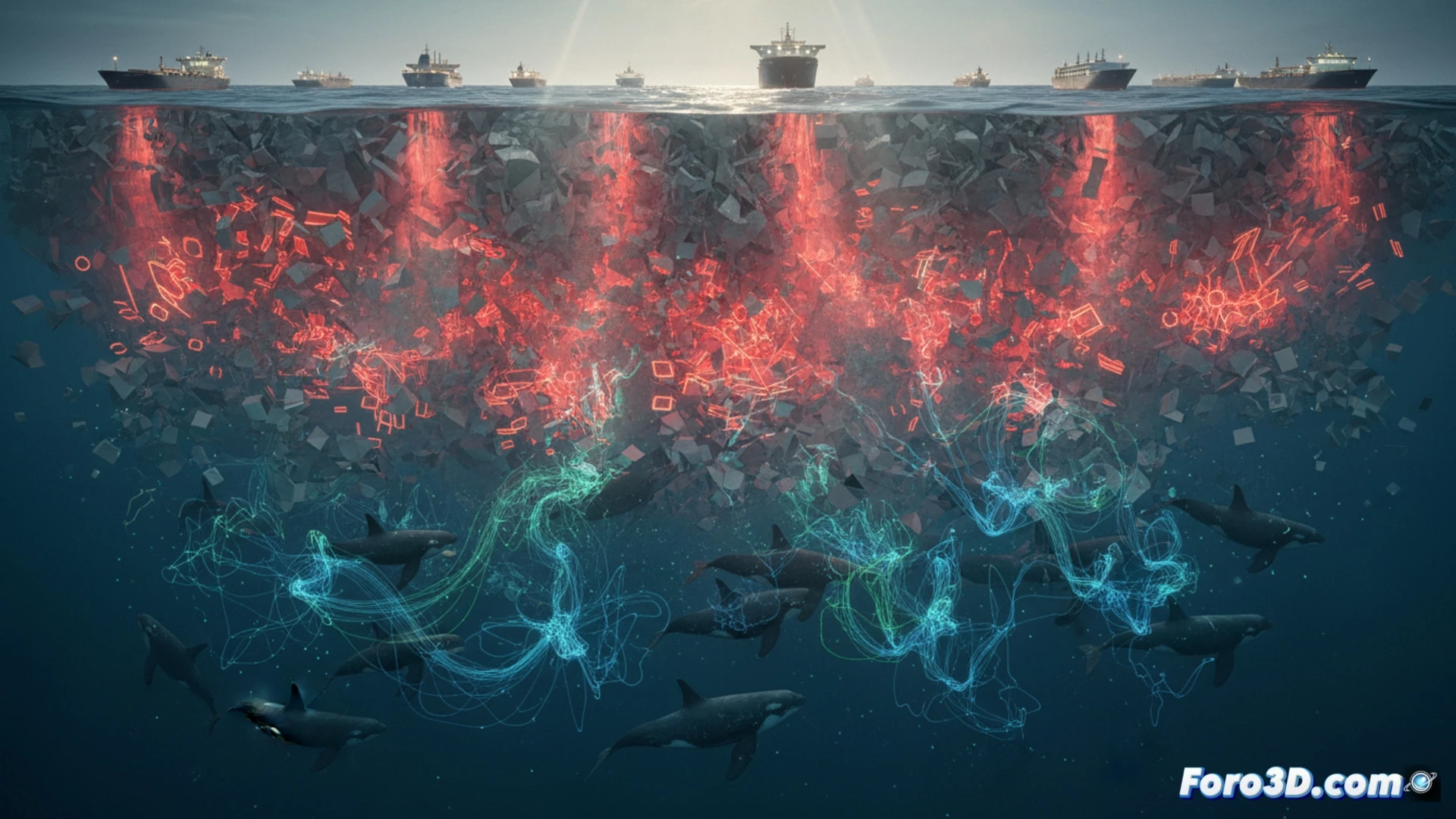
Modeling the vocal spectrum against maritime traffic noise 🐋
To represent this conflict, I propose a 3D simulation that compares the vocal range of pilot whales with the frequency spectrum of ships. The anatomical model should show the cetacean's larynx and its physiological limit: below 100 meters, the ability to compensate for noise collapses. The sonic fog would be visualized as a dynamic volume of particles that densifies at the surface. The whales, represented as acoustic emission points, attempt to communicate, but their signals dissipate as they cross the noise wall. The simulation should include real hydrophone data to calibrate intensity.
The forced migration we don't see 🚢
The most tragic aspect of this phenomenon is that whales do not flee from noise out of a sense of danger, but simply because they cannot hear each other. The simulation should show how the group visually disintegrates upon losing acoustic cohesion. By not processing noise as a threat, they abandon food-rich areas to seek quieter but impoverished zones. The 3D model should reflect this forced migration, tracing routes that deviate from food sources toward sterile silence.
What level of anatomical detail would you need to faithfully represent this species?