The safety of autonomous ships depends on the precision of their sensors, but nature imposes fuzzy limits. We analyze the collision of a passenger ferry against a dock in dense fog conditions. Through a 3D recreation using V-Ray and Unreal Engine 5, researchers simulated how the refraction of suspended water particles can blind proximity LiDAR systems, offering a technical lesson on the limits of artificial perception.
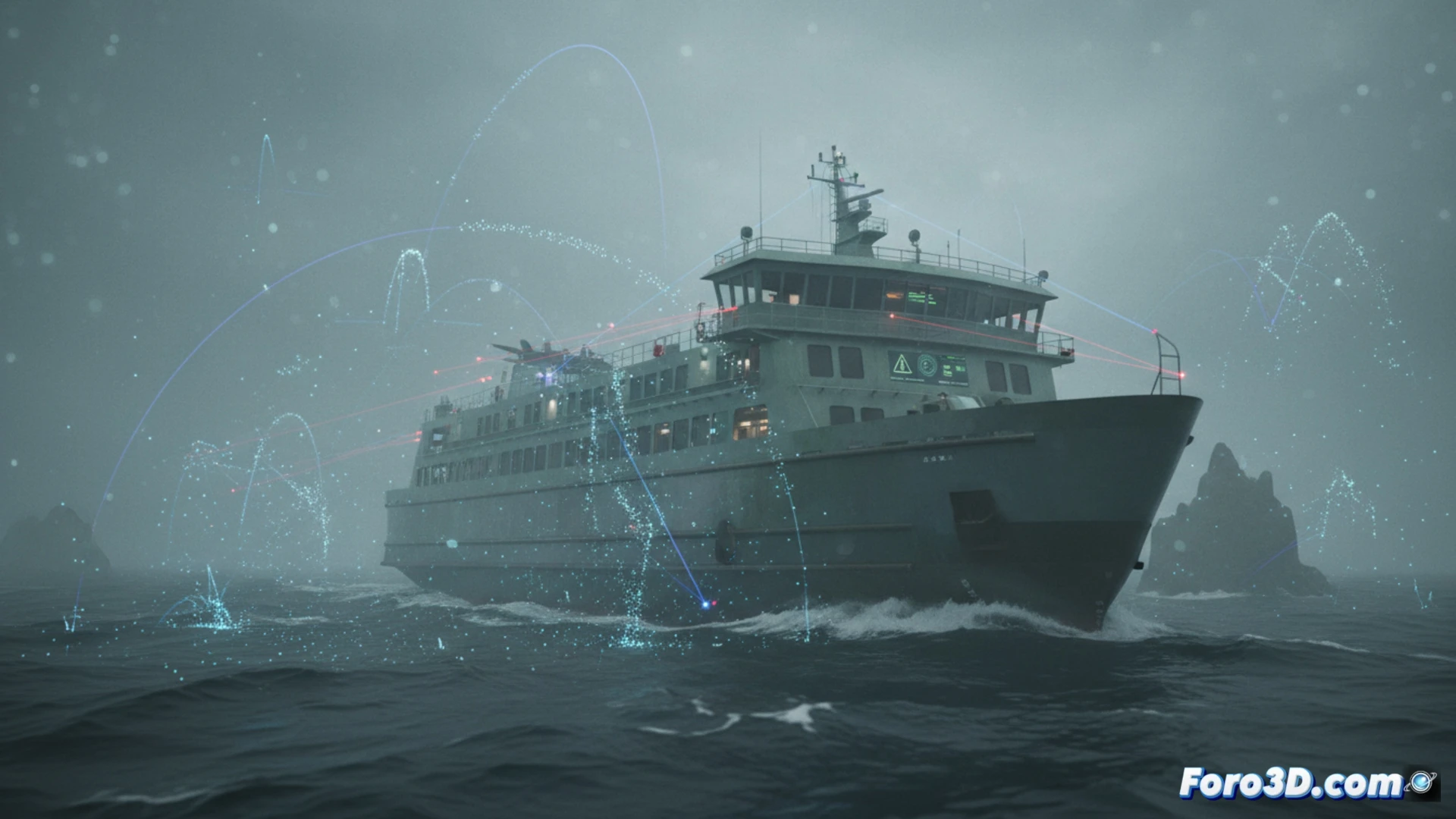
Recreation of sensory failure with V-Ray and Unreal Engine 5 🚢
The team used Rhino to model the exact geometry of the dock and the ferry, exporting the data to CloudCompare to align the real LiDAR point cloud with the simulation. In Unreal Engine 5, a fog particle system with variable densities was implemented, while V-Ray calculated light scattering (Mie scattering) over each water droplet. The results showed that, at a distance of 50 meters, the LiDAR beam suffers a 70% attenuation due to multiple refraction, generating false distance echoes that the system interpreted as free space, triggering the collision maneuver.
Lessons for autonomous navigation in adverse environments 🌫️
The simulation validated the hypothesis that fog not only reduces range but also introduces optical artifacts that deceive sensor fusion algorithms. This case demonstrates that sensory redundancy (LiDAR + radar + thermal camera) is mandatory on commercial autonomous ships. The 3D recreation allows engineers to identify the exact point of failure without risking lives, establishing automatic zero-speed protocols when particle density exceeds a critical threshold.
What lessons learned from the simulation of deadly fog on an autonomous ferry can be applied to design redundant LiDAR systems that prevent catastrophes in real marine environments?
(PS: Simulating catastrophes is fun until the computer crashes and you are the catastrophe.)