A fatal accident in an industrial turbine left a pattern of microscopic stains that defied traditional visual reconstruction. To determine the exact position of the victim relative to the suction zone, a forensic workflow integrating high-density laser scanning, particle simulation, and fluid dynamics was implemented. This analysis demonstrates how 3D technology converts imperceptible biological evidence into quantifiable data for expert investigation.
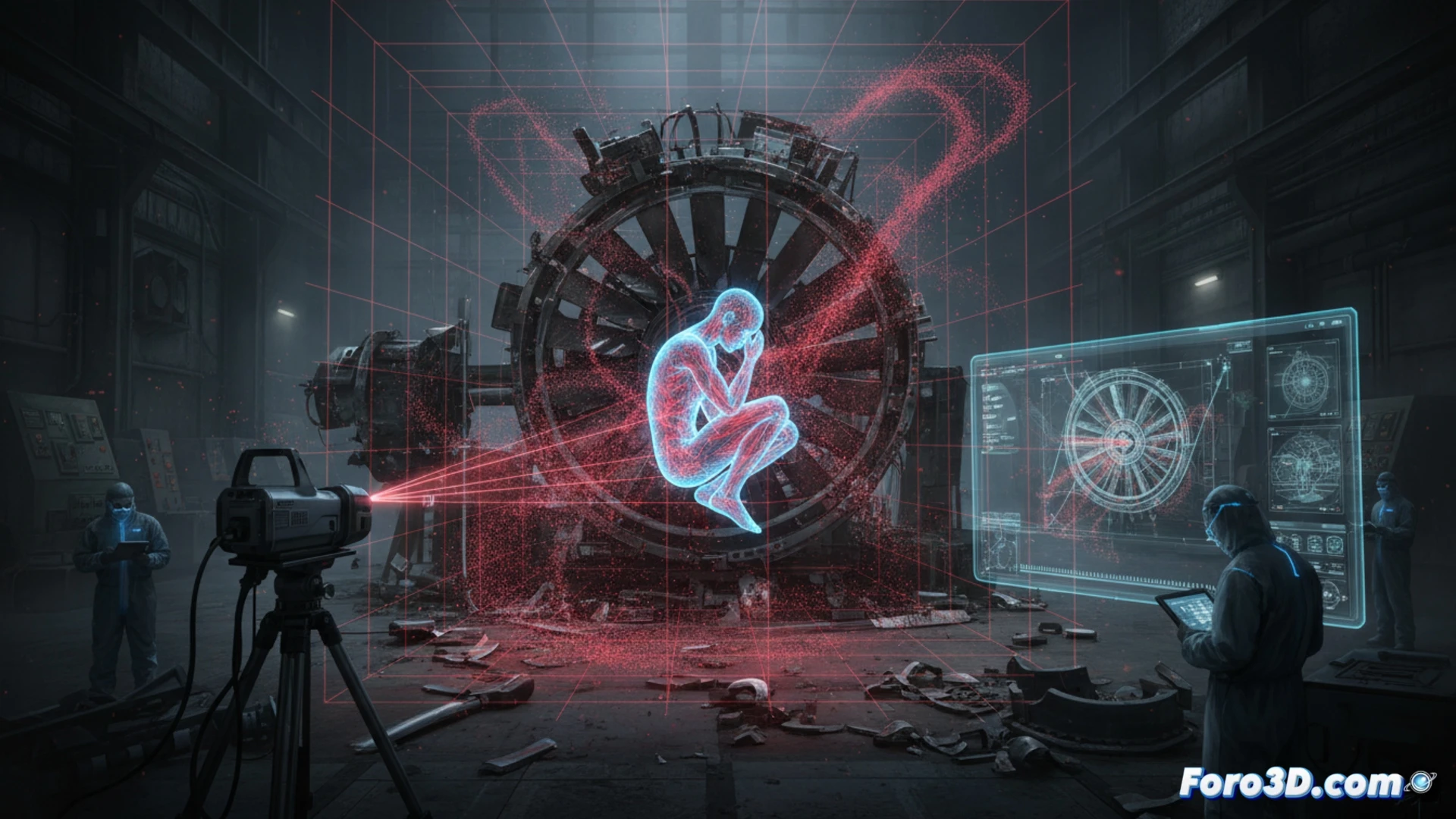
Technical Workflow: From Point Cloud to Fluid Dynamics 🔬
The process began with a high-density laser scan of the turbine environment, capturing the exact geometry of the suction ducts and surrounding surfaces. The data was imported into FARO Scene to align and clean the point cloud, removing ambient noise. Subsequently, the base mesh was exported to Blender, where a particle system with fluid dynamics (High-Velocity Mist) was configured to simulate the dispersion of the blood mist. Velocity, pressure, and viscosity parameters were adjusted according to the accident conditions. The resulting trajectories were refined in MeshLab, filtering outliers and smoothing the geometry to ensure submillimeter precision. Finally, the model was rendered in KeyShot, generating visualizations that correlate microscopic stains with specific impact vectors.
Expert Implications and Model Validation ⚖️
The combination of these tools established that the victim was located 1.2 meters from the suction edge, at a 23-degree angle relative to the turbine axis, contradicting the initial hypotheses of the investigation. This case underscores the need to integrate particle simulation into the forensic pipeline, as fluid dynamics reveals patterns that mere visual inspection or static photogrammetry cannot detect. The model's accuracy was validated by comparing simulated trajectories with actual stains, achieving a correlation coefficient of 94.7%.
Would you use a laser scanner or photogrammetry to document this case? 🤔