In January 2008, the province of Shandong, China, woke up under a layer of intense yellow snow. The phenomenon, known as Binzhou's Yellow Snow, sparked a scientific debate between two hypotheses: the arrival of sand from the Gobi Desert carried by storms, or a dangerous cloud of industrial chemical pollution. To clarify the event, 3D simulation was used, combining Houdini for particle dynamics and Maya with V-Ray for rendering, allowing the recreation of atmospheric dispersion and the evaluation of the real impact of each scenario.
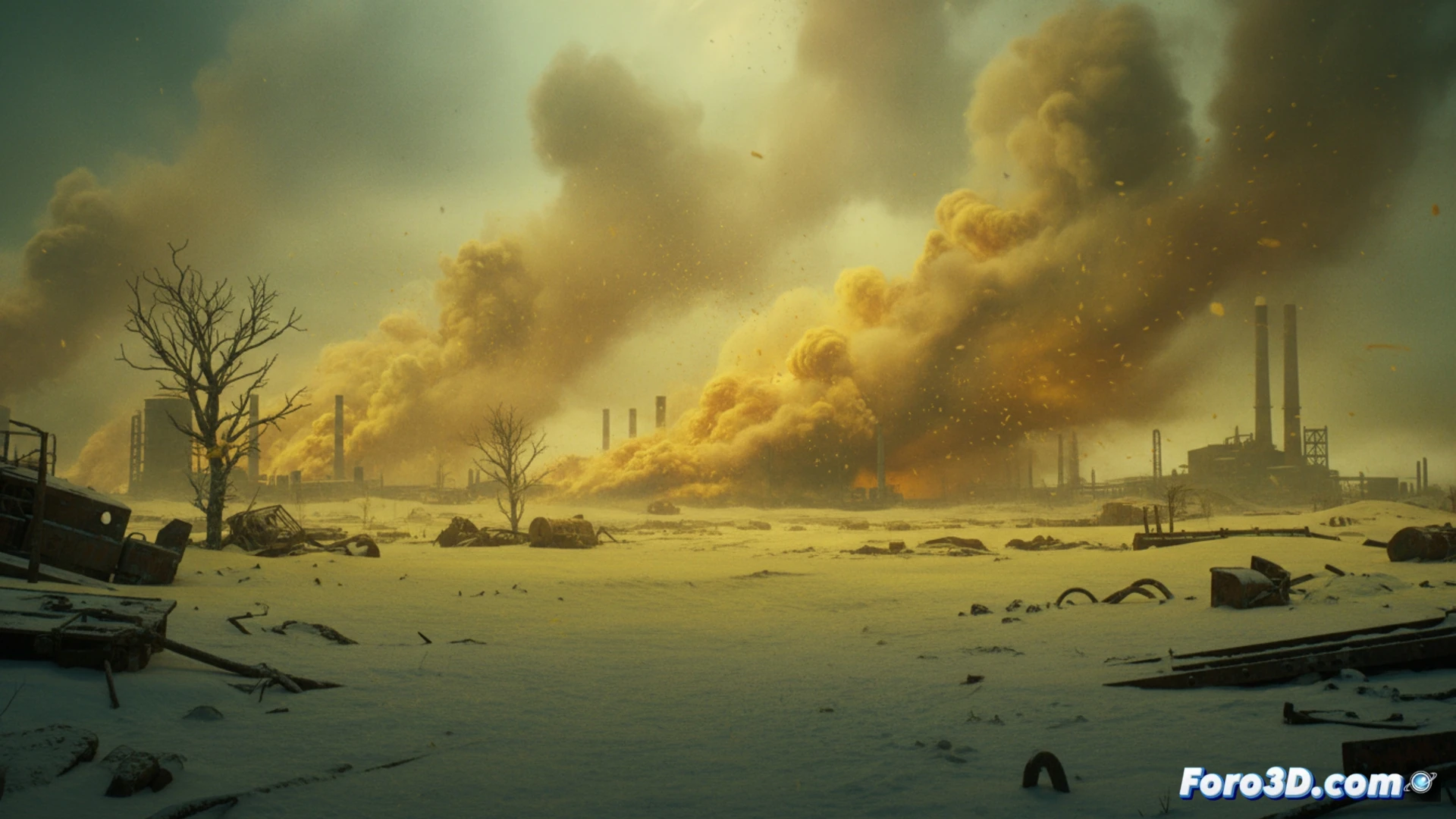
Houdini and Maya: Modeling Pollutant Particle Dispersion 🌫️
The technical workflow began in Houdini, where a particle system was programmed to simulate the behavior of two types of materials: mineral dust (sand) and industrial chemical aerosols. Data on prevailing winds, Shandong's topography, and the location of petrochemical complexes were input. Sand particles showed faster fall and a granular texture, while chemical particles, lighter and more reactive, remained suspended and adhered to ambient humidity. Then, in Autodesk Maya with V-Ray, both simulations were lit with winter ambient light, generating comparative renders. The chemical pollution hypothesis showed a more uniform color saturation and fixation on soil and vegetation, coinciding with local toxicity reports.
The Value of Simulation in Disaster Prevention 🛡️
The 3D recreation not only visualized the event but also demonstrated how simulation can differentiate between a natural disaster and a man-made one. By comparing the renders of both hypotheses, experts could observe that the distribution of yellow snow in Binzhou matched an industrial emission pattern more closely than a desert wind transport pattern. This analysis, carried out with tools like Cinema 4D for post-production, reinforces the need to use computer graphics to model environmental emergencies, helping governments and communities respond accurately to invisible threats in the atmosphere.
What computer simulation techniques allow for the most accurate recreation of the atmospheric dispersion of chemical pollutants, as in the case of the yellow snowfall in Binzhou, and how can they be applied to predict similar catastrophes?
(PS: Simulating disasters is fun until your computer crashes and you are the disaster.)