When exhaustion pushes you to devour an entire pizza or ice cream in the middle of the night, it is not a lack of willpower or an act of gluttony. It is pure neurobiology. The human relationship with food transcends survival and becomes a primitive tool for emotional regulation. Under chronic stress, the hypothalamic-pituitary-adrenal axis constantly releases cortisol, altering satiety signals and ordering the body to store energy as if it were in constant danger. This evolutionary mechanism, designed for times of scarcity, has not adapted to modern life where food is abundant.
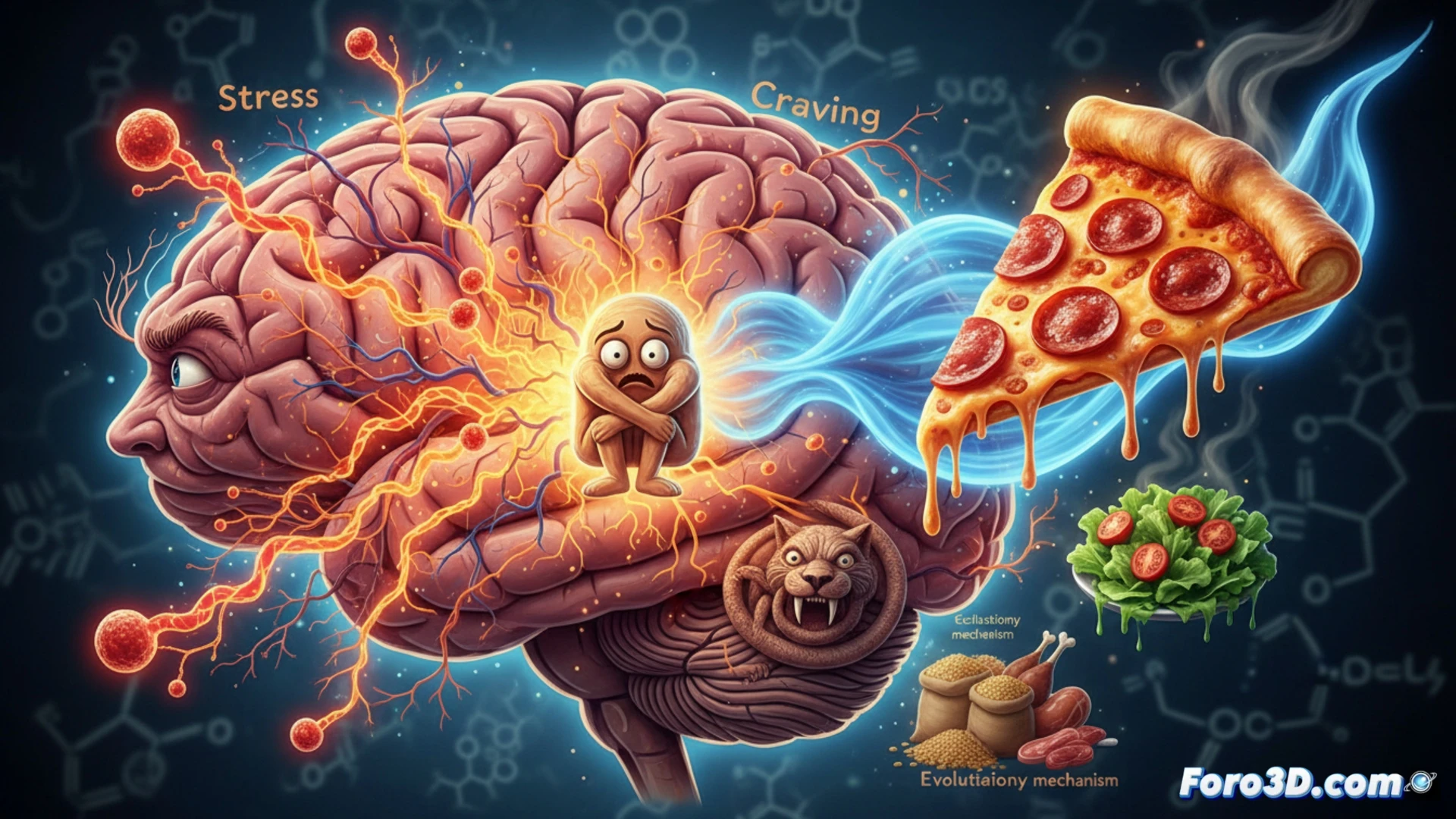
3D Modeling of the HPA Axis and Cortisol Response 🧠
To visualize this process, we propose an interactive 3D infographic that models the hypothalamic-pituitary-adrenal axis. The model would show how chronic stress triggers a sustained release of cortisol, the hormone that reprograms metabolism. In the animation, the brain demands carbohydrates and sugars for quick energy, represented by three-dimensional models of ultra-processed foods glowing with intense colors. In contrast, models of healthy foods appear opaque and visually unappealing during the stress peak. A visual comparator would allow the user to distinguish between emotional hunger (sudden, specific, and urgent) and physiological hunger (gradual, generic, and satiable with any food), helping to educate about the real mechanisms behind cravings.
The Emotional Paradox: Extreme Sadness vs. Anxiety 😔
Interestingly, not all negative emotions activate the same circuit. While anxiety and chronic stress trigger a desire for sugar and fat, deeply negative emotions like extreme sadness provoke the opposite: a total loss of appetite. This duality demonstrates that emotional hunger is not a simple whim, but a specific neurobiological response to concrete stimuli. Understanding that the brain seeks to regulate itself through food is the first step in developing mindful eating strategies, where visual education and interactive models like this 3D infographic can be key tools to break the cycle of impulsive cravings.
How can 3D visualization of the brain's stress and reward circuits help reprogram the craving for ultra-processed food in real time
(PS: modeling an apple in 3D is easy, the hard part is making it not look like a sphere with red texture)