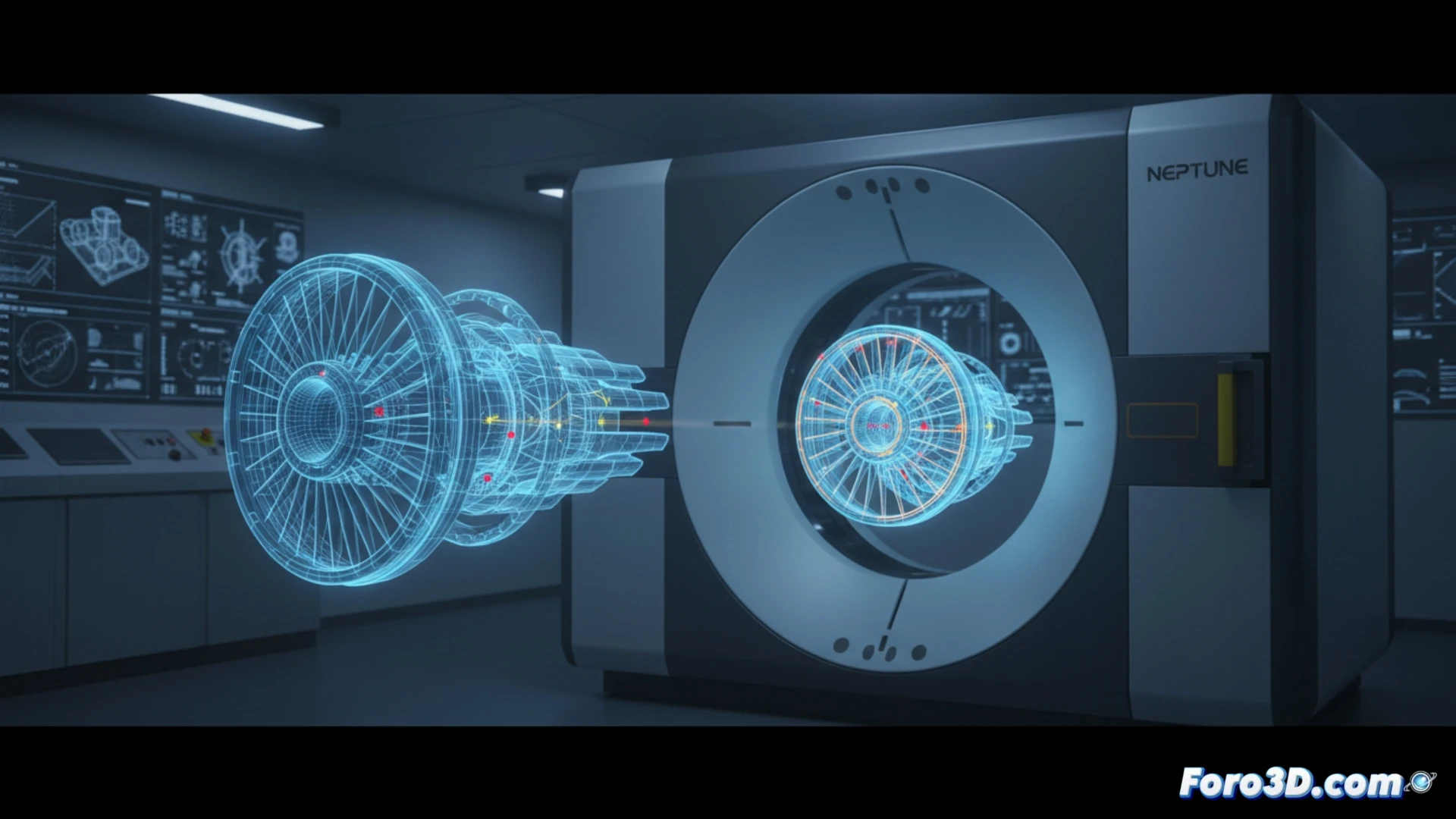
Lumafield's Neptune industrial CT scanner is revolutionizing the concept of the digital twin in the manufacturing sector. Unlike virtual models created from a theoretical CAD design, Neptune generates exact virtual replicas of already manufactured physical products. This allows engineers to see inside a metal part or an electronic assembly without needing to cut or destroy it, detecting hidden flaws such as porosity, internal cracks, or misalignments that compromise the product's structural integrity.
Speed and resolution in volumetric capture 🚀
Neptune's technology stands out for its high-speed scanning capability, reducing inspection cycles from hours to minutes. The system uses a high-power X-ray source and a state-of-the-art flat panel detector that captures thousands of projections in a continuous 360-degree rotation. The result is a voxelized volume with submillimeter resolution, where each point represents the actual density of the material. Engineers can import this digital twin directly into analysis software to compare it with the original CAD model, identifying dimensional deviations or manufacturing defects that would go unnoticed in a superficial visual inspection.
Non-destructive inspection as the basis for predictive maintenance 🔍
Neptune's true value lies in its application for material fatigue simulation and lifecycle analysis. By having a faithful digital twin of a part's actual state, engineering teams can run mechanical or thermal stress simulations on the scanned model. This allows predicting where and when a failure will occur before it happens in the physical world, transforming reactive maintenance into predictive maintenance. Lumafield thus democratizes access to industrial tomography, turning CT inspection into a standard tool within the digital twin ecosystem.
How does the integration of Lumafield's Neptune industrial CT scanner affect the accuracy and usefulness of digital twins in detecting internal defects during the manufacturing process?
(PS: My digital twin is right now in a meeting, while I'm here modeling. So technically, I'm in two places at once.)